Freedom251 › Runtime Monitoring Software
Coroot
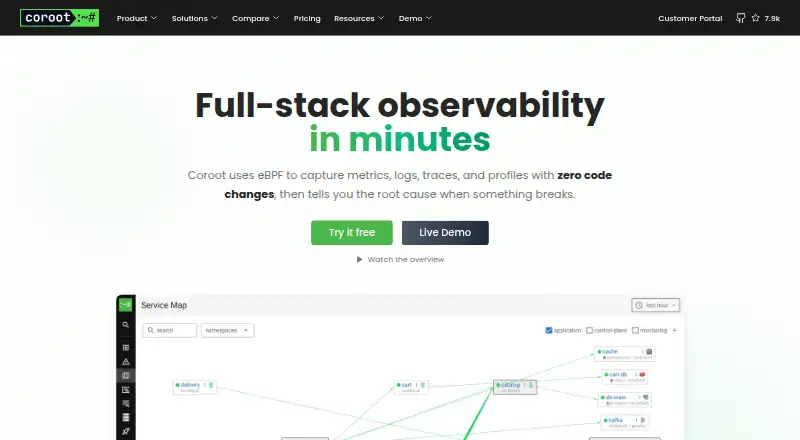
What Coroot is
Coroot is an open-source observability platform for monitoring applications and infrastructure. It uses eBPF to collect metrics, logs, traces and profiling data without code changes. Its service maps show services and their dependencies, while distributed tracing combines eBPF auto-instrumentation with OpenTelemetry SDK traces to follow requests end to end. Continuous profiling can pinpoint CPU spikes to a line of code.
Coroot tracks cloud costs across AWS, GCP, Azure, other cloud environments and on-premises systems without requiring cloud-account access. It can flag risks such as single-instance applications, unreplicated databases, poor replica placement and publicly exposed services. For incident analysis, it correlates telemetry, events and profiles to identify likely causes, show supporting evidence and suggest fixes. Notifications can go to Slack, Microsoft Teams, PagerDuty, Opsgenie or webhooks.
The software is self-hosted, so data remains within the customer's infrastructure. Community Edition is Apache 2.0 licensed and can run on premises or in a customer's cloud. Coroot supports Kubernetes, OpenShift, Docker, Docker Swarm, several Linux distributions and Windows agents. Linux deployments require kernel version 5.1 or later. Community Edition is free; Standard costs $1 per monitored CPU core/month, with no ingestion fees.
Who it suits
Coroot suits teams that need observability across applications and infrastructure, including service maps, tracing, profiling and cloud cost insights. It is also suited to organizations that want to keep observability data in their own infrastructure or deploy the Apache 2.0 Community Edition.
What it does well
- Collects metrics, logs, traces and profiling data without code changes.
- Maps services and dependencies automatically.
- Profiles applications and pinpoints CPU spikes to a code line.
- Tracks cloud costs without cloud-account access.
- Sends alerts through Slack, Teams, PagerDuty, Opsgenie and webhooks.
- Community Edition is Apache 2.0 licensed.
What to know first
- Self-hosted deployment requires managing the software within customer infrastructure.
- Linux deployments require kernel version 5.1 or later.
- Standard pricing is per monitored CPU core each month.
Limits
Community Edition is described as providing core features. Standard is billed at $1 per monitored CPU core/month; Premium includes 24×7 and phone support, premium onboarding and air-gapped installation support.
Plans
| Plan | Billed and limits | Price |
|---|---|---|
| Community Edition | core features · Apache 2.0 · self-hosted | Free |
| Community Edition / Free Open Source | Core observability features · self-hosted | Free |
| Enterprise Edition | per monitored CPU core/month · All observability features · unlimited users · enterprise support · self-hosted | $1 a month |
| Standard | per monitored CPU core/month · volume discounts · business-hours support · no ingestion fees | $1 a month |
| Pro | per month · Plan details not provided | $25 a month |
| Premium | 24×7 support · phone support · premium onboarding · air-gapped installation support | On request |
| Enterprise | contact sales · Custom terms | On request |
As coroot.com lists them, read 30 Sept 2026. The maker's own page has the final word.
Getting started
- Visit the Coroot website.
- Choose Community Edition or Standard based on the plan details.
- Deploy Coroot on a supported environment such as Kubernetes, Docker, a supported Linux distribution or Windows agents.
- For Linux deployments, use kernel version 5.1 or later.
Coroot is a self-hosted observability platform that brings application and infrastructure signals together for teams operating distributed services. Its breadth—from service maps and tracing to risk detection and incident analysis—makes it a strong fit for operators who need more than metrics alone. The key trade-offs are the Linux kernel floor for eBPF-based collection and Standard’s per-monitored-core pricing.
Overview
Founded in 2021, Coroot collects metrics, logs, traces and profiling data without requiring code changes. It combines that telemetry with service mapping, cloud-cost insights and infrastructure risk detection, aiming to help teams understand both what is happening and where likely causes lie.
Coroot is self-hosted, so data remains within the customer’s infrastructure. Its Community Edition is open source under Apache 2.0 and can run on premises or in a customer’s cloud. That control is valuable for teams with data-residency needs, but the self-hosted model makes the deployment environment a deciding factor.
Key features
Service maps and tracing
Automatic service and dependency maps are advertised with 100% coverage, giving operators a way to see relationships without assembling them manually. Distributed tracing pairs eBPF auto-instrumentation with OpenTelemetry SDK traces, so teams can combine automatic request tracking with traces their applications already emit.
Profiling and incident analysis
Continuous profiling can pinpoint CPU spikes down to a line of code, making it useful when aggregate metrics show a slowdown but not its source. Coroot’s AI root cause analysis correlates metrics, logs, traces, events and profiles to identify likely incident causes, with evidence and suggested fixes. This broad correlation is useful during investigations, though the output is framed as likely causes rather than a guaranteed diagnosis.
Cost, risk and alerts
Cloud-cost tracking works without cloud-account access and supports AWS, GCP, Azure and other cloud or on-premises environments. Risk detection flags conditions such as single-instance applications, unreplicated databases, poor replica placement and publicly exposed services. Notifications can go to Slack, Microsoft Teams, PagerDuty, Opsgenie or webhooks, helping teams route findings into existing alert channels.
Container metrics, resource alerts, image monitoring, runtime events and container log collection are supported. Deployment targets include Kubernetes, OpenShift, Docker, Docker Swarm, Ubuntu, Debian, RHEL, CentOS and Windows agents.
Pricing
Coroot uses a freemium model with a free plan, paid monitoring from $1 per monitored CPU core/month, and a 14-day trial.
| Plan | Price | What it includes |
|---|---|---|
| Community Edition | free | Core features, Apache 2.0 license and self-hosted deployment. |
| Standard | $1 per monitored CPU core/month | Volume discounts, business-hours support by email, chat or ticket, and no ingestion fees. |
| Premium | Custom pricing | 24×7 and phone support, premium onboarding, and air-gapped installation support. |
Community Edition suits teams that want the core platform without a monitoring bill and can operate a self-hosted deployment. Standard adds paid monitoring and business-hours support; its per-core basis makes monitored infrastructure size directly relevant to cost, while the absence of ingestion fees avoids a separate ingestion charge. Premium is aimed at organizations that need round-the-clock assistance, phone support or air-gapped installation help.
Platforms
Coroot supports self-managed Kubernetes and managed orchestrators including EKS, GKE, AKS and OKE, as well as OpenShift, K3s, MicroK8s and Docker Swarm. It also supports Docker and Linux distributions including Ubuntu, Debian, RHEL and CentOS, with Windows agents. Linux systems need kernel version 5.1 or newer because Coroot relies heavily on eBPF; older kernels are outside its stated requirements.
Who it's for
Coroot is best suited to engineering and operations teams running containerized or distributed services that want a single, self-hosted view of service relationships, performance, costs and operational risks. Its open-source Community Edition can appeal to teams prioritizing source transparency and infrastructure control. It is less suitable for environments whose Linux systems cannot meet the kernel requirement or teams that do not want to manage a self-hosted platform.
Pros and cons
- Pros: Metrics, logs, traces and profiling in one platform, with eBPF collection that does not require code changes.
- Pros: Service maps, risk detection and cross-signal incident analysis extend visibility beyond raw telemetry.
- Pros: Apache 2.0 Community Edition and self-hosting keep deployment and data within the customer’s infrastructure.
- Cons: Linux kernel 5.1 or newer is required for the eBPF-based approach.
- Cons: Standard pricing scales by monitored CPU core, so teams need to account for the size of the monitored estate.
- Cons: Self-hosting is a poor fit for teams seeking a platform that runs outside their own infrastructure.
Alternatives
For a narrower profiling focus, Continuous Profiling Tools is a useful category to explore; eBPF Observability Tools helps compare tools centered on eBPF, while Kubernetes Monitoring and Container Monitoring focus the search on those environments.
Choose Guance Container Monitoring if a free plan capped at 10 hosts, 10,000 metric series per day, 10 million log records per day and seven-day rolling retention fits your container-monitoring needs. Middleware is another freemium option, with its free tier offering up to 100GB of data, 1,000 RUM sessions and 20,000 synthetic checks.
Grafana Cloud Application Observability is worth considering if you want a free cloud plan with 2,232 host hours rather than Coroot’s self-hosted Community Edition. For a free benchmark tool rather than a full observability platform, consider LMbench.
Metoro Kubernetes Profiling may suit a profiling-focused Kubernetes setup: its free Hobby plan covers one cluster, one user, two nodes and 28-day retention. OneUptime is an open-source, Apache 2.0 platform that can also be self-hosted. For an open-source profiling option, Parca is available under Apache 2. For hosted profiling with a free tier, Pyroscope offers 50 GB ingested per month and 14-day retention on its free plan.
Verdict
Choose Coroot if you run distributed or containerized services and want self-hosted observability that connects telemetry with service maps, profiling, cost insights, risk detection and incident analysis. Its strongest case is the breadth of operational context in an Apache 2.0 Community Edition; look elsewhere if your Linux kernels are older than 5.1, you do not want to self-host, or per-core billing is a poor fit.
Verdict
Choose Coroot if you need self-hosted observability with service maps, tracing, profiling and incident analysis. Community Edition provides a free Apache 2.0 option, while Standard adds paid monitoring at $1 per monitored CPU core/month. Linux environments with kernels older than 5.1 do not meet its stated requirement.
Questions
Is Coroot free?
Yes. Community Edition costs nothing. Standard costs $1 per monitored CPU core/month.
Is Coroot open source?
The Community Edition is licensed under Apache 2.0, with full source-code transparency.
Where can Coroot run?
It supports Kubernetes, OpenShift, Docker, Docker Swarm, Ubuntu, Debian, RHEL, CentOS and Windows agents. Linux deployments require kernel version 5.1 or later.
Does Coroot offer a free trial?
Yes. A 14-day trial is listed.
Which alert integrations does Coroot support?
Notifications can go through Slack, Microsoft Teams, PagerDuty, Opsgenie and webhooks.
What support is included with the paid plans?
Standard includes business-hours support by email, chat or ticket. Premium includes 24×7 and phone support.
Facts from Coroot's own pages
- AI model integrations
- Enterprise AI configuration supports Anthropic, OpenAI and OpenAI-compatible endpoints including tested Google Gemini and DeepSeek connections. · docs.coroot.com, 19 Oct 2026
- AI root-cause analysis
- AI RCA is available in Enterprise or through Coroot Cloud integration, which provides Community Edition users with 10 free investigations per month. · docs.coroot.com, 19 Oct 2026
- Alert integrations
- Alert notifications can be routed to Slack, Microsoft Teams, PagerDuty, Opsgenie or a customizable webhook. · docs.coroot.com, 19 Oct 2026
- API access change
- Release 1.26.8 added service accounts and user API keys for programmatic access to the MCP endpoint and API. · github.com, 19 Oct 2026
- Application health
- The platform provides real-time service health summaries, log correlation and SLO tracking. · coroot.com, 19 Oct 2026
- Cloud cost insights
- Coroot tracks cloud costs without cloud-account access and supports AWS, GCP, Azure and other cloud or on-premises environments. · coroot.com, 30 Sept 2026
- Cloud cost monitoring
- Cost monitoring supports AWS, GCP and Azure pricing models and can allocate usage, allocation and overprovisioning costs to applications. · docs.coroot.com, 19 Oct 2026
- Company founding
- LinkedIn lists Coroot as founded in 2021. · linkedin.com, 19 Oct 2026
- Company headquarters
- LinkedIn lists the headquarters as Palo Alto, California. · linkedin.com, 19 Oct 2026
- Company size
- LinkedIn lists Coroot as a privately held software-development company with 2–10 employees. · linkedin.com, 19 Oct 2026
- Continuous profiling
- Its profiler continuously profiles node processes and can associate profiles with container metadata. · docs.coroot.com, 19 Oct 2026
- Deployment targets
- Coroot supports Kubernetes, OpenShift, Docker, Docker Swarm, Ubuntu, Debian, RHEL, CentOS and Windows agents. · docs.coroot.com, 30 Sept 2026
- Deployment tracking
- Coroot discovers Kubernetes rollouts, compares releases and can show the cloud-cost effect of a deployment. · github.com, 19 Oct 2026
- Distributed tracing
- The node agent can capture outbound requests with eBPF and export them as OpenTelemetry spans when applications lack instrumentation. · docs.coroot.com, 19 Oct 2026
- Documentation depth
- The public documentation includes installation guides, architecture, alerting, profiling, tracing, cost monitoring, risk monitoring, configuration and MCP/API authentication. · docs.coroot.com, 19 Oct 2026
- Founded
- 2021 · coroot.com, 23 Sept 2026
- Funding
- Crunchbase lists Coroot as private, pre-seed and records one pre-seed funding round with NC Tweener Fund as investor. · crunchbase.com, 19 Oct 2026
- Legal name
- Crunchbase identifies the legal name as Coroot Inc. · crunchbase.com, 19 Oct 2026
- License
- The Coroot repository is licensed under Apache License 2.0. · github.com, 19 Oct 2026
- Limit: access controls
- A G2 reviewer says authentication and authorization would be useful additions. · g2.com, 19 Oct 2026
- Limit: log and trace storage
- G2 reviewers report missing or insufficient backend storage for logs and traces, and one reports log data not appearing as expected. · g2.com, 19 Oct 2026
- Limit: scalability maturity
- A G2 reviewer cites a lack of production-ready configurations for larger deployments. · g2.com, 19 Oct 2026
- Linux requirement
- Coroot requires a minimum supported Linux kernel version of 5.1 because it relies heavily on eBPF. · docs.coroot.com, 30 Sept 2026
- MCP interface
- Coroot exposes topology, health signals, traces, PromQL, logs and metric discovery through an MCP endpoint authenticated by OAuth or API keys. · docs.coroot.com, 19 Oct 2026
Where Coroot stands on Freedom251
- Runtime Monitoring Software#1 of 56
- Continuous Profiling Tools#1 of 30
- eBPF Observability Tools#1 of 29
- Kubernetes Monitoring#2 of 54
- Container Monitoring#2 of 49