Freedom251 › Application Performance Monitoring

Apache SkyWalking
What Apache SkyWalking is
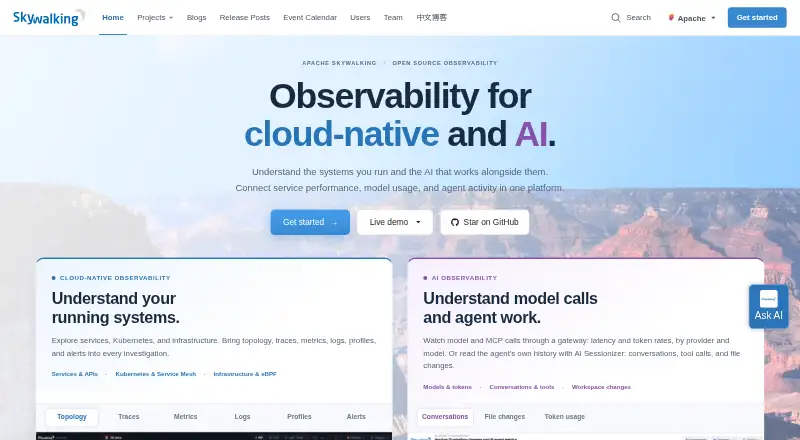
Apache SkyWalking is a self-hosted observability platform for cloud-native systems and AI workloads. It combines traces, metrics, logs, and profiling to help users inspect services, Kubernetes, and infrastructure through topology views, telemetry, profiles, and alerts. For AI workloads, users can examine model and MCP call latency and token rates, as well as agent conversations, tool calls, and recorded file changes. The project lists agents for Java, Python, NodeJS, Go, Rust, PHP, Ruby, Nginx LUA, Kong, and client-side JavaScript. Its integrations and ecosystem include OpenTelemetry OTLP, Istio, Envoy, Kubernetes, Grafana, and MCP. BanyanDB is described as a database for ingesting, analyzing, and storing metrics, tracing, and logging data. Docker installation instructions cover Linux, macOS, WSL, and Windows PowerShell. Horizon UI supports SkyWalking natively from v11 and partially for v10. The project documents several Horizon UI security controls, and recommends verifying official Apache source releases with PGP or SHA512 signatures. The GraalVM distribution is marked experimental.
Who it suits
Apache SkyWalking suits teams operating cloud-native systems or AI workloads that need to inspect telemetry and service relationships. It is for users prepared to deploy and manage a self-hosted platform.
What it does well
- Combines traces, metrics, logs, and profiling.
- Provides views of AI calls and agent activity.
- Lists agents across multiple languages and systems.
- Docker installation instructions cover Linux, macOS, WSL, and Windows.
What to know first
- Self-hosted deployment is required.
- Horizon UI supports SkyWalking natively from v11 and partially for v10.
- GraalVM distribution is marked experimental.
Limits
The free plan is an open-source, self-hosted deployment. Horizon UI supports SkyWalking natively since v11 and partially for v10; the GraalVM distribution is experimental.
Plans
| Plan | Billed and limits | Price |
|---|---|---|
| Apache SkyWalking | Open-source observability platform; self-hosted deployment | Free |
As skywalking.apache.org lists them, read 4 Oct 2026. The maker's own page has the final word.
Getting started
- Visit the Apache SkyWalking website.
- Choose a Docker-based installation route for Linux, macOS, WSL, or Windows PowerShell.
- Set up agents for the languages or systems in your environment.
- Connect relevant integrations such as OpenTelemetry OTLP, Kubernetes, or Grafana.
- Verify Apache source downloads with PGP or SHA512 signatures.
Apache SkyWalking is a self-hosted observability platform for cloud-native services and AI workloads. It is a strong fit for teams that want to connect service telemetry, infrastructure, and AI activity in one system. Its breadth is useful, but teams must run and maintain the platform themselves.
Overview
SkyWalking combines traces, metrics, logs, and profiling for investigations that span service behavior and infrastructure. Its cloud-native views cover services, Kubernetes, and infrastructure through topology, telemetry, profiles, and alerts. That wider scope can help teams trace a problem across dependencies and signal types rather than stopping at request traces.
For AI workloads, users can inspect model and MCP call latency and token rates, and examine agent conversations, tool calls, and recorded file changes. The project is part of the Apache Software Foundation. Its source releases are official Apache artifacts, and the project recommends verifying downloads with PGP or SHA512 signatures.
Key features
- Joined-up telemetry: Distributed and transaction tracing, dependency mapping, real user monitoring, and log correlation sit alongside metrics, logs, and profiling. This range suits teams that need more than a tracing view, though its value depends on operating a self-hosted system.
- Agents across languages and components: Agents cover Java, Python, NodeJS, Go, Rust, PHP, Ruby, Nginx LUA, Kong, and client-side JavaScript. That can make SkyWalking relevant to mixed stacks, while the project’s named agents do not guarantee that every application or version is covered.
- Integration ecosystem: The project identifies OpenTelemetry OTLP, Istio, Envoy, Kubernetes, Grafana, and MCP among its integrations and ecosystem projects. BanyanDB is described as a database for ingesting, analyzing, and storing metrics, tracing, and logging data.
- Security and maturity considerations: Horizon UI documents Content-Security-Policy, strict session cookies, no-store API responses, and optional login auditing. Horizon UI works natively with SkyWalking v11 and only partially with v10, so compatibility matters when choosing a version; the GraalVM distribution is explicitly experimental.
Pricing
Apache SkyWalking — free. The free open-source platform is self-hosted, so there is no software charge, but teams take on deployment and operation. It fits organizations able to manage their own observability infrastructure; it is less suitable for those seeking a hosted service. No seat or telemetry quota is attached to the stated plan.
Platforms
SkyWalking is available for API, Linux, macOS, self-hosted, web, and Windows environments. Docker-based installation instructions cover Linux, macOS, WSL, and Windows PowerShell. The supported deployment model is self-hosted, which gives teams control over running the platform but leaves setup and ongoing operation with them.
Who it's for
SkyWalking is a sensible choice for engineering teams with cloud-native systems, mixed-language services, or AI workloads that need service and infrastructure observability together. Its AI inspection and broad telemetry coverage make it particularly relevant where model and MCP calls are part of the operating picture. Teams looking for a managed service, or unwilling to own deployment and maintenance, should consider another option.
Pros and cons
- Pro — Multiple signals in one platform: Traces, metrics, logs, profiling, dependency mapping, and log correlation support investigations that cross telemetry types.
- Pro — AI workload visibility: Model and MCP latency and token rates, plus agent conversations and tool calls, extend its scope beyond conventional service monitoring.
- Pro — Wide agent and integration coverage: The named language agents and ecosystem integrations can serve varied cloud-native stacks.
- Con — Self-hosted operation is required: Teams must provide and manage the deployment rather than rely on a hosted SkyWalking service.
- Con — Horizon UI compatibility depends on version: Native support starts at v11, while v10 support is partial.
- Con — The GraalVM distribution is experimental: Teams seeking a non-experimental distribution should avoid treating it as a production-ready option.
Alternatives
For readers comparing tools, these options make different trade-offs in deployment, pricing, and scope:
- Application Performance Monitoring is a category directory for comparing application-monitoring choices.
- Distributed Tracing Tools is a category directory for comparing tracing-focused options.
- Middleware is worth considering for teams that want a freemium option with a free trial and published Free Forever allowances, including up to 100GB of data, 1k RUM sessions, and 20k synthetic checks.
- Grafana Cloud Application Observability suits teams seeking a freemium service with an always-free tier of 2,232 host hours, rather than SkyWalking’s self-hosted model.
- Honeycomb offers a freemium service and free trial; its Free plan includes up to 20M events per month, 100M metrics data points per month, and 2 triggers, making it a candidate for teams comparing published usage allowances.
- Jaeger is another free, self-hosted, open-source, cloud-native choice, suited to readers focused on distributed tracing rather than SkyWalking’s broader telemetry and AI observability scope.
- ManageEngine Applications Manager may fit teams preferring a freemium option with a stated cap of five apps or servers on its Free plan.
- New Relic Kubernetes Monitoring is an option for Kubernetes monitoring with a free tier and a Pro plan priced at $349 a year for annual commitments, including 100 GB of free data ingest.
- SigNoz offers a self-hosted community plan for teams comfortable managing their own infrastructure, storage, scaling, upgrades, and backups, as well as a cloud option.
- Uptrace is a freemium cloud option with 50 GB free per month, unlimited users, services, and hosts, for teams who prefer a hosted model.
Verdict
Choose Apache SkyWalking if your team can self-host and wants broad service observability alongside inspection of AI calls and agent activity. Its chief advantage is bringing varied telemetry and AI workload signals into one platform; its main drawback is the operational burden, with Horizon UI version compatibility an additional consideration. Teams that want managed hosting or need native Horizon UI support on v10 should look elsewhere.
Verdict
Apache SkyWalking covers service observability and AI workload inspection in a self-hosted package. Its Horizon UI compatibility varies by SkyWalking version, and the GraalVM distribution is experimental.
Questions
How much does Apache SkyWalking cost?
The listed plan is free.
Is Apache SkyWalking self-hosted?
Yes. Its deployment model is self-hosted.
Which platforms are listed?
The listed platforms are API, Linux, macOS, self-hosted, web, and Windows.
What integrations does it offer?
The listed integrations and ecosystem projects include OpenTelemetry OTLP, Istio, Envoy, Kubernetes, Grafana, and MCP.
Who maintains Apache SkyWalking?
The project identifies Apache SkyWalking as an Apache Software Foundation project.
Which SkyWalking versions does Horizon UI support?
Horizon UI supports SkyWalking natively since v11 and partially for v10.
Facts from Apache SkyWalking's own pages
- Agents
- The project lists agents for Java, Python, NodeJS, Go, Rust, PHP, Ruby, Nginx LUA, Kong, and client-side JavaScript. · skywalking.apache.org, 4 Oct 2026
- AI observability
- The site says users can inspect model and MCP call latency and token rates, and explore AI agent conversations, tool calls, and recorded file changes. · skywalking.apache.org, 4 Oct 2026
- Cloud-native coverage
- The site describes exploring services, Kubernetes, and infrastructure with topology, telemetry, profiles, and alerts. · skywalking.apache.org, 4 Oct 2026
- Compatibility limit
- Horizon UI supports SkyWalking natively since v11 and partially for v10. · skywalking.apache.org, 4 Oct 2026
- Deployment
- The get-started page provides Docker-based installation instructions for Linux, macOS, WSL, and Windows PowerShell. · skywalking.apache.org, 4 Oct 2026
- Download verification
- The downloads page says Apache source releases are official artifacts and recommends verifying downloads with PGP or SHA512 signatures. · skywalking.apache.org, 4 Oct 2026
- Experimental component
- The GraalVM distribution is explicitly marked experimental. · skywalking.apache.org, 4 Oct 2026
- Integrations
- The site identifies OpenTelemetry OTLP, Istio, Envoy, Kubernetes, Grafana, and MCP among its integrations and ecosystem projects. · skywalking.apache.org, 4 Oct 2026
- Project governance
- The site identifies Apache SkyWalking as an Apache Software Foundation project. · skywalking.apache.org, 4 Oct 2026
- Purpose
- Apache SkyWalking is an observability platform for cloud-native systems and AI workloads. · skywalking.apache.org, 4 Oct 2026
- Security
- Horizon UI documents Content-Security-Policy, strict session cookies, no-store API responses, and optional login auditing. · skywalking.apache.org, 4 Oct 2026
- Storage
- BanyanDB is described as an observability database for ingesting, analyzing, and storing metrics, tracing, and logging data. · skywalking.apache.org, 4 Oct 2026
- Support
- The project directs users to GitHub discussions for questions and issues and provides a developer mailing list and Slack community contact instructions. · skywalking.apache.org, 4 Oct 2026
- Telemetry
- The platform brings traces, metrics, logs, and profiling together to help users understand services. · skywalking.apache.org, 4 Oct 2026
Where Apache SkyWalking stands on Freedom251
- Application Performance Monitoring#2 of 37
- Distributed Tracing Tools#2 of 32
- Runtime Monitoring Software#6 of 56