Freedom251 › Continuous Profiling Tools
Metoro Kubernetes Profiling
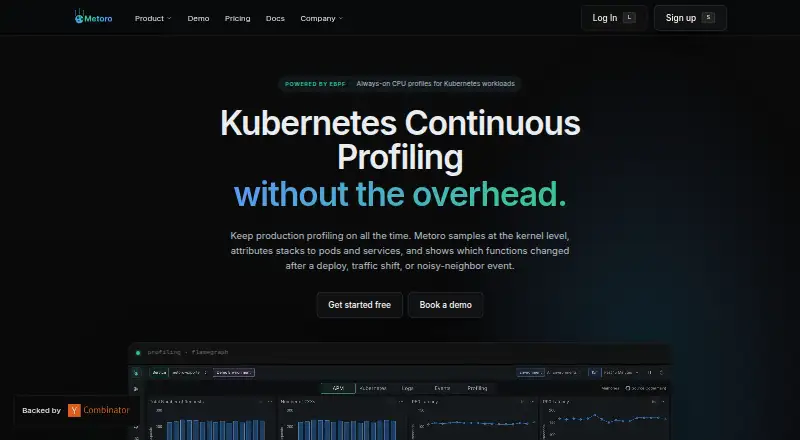
What Metoro Kubernetes Profiling is
Metoro Kubernetes Profiling continuously samples Kubernetes workloads with an eBPF profiler that runs at the kernel level. It presents interactive flame graphs that can be grouped by service, pod, or container and filtered by cluster, namespace, deployment, or Kubernetes label. Metoro says the profiler samples at 97Hz per CPU core and is designed to stay below 0.5% CPU overhead per node. Supported runtimes include Go, Python, C++, C, Rust, Node.js, and Java; other runtimes can appear through host-level frames. Profiling needs no SDKs, application changes, language agents, restarts, or rebuilds, and can cover third-party containers and vendor workloads. Profiles connect with Metoro APM traces, logs, metrics, pod state, and deployment context. Install via Helm, with Cloud, BYOC, and on-premises deployment options. The Hobby plan is free and includes one cluster, one user, two nodes, and 28-day retention. Scale costs $20 USD per node per month, plus $0.20 per GB over 100GB per node. Enterprise pricing is by contract.
Who it suits
It suits teams investigating CPU and memory performance in Kubernetes workloads, including third-party containers they do not build. Deployment options include Metoro Cloud, BYOC, and on-premises.
What it does well
- Interactive flame graphs with workload and cluster filters
- No SDKs, code changes, restarts, or rebuilds required
- Profiles connect with traces, logs, metrics, and pod context
- Free Hobby plan includes two nodes and 28-day retention
What to know first
- Hobby is limited to one cluster, one user, and two nodes
- Scale charges $0.20 per GB above 100GB per node
- eBPF requires Linux kernel 4.18 or newer
Limits
Hobby includes one cluster, one user, and two nodes with 28-day retention. Scale is $20 USD per node per month and charges $0.20 per GB above 100GB per node; it includes 28-day retention.
Plans
| Plan | Billed and limits | Price |
|---|---|---|
| Hobby | Free forever · 1 cluster · 1 user · 2 nodes · 28-day retention | Free |
| Cloud | $20 per host/month · Fully managed cloud · unlimited users · SSO/SAML · full observability | $20 a month |
| Scale | $20 USD per Kubernetes node/month; $0.20/GB over 100GB per node · Unlimited clusters · unlimited users · unlimited nodes · 28-day retention · engineer Slack support | $20 a month |
| Enterprise | Let's talk · Unlimited clusters · unlimited users · unlimited nodes · bulk discounts · 24/7 support · custom SLA · on-premises · BYOC | On request |
| BYOC | Contact us · Isolated instance in your cloud · feature parity with Cloud · managed by Metoro · one-month pilot | On request |
| On Prem | Contact us · Isolated instance · customer-managed · dedicated support engineer · one-month pilot | On request |
As metoro.io lists them, read 15 Oct 2026. The maker's own page has the final word.
Getting started
- Open the Metoro Kubernetes Profiling website.
- Choose Metoro Cloud, BYOC, or on-premises deployment.
- Select the Hobby, Scale, or Enterprise plan that fits your deployment.
- Install Metoro with Helm on a supported Kubernetes environment.
- Confirm the nodes run Linux kernel 4.18 or newer for eBPF profiling.
Metoro Kubernetes Profiling is a continuous Kubernetes profiler built around kernel-level eBPF sampling. It fits platform and application teams that need CPU and memory visibility without changing application builds, including workloads supplied by vendors. Its strongest advantage is the combination of low intended overhead and Kubernetes-aware context; the main buying question is whether per-node and excess-data charges fit your fleet.
Overview
Metoro profiles workloads continuously with an eBPF sampler running in the kernel. Instrumentation requires no SDK, application-code change, language agent, restart, or rebuild, so it can cover both software your team owns and third-party containers you cannot recompile. Sampling runs at 97Hz per CPU core and is designed for less than 0.5% CPU overhead per node, making the approach suitable for ongoing observation rather than only occasional diagnostic sessions.
CPU and memory profiles are connected to Metoro APM traces, logs, metrics, pod state, and deployment context. That linkage gives an investigation more operational framing than a standalone profile and can help relate a hotspot to a deployment or service. Hobby and Scale retain data for 28 days.
Key features
Kubernetes-focused flame graphs
Interactive flame graphs can be aggregated by service, pod, or container, then filtered by cluster, namespace, deployment, or Kubernetes label. These dimensions are useful for narrowing a fleet-wide problem to a particular workload or release. Continuous alerts add a way to surface profiling conditions instead of relying solely on manual inspection.
Runtime and workload coverage
Metoro lists Go, Python, C++, C, Rust, Node.js, and Java support. Other runtimes can still expose host-level frames, although the listed runtime support is the clearer fit when language-level attribution matters. Because profiling is eBPF-based, vendor and other third-party workloads are within scope even when their source and build pipeline are outside your control.
Operations and integrations
Installation uses Helm, and deployment choices are Metoro Cloud, bring-your-own-cloud (BYOC), or on-premises. Metoro Cloud integrates with Slack, PagerDuty, Datadog, Grafana, webhooks, REST APIs, and OpenTelemetry. Its GitHub App can create pull requests with suggested fixes and GitHub issues from investigations, which is most useful to teams that already route remediation through GitHub.
Metoro Cloud states SOC 2 Type II certification, TLS 1.3 in transit, AES-256 at rest, SSO/SAML 2.0, role-based access control, and immutable audit logs. Scale support includes Slack access to Metoro engineers; Enterprise adds 24/7 white-glove support and onboarding.
Pricing
Hobby
Hobby is free forever at no cost. It covers one cluster, one user, and two nodes with 28-day retention. This is a credible way for an individual or very small Kubernetes environment to evaluate continuous profiling, but the node, cluster, and seat caps make it unsuitable for a larger shared platform.
Scale
Scale costs $20 a month, billed at $20 USD / node / month, with an additional $0.20 / GB on excess over 100GB / node. It provides unlimited clusters, users, and nodes plus 28-day retention. The unlimited resource counts remove Hobby's structural caps, but node-based billing means cost grows with fleet size and the excess-data charge matters for high-volume profiling.
Enterprise
Enterprise has custom pricing and is billed by contract, with BYOC or on-premises deployment, unlimited clusters, users, and nodes, custom retention, and custom SLAs. It is the appropriate tier for organizations that require negotiated operational terms or retention beyond the standard 28 days. A 14-day trial is offered for evaluating the paid service.
Platforms
Metoro is offered through web and API access, with Linux and self-hosted deployment options. It supports EKS, GKE, AKS, OpenShift, Rancher, k3s, and self-managed CNCF-conformant Kubernetes distributions. eBPF requires Linux kernel 4.18 or newer, so clusters on older kernels are outside the stated requirement.
Who it's for
Choose Metoro when Kubernetes is the operating boundary and you want continuous CPU and memory profiles correlated with traces, logs, metrics, and deployment state. It is particularly well suited to platform teams, organizations running vendor containers, and engineering groups that cannot justify instrumenting every service. Hobby fits a two-node experiment; Scale fits teams needing unlimited clusters and users; Enterprise fits controlled BYOC or on-premises environments with custom retention or SLAs.
Look elsewhere if your priority is a broad, host-oriented monitoring service rather than Kubernetes profiling, if your environment cannot meet the Linux kernel requirement, or if per-node and excess-data billing is difficult to forecast.
Pros and cons
Pros
- No code instrumentation: SDKs, agents, rebuilds, restarts, and application changes are not required.
- Low intended overhead: 97Hz sampling is designed for less than 0.5% CPU overhead per node.
- Useful Kubernetes dimensions: Service, pod, container, cluster, namespace, deployment, and label views make narrowing investigations practical.
- Third-party coverage: eBPF can profile containers and vendor workloads you do not build.
- Deployment and security choice: Cloud, BYOC, and on-premises options are paired with stated enterprise controls.
Cons
- Small free tier: Hobby is limited to one cluster, one user, and two nodes.
- Usage-sensitive Scale pricing: $20 per node per month is supplemented by $0.20 per excess GB over 100GB per node.
- Kernel dependency: eBPF requires Linux kernel 4.18 or newer.
- Runtime caveat: Runtimes outside the named list are represented at host level rather than with the listed language coverage.
Alternatives
For a wider comparison, see the Continuous Profiling Tools and eBPF Observability Tools lists.
- Guance Container Monitoring is a freemium, multi-platform option whose free plan covers up to 10 hosts, 10,000 metric series per day, 10 million log records per day, and seven-day rolling retention; choose it when general container metrics and logs matter more than Metoro's profiling context.
- Middleware offers a free-forever plan with up to 100GB of data, 1,000 RUM sessions, and 20,000 synthetic checks; it is a better fit for teams prioritizing broader application experience and testing coverage.
- Grafana Cloud Application Observability has an always-free tier with 2,232 host hours and a Pro plan priced at $0.025 per host hour plus a $19 monthly platform fee; choose it when Grafana-centric application observability and host-hour pricing suit you.
- Coroot provides a self-hosted Apache 2.0 Community Edition and a Standard plan billed per monitored CPU; it suits teams seeking open-source, self-hosted observability.
- LMbench is free GPL-2.0 benchmark software for Linux and Windows, intended for benchmarking rather than continuous Kubernetes profiling.
- OneUptime is an open-source Apache 2.0 platform that can be self-hosted; pick it when inspectable source and broader incident tooling are the priority.
- Parca is free, Apache 2-licensed profiling software; it is the natural alternative for teams wanting an open-source profiling stack.
- Pyroscope has an always-free plan with 50GB ingested per month and 14-day retention, plus a $19 monthly Pro platform fee; choose it when standalone continuous profiling with ingestion-based limits is preferable.
Verdict
Metoro is a strong choice for Kubernetes teams that need continuous CPU and memory profiling tied directly to operational context, especially across unmodifiable vendor workloads. Choose it for no-code eBPF coverage, Kubernetes filtering, and flexible deployment; look elsewhere when you need a broader monitoring suite, open-source-first deployment, or more predictable costs than per-node and excess-data billing provide.
Verdict
Metoro links low-overhead, continuous profiling with application and Kubernetes context, and supports several deployment models. The free plan is limited, while Scale is priced per node with an additional excess-data charge.
Questions
Is there a free plan?
Yes. Hobby is free forever and includes one cluster, one user, two nodes, and 28-day retention.
What does Scale cost?
Scale costs $20 USD per node per month, with $0.20 per GB on usage above 100GB per node.
Which deployment options are available?
Metoro is available as Metoro Cloud, BYOC, or on-premises, and is installed with Helm.
Which Kubernetes environments does it support?
Metoro lists EKS, GKE, AKS, OpenShift, Rancher, k3s, kind, and self-managed CNCF-conformant Kubernetes distributions. eBPF requires Linux kernel 4.18 or newer.
Which runtimes can it profile?
Metoro lists Go, Python, C++, C, Rust, Node.js, and Java, with host-level frames for other runtimes.
Does it integrate with other tools?
Metoro Cloud integrates with Slack, PagerDuty, Datadog, Grafana, webhooks, REST APIs, and OpenTelemetry. Profiles also connect with Metoro APM traces, logs, metrics, pod state, and deployment context.
Facts from Metoro Kubernetes Profiling's own pages
- AI operations
- Metoro offers automated issue detection, alert investigation, root-cause analysis, deployment verification, runtime-to-code context and remediation workflows. · metoro.io, 15 Oct 2026
- AI privacy
- The AI policy says AI is opt-in, providers do not train on customer data, connections and stored results are encrypted, and agents have no general internet access. · metoro.io, 15 Oct 2026
- API
- The API reference documents a POST environment-creation endpoint using bearer authentication that returns an environment token. · metoro.io, 15 Oct 2026
- APM
- Its eBPF collection maps Kubernetes services, requests, latency, errors and traces without manual instrumentation. · metoro.io, 15 Oct 2026
- Automatic instrumentation
- Metoro installs an eBPF DaemonSet with Helm and gathers telemetry without application code changes, SDKs, sidecars or container restarts. · metoro.io, 15 Oct 2026
- Company founding
- LinkedIn gives Metoro a 2023 founding year and San Francisco, California headquarters. · linkedin.com, 15 Oct 2026
- Company size
- LinkedIn lists Metoro as privately held with 11–50 employees. · linkedin.com, 15 Oct 2026
- Continuous profiling
- The Kubernetes Profiling feature continuously samples CPU activity at the kernel, attributes stacks to pods and services, and relates changes to deployments, traffic shifts and noisy neighbors. · metoro.io, 15 Oct 2026
- Correlation
- Profiles are connected to Metoro APM traces, logs, metrics, pod state, and deployment context. · metoro.io, 30 Sept 2026
- Deployment
- Metoro is installed with Helm and is available as Metoro Cloud, BYOC, or on-premises deployment. · metoro.io, 30 Sept 2026
- Deployment options
- Metoro offers managed Cloud, BYOC in a customer account and on-premises deployment models. · metoro.io, 15 Oct 2026
- Documentation and support
- Metoro provides Mintlify-hosted technical documentation, a community Slack and dedicated Slack Connect support for customers. · metoro.io, 15 Oct 2026
- Flame graphs
- Interactive flame graphs can be aggregated by service, pod or container and filtered by cluster, namespace, deployment or Kubernetes label. · metoro.io, 15 Oct 2026
- Funding
- Crunchbase lists a Metoro pre-seed funding round, but the amount and date are hidden on the public page. · crunchbase.com, 15 Oct 2026
- Instrumentation
- Profiling requires no SDKs, application code changes, language agents, restarts, or rebuilds. · metoro.io, 30 Sept 2026
- Integrations
- Official documentation lists Slack, PagerDuty and webhooks as alert destinations, while the Cloud page also names Datadog and Grafana. · metoro.io, 15 Oct 2026
- Kubernetes support
- Metoro states support for EKS, GKE, AKS, OpenShift, Rancher, k3s, kind, and self-managed CNCF-conformant Kubernetes distributions; eBPF requires Linux kernel 4.18 or newer. · metoro.io, 30 Sept 2026
- Languages
- Metoro lists Go, Python, C++, C, Rust, Node.js, and Java as supported runtimes, with host-level frames for other runtimes. · metoro.io, 30 Sept 2026
- Limit: G2 reviewer
- That reviewer said the main difficulty was making sense of the large amount of information presented. · g2.com, 15 Oct 2026
- Limit: independent review
- FunBlocks said regulated teams may be uneasy about AI-generated code changes and requested finer controls over agent decisions plus broader custom-CRD support. · funblocks.net, 15 Oct 2026
- Logs and events
- The platform searches application logs, Kubernetes events, deployment changes and workload metadata through one investigation path. · metoro.io, 15 Oct 2026
- MCP and SDK extensibility
- Metoro publishes an MCP server that can be built in Go and exposes tools for querying Metoro data from AI clients, although it cannot start an AI investigation run directly. · metoro.io, 15 Oct 2026
- Notable news
- LinkedIn records Metoro’s Product Hunt launch announcement approximately six months before the page capture. · linkedin.com, 15 Oct 2026
- OpenTelemetry
- The in-cluster exporter accepts custom metrics through an OTLP HTTP endpoint and examples are provided for Python, Go and Node.js. · metoro.io, 15 Oct 2026
Where Metoro Kubernetes Profiling stands on Freedom251
- Continuous Profiling Tools#7 of 30
- eBPF Observability Tools#13 of 29