Freedom251 › Browser Automation Tools

CodeceptJS
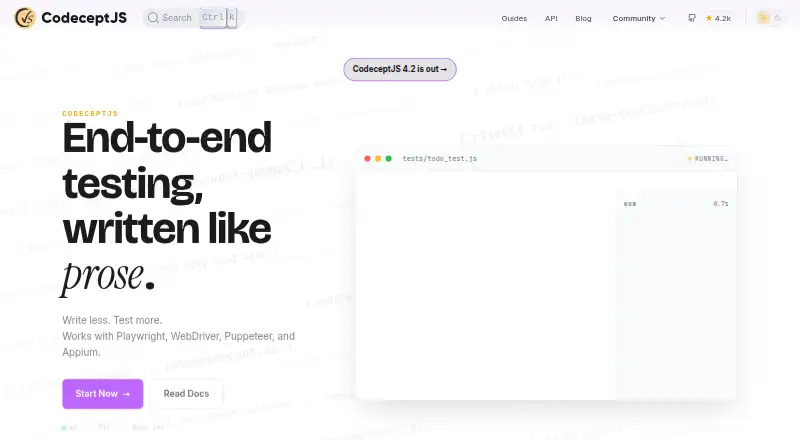
What CodeceptJS is
CodeceptJS is an end-to-end testing framework for writing tests as readable scenarios of user actions. It works with Playwright, WebDriver, Puppeteer, and Appium, so teams can use different test engines. Its Playwright helper supports Chromium, Firefox, WebKit, and Electron, while the installation guide describes native iOS and Android testing through Appium and WebDriverIO. Built-in REST and GraphQL helpers cover API testing without a browser. Tests can be organized with page objects, data fixtures, and plugins. The homepage describes live test debugging through an MCP server for agents and AI-assisted selector repair; test output includes step-by-step information and automatic screenshots. WebDriver tests can run on remote or cloud grids such as Sauce Labs, BrowserStack, and LambdaTest. CodeceptJS is free, open source, and MIT licensed. The installation guide says version 4.2 requires Node.js 22.12 or newer. The official site links to GitHub Discussions, GitHub Issues, and a Slack community. It is listed for Android, API, iOS, Linux, macOS, self-hosted, web, and Windows contexts.
Who it suits
CodeceptJS suits developers who want readable end-to-end tests across browser, mobile, or API workflows. It may also fit teams organizing tests with page objects, fixtures, and plugins.
What it does well
- Works with Playwright, WebDriver, Puppeteer, and Appium.
- Built-in REST and GraphQL helpers test APIs without a browser.
- Supports native iOS and Android testing through Appium and WebDriverIO.
- Test output includes step-by-step details and automatic screenshots.
- Free and MIT licensed.
What to know first
- Version 4.2 requires Node.js 22.12 or newer.
Limits
CodeceptJS 4.2 requires Node.js 22.12 or newer.
Plans
| Plan | Billed and limits | Price |
|---|---|---|
| Free · Open source · MIT | MIT licensed · Node.js framework | Free |
As codecept.io lists them, read 11 Oct 2026. The maker's own page has the final word.
Getting started
- Visit the CodeceptJS website
- Install Node.js 22.12 or newer for CodeceptJS 4.2
- Install CodeceptJS from its installation guide
- Choose a supported engine such as Playwright, WebDriver, Puppeteer, or Appium
- Use the support channels linked on the official site if needed
CodeceptJS is a scenario-focused end-to-end testing framework for teams that want readable user workflows across browser, mobile, and API checks. Its broad engine support and open-source license make it a practical choice for engineering teams willing to manage a Node.js toolchain; version 4.2’s Node.js requirement is the main compatibility checkpoint.
Overview
Founded in 2015, CodeceptJS describes tests as sequences of user actions rather than as collections of low-level commands. That approach can make business workflows easier to review and maintain, particularly when several test targets need a common structure. It is a Node.js framework, and CodeceptJS 4.2 requires Node.js 22.12 or newer, so older runtime environments may need an upgrade before adoption.
The framework is free, open source, and released under the MIT license. There is no paid tier or trial to evaluate, which removes licensing cost but leaves setup, execution infrastructure, and any remote grid charges to the team.
Key features
Several execution engines
CodeceptJS works with Playwright, WebDriver, Puppeteer, and Appium. This gives teams flexibility to align the helper with an existing browser or device setup, although the selected engine affects configuration and operational choices. Its Playwright helper covers Chromium, Firefox, WebKit, and Electron, making it suitable for multi-browser checks rather than a single-browser-only suite.
Browser, mobile, and API testing
Native iOS and Android testing is described through Appium and WebDriverIO. Built-in REST and GraphQL helpers also allow API tests without launching a browser. Keeping these targets under one scenario-oriented framework can reduce fragmentation for teams covering full user journeys; a project focused solely on one narrow test type may not need that breadth.
Organized suites and diagnostics
Page objects, data fixtures, and plugins provide ways to structure larger suites and reuse setup. Test output includes step-by-step information and automatic screenshots, giving failures more context during triage. The homepage also describes live test debugging through an MCP server for agents and AI-assisted selector repair, an option for teams experimenting with agent-assisted maintenance rather than a requirement for ordinary test runs.
Remote execution and community support
WebDriver tests can run on remote or cloud grids including Sauce Labs, BrowserStack, and LambdaTest. That helps teams extend coverage without limiting execution to local machines, while potentially adding external service configuration and usage costs. Support channels include GitHub Discussions, GitHub Issues, and a Slack community.
Pricing
| Plan | Price | Best for |
|---|---|---|
| Free · Open source · MIT | free | Teams and individuals needing a Node.js framework with multiple engines |
The single plan is MIT licensed and has no seat, quota, or trial restriction stated. It is therefore the straightforward choice for production teams and personal projects alike, provided they can supply the required Node.js environment and any desired device or cloud-grid infrastructure. There is no paid upgrade within CodeceptJS to add hosted execution or commercial support.
Platforms
CodeceptJS supports Android, iOS, web, API, Linux, macOS, Windows, and self-hosted deployments. The cross-platform listing suits organizations running tests across desktop operating systems while targeting browser, mobile, and service layers. Native mobile coverage depends on the Appium and WebDriverIO path, and browser execution depends on the chosen helper.
Who it's for
CodeceptJS is best for development and QA teams that want readable, scenario-based end-to-end tests spanning browsers, native mobile apps, and REST or GraphQL APIs. It is especially compelling when an organization needs to choose among Playwright, WebDriver, Puppeteer, and Appium or connect WebDriver suites to cloud grids. Teams that cannot move to Node.js 22.12 for version 4.2, or that want a fully hosted testing service rather than a framework to operate, should look elsewhere.
Pros and cons
Pros
- Broad target coverage: browser, native iOS and Android, and API helpers can share one testing approach.
- Engine choice: Playwright, WebDriver, Puppeteer, and Appium accommodate different browser and device environments.
- Useful failure context: step-by-step output and automatic screenshots support faster diagnosis.
- Low licensing barrier: the MIT license and 0.00 USD price permit use without a paid plan.
- Extensible organization: page objects, fixtures, and plugins support larger suites.
Cons
- Recent runtime dependency: version 4.2 requires Node.js 22.12 or newer.
- Setup varies by engine: choosing among helpers and execution targets adds configuration decisions.
- Infrastructure remains yours: remote grids and mobile environments require separate setup and may involve their own costs.
- AI features are optional workflow additions: the MCP debugging and selector-repair capabilities do not replace conventional test maintenance.
Alternatives
Choose Steel instead if you want a freemium browser and API platform with a free Launch plan, $30 in one-time credits, and a paid Scale tier at $250 a month.
Browserless is a freemium web option with a free plan capped at 1,000 units per month, two concurrent browsers, and two-minute sessions.
Kameleo fits teams needing browser and mobile-oriented coverage across desktop platforms, with a free plan limited to two concurrent browsers and 300 minutes of browser usage.
Katalon Studio is the alternative to consider for a paid product offering low-code and full-code authoring plus an AI Assistant and MCP Server.
Nightwatch offers an open-source, no-paywall approach across web and mobile targets.
TestCafe is another MIT-licensed, open-source test runner, with paid options beyond its free framework.
TestMu AI Web Automation suits teams wanting a freemium hosted automation service with a free allocation of 100 lifetime minutes and two parallel sessions.
testRigor is a freemium alternative that includes a public open-source plan alongside trial-based offerings.
For a broader shortlist, see Browser Automation Tools.
Verdict
Choose CodeceptJS if you need one free, MIT-licensed Node.js framework for readable end-to-end scenarios across multiple browser engines, native mobile apps, and APIs. Its main advantage is coverage and engine choice without licensing fees; look elsewhere if the Node.js 22.12 requirement or the need to operate your own execution infrastructure outweighs that flexibility.
Verdict
CodeceptJS offers several test engines, browser and mobile coverage, and API helpers under a free MIT license. Check the Node.js requirement for version 4.2 before installing.
Questions
How much does CodeceptJS cost?
CodeceptJS is free to use under the MIT license.
Is CodeceptJS open source?
Yes. The project is open source and MIT licensed.
Which test engines does it work with?
It works with Playwright, WebDriver, Puppeteer, and Appium.
Can CodeceptJS test APIs?
Yes. Built-in REST and GraphQL helpers support API testing without a browser.
Can it test mobile apps?
The installation guide describes native iOS and Android testing through Appium and WebDriverIO.
What Node.js version does it require?
The installation guide says CodeceptJS 4.2 requires Node.js 22.12 or newer.
Facts from CodeceptJS's own pages
- AI-assisted workflows
- The homepage describes live test debugging through an MCP server for agents and AI-assisted selector repair. · codecept.io, 11 Oct 2026
- API testing
- Built-in REST and GraphQL helpers support API testing without a browser. · codecept.io, 11 Oct 2026
- Browser support
- The Playwright helper supports Chromium, Firefox, WebKit, and Electron. · codecept.io, 11 Oct 2026
- Cloud grids
- The WebDriver installation guide says tests can run on remote or cloud grids such as Sauce Labs, BrowserStack, and LambdaTest. · codecept.io, 11 Oct 2026
- Founded
- 2015 · codecept.io, 28 Sept 2026
- License
- The project is free, open source, and MIT licensed. · codecept.io, 11 Oct 2026
- Mobile testing
- The installation guide describes native iOS and Android testing through Appium and WebDriverIO. · codecept.io, 11 Oct 2026
- Purpose
- CodeceptJS is an end-to-end testing framework that lets users write tests as readable scenarios of user actions. · codecept.io, 11 Oct 2026
- Reports and debugging
- The homepage says test output includes step-by-step information and automatic screenshots. · codecept.io, 11 Oct 2026
- Runtime
- The installation guide says CodeceptJS 4.2 requires Node.js 22.12 or newer. · codecept.io, 11 Oct 2026
- Support channels
- The official site links to GitHub Discussions, GitHub Issues, and a Slack community. · codecept.io, 11 Oct 2026
- Test engines
- It works with Playwright, WebDriver, Puppeteer, and Appium. · codecept.io, 11 Oct 2026
- Test organization
- The framework supports page objects, data fixtures, and plugins. · codecept.io, 11 Oct 2026
Where CodeceptJS stands on Freedom251
- Browser Automation Tools#9 of 62