
Browserless
by Browserless
What Browserless is
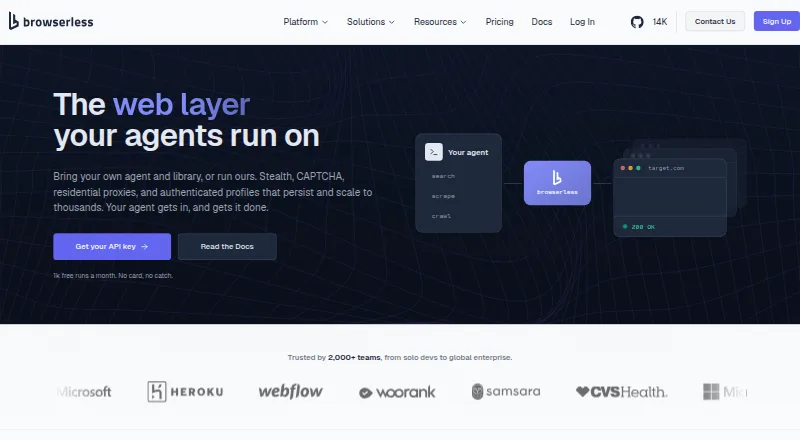
Browserless runs managed headless browser sessions for automation through WebSocket connections, Puppeteer, and Playwright. Its REST APIs support screenshots, PDFs, scraping, and content extraction, while BrowserQL provides GraphQL-based automation. Sessions can persist and reconnect; other listed tools include stealth mode, CAPTCHA solving, and regional browser endpoints. The service offers cloud execution and self-hosting, with web access and support by email, chat, community, and documentation. Integrations include Puppeteer, Playwright, n8n, Zapier, Browser Use, Vercel AI SDK, LangChain, and MCP. Browserless is open source and has a free plan with 1,000 units per month, two concurrent browsers, sessions up to two minutes, one day of persisted sessions and replays, and an eight-hour log search window. Prototyping costs $25 a month, billed annually, and includes 20,000 units per month and sessions up to 15 minutes. Starter and Scale cost 140.00 USD and $350 a month, respectively, billed annually. Enterprise pricing is custom.
Who it suits
Browserless suits teams automating browser tasks with Puppeteer, Playwright, or APIs, including those that need cloud or self-hosted deployment. Its listed integrations also suit workflows using tools such as n8n, Zapier, or LangChain.
What it does well
- Connects with Puppeteer and Playwright over WebSocket.
- REST APIs cover screenshots, PDFs, scraping, and extraction.
- Offers persistent sessions and reconnects.
- Supports cloud and self-hosted deployment.
- Free plan includes 1,000 monthly units.
What to know first
- Free sessions are limited to two minutes.
- Free plan allows two concurrent browsers.
- Paid plans start at $25 a month, billed annually.
Limits
The Free plan allows 1,000 units per month, two concurrent browsers, and sessions up to two minutes. It retains sessions and replays for one day and provides an eight-hour log search window. The $25 a month Prototyping plan, billed annually, raises these limits to 20,000 units, 10 concurrent browsers, 15-minute sessions, seven-day storage, and a 24-hour log search window.
Plans
| Plan | Billed and limits | Price |
|---|---|---|
| Free | Custom price · 1,000 units/month · 2 concurrent browsers · 2-minute maximum session time · 1 day persisted sessions and replays storage · 8-hour log search window | On request |
| Prototyping | billed annual · 20,000 units/month · 10 maximum concurrent browsers · 15-minute maximum session time · 7-day persisted sessions and replays storage · 24-hour log search window | $25 a month |
| Starter | billed annual · 180,000 units/month · 40 maximum concurrent browsers · 30-minute maximum session time · 30-day persisted sessions and replays storage · 3-day log search window | $140 a month |
| Scale | billed annual · 500,000 units/month · 100 maximum concurrent browsers · 60-minute maximum session time · 90-day persisted sessions and replays storage · 7-day log search window | $350 a month |
| Enterprise | Custom price · Millions of units consumed · Hundreds or thousands of concurrent browsers | On request |
As browserless.io lists them, read 19 Sept 2026. The maker's own page has the final word.
Getting started
- Open the Browserless website.
- Choose cloud execution or the self-hosted option.
- Start with the Free plan or select an annual paid plan.
- Connect through Puppeteer, Playwright, REST APIs, or BrowserQL.
- Use the listed integrations, including n8n, Zapier, LangChain, or MCP.
Overview
Browserless is browser automation infrastructure for developers and teams building workflows around live browsers, APIs, or established automation tools. It suits projects that need cloud execution or a self-hosted deployment; its strongest case is breadth of access, while session limits make plan selection consequential.
Founded in 2015, Browserless is open source and supports web access, multiple browser engines, and multiple languages. Its compliance coverage includes SOC 2, GDPR, and HIPAA, alongside two-factor authentication. Support is available through email, chat, community, and documentation.
Key features
- Managed browser sessions: WebSocket sessions connect with Puppeteer and Playwright, while persistence and reconnects support workflows that span more than one interaction. Maximum session time and stored-session duration rise with the plan, so short-lived free sessions are less suitable for longer-running work.
- APIs and BrowserQL: REST APIs handle screenshots, PDFs, scraping, and content extraction. BrowserQL adds a GraphQL automation interface, giving teams another route beyond the supported Puppeteer and Playwright connections.
- Automation safeguards and reach: Stealth mode, CAPTCHA solving, and regional browser endpoints broaden the available toolkit. Integrations include n8n, Zapier, Browser Use, Vercel AI SDK, LangChain, and MCP, as well as Puppeteer and Playwright.
- Deployment choice: Cloud execution reduces the need to operate browser infrastructure, while self-hosting offers a deployment alternative. The parallel-run and parallel-session figures are both 10; the plans separately specify maximum concurrent browsers.
Pricing
Browserless has a free plan and annual-billed paid tiers. The paid entry point is $25 a month, billed annually, so it is not a month-to-month price. There is no free trial; the free plan is the way to assess the service before committing.
| Plan | Price | Limits and included capacity |
|---|---|---|
| Free | Free | 1,000 units/month; 2 concurrent browsers; 2-minute maximum session; 1 day of persisted sessions and replays storage; 8-hour log search window. |
| Prototyping | $25 a month, billed annually | 20,000 units/month; 10 maximum concurrent browsers; 15-minute maximum session; 7 days of persisted sessions and replays storage; 24-hour log search window. |
| Starter | $140 a month, billed annually | 180,000 units/month; 40 maximum concurrent browsers; 30-minute maximum session; 30 days of persisted sessions and replays storage; 3-day log search window. |
| Scale | $350 a month, billed annually | 500,000 units/month; 100 maximum concurrent browsers; 60-minute maximum session; 90 days of persisted sessions and replays storage; 7-day log search window. |
| Enterprise | Custom pricing | For large-scale deployments consuming millions of units and running hundreds or thousands of concurrent browsers. |
The free tier is useful for small experiments, but its two-minute session cap, two-browser concurrency, and 1,000-unit allowance leave little room for sustained or parallel workloads. Prototyping is a more practical starting point for development that needs 10 browsers and 15-minute sessions, although the annual billing term matters. Starter and Scale increase both throughput and operational headroom, and extend storage and log search; choose between them according to whether 180,000 or 500,000 monthly units and 30- or 60-minute sessions fit the workload. Enterprise is aimed at much larger deployments, with custom pricing rather than a fixed monthly amount.
Platforms
Browserless is listed for web use and supports both cloud execution and self-hosted deployment. Multiple browser engines and programming languages are supported, without a specific inventory given.
Who it's for
Browserless is a strong fit for developers who want browser sessions accessible through familiar automation libraries, REST APIs, or GraphQL, and for teams that value a choice between cloud and self-hosting. Its persistence, reconnects, regional endpoints, and growing concurrency ceilings suit workflows that need more than one-off browser requests. It is less compelling for light use if a two-minute maximum session and small free quota are not enough, or for buyers who need a paid monthly commitment without annual billing.
Pros and cons
- Pro: Several interfaces—WebSocket, Puppeteer, Playwright, REST, and BrowserQL—let teams use different approaches for browser automation and output extraction.
- Pro: Cloud and self-hosted deployment, persistent sessions, and reconnects accommodate different operating needs and longer workflows.
- Pro: Capacity scales from a free 1,000-unit plan to Enterprise deployments described in millions of units and thousands of concurrent browsers.
- Con: The free plan caps sessions at two minutes and concurrency at two browsers, making it a narrow test environment rather than a dependable option for substantial workloads.
- Con: Paid prices are tied to annual billing, and there is no free trial for trying a paid tier.
Alternatives
Browse browser automation tools to compare options across the category. Choose Steel if its freemium, open-source offering and one-time $30 credits on the free Launch plan better suit an initial usage-based evaluation; its Scale plan is $250 a month.
Kameleo is worth considering when broad platform coverage, including mobile and desktop operating systems, is more important; its free plan includes two concurrent browsers and 300 minutes of browser usage time. Nightwatch is an alternative for readers seeking an open-source option with no paywalls. TestCafe may fit those who want a free, MIT-licensed test runner and an available free trial.
TestMu AI Web Automation offers a free tier with 100 lifetime minutes and two parallel web and mobile automation sessions, which may suit limited evaluation across those session types. testRigor is another freemium alternative with a public open-source plan. WebdriverIO is a free, open-source automation framework that requires Node.js. Cypress may suit teams comparing a freemium testing product whose free Starter plan includes 10 users and 500 test results per month.
Verdict
Choose Browserless if your team needs flexible browser automation interfaces, persistent sessions, and a choice of cloud or self-hosted deployment, with room to scale concurrency. Its principal drawback is the gap between a tightly capped free plan and paid tiers billed annually. If those session limits or billing terms do not fit, compare alternatives before committing.
Verdict
Browserless combines browser automation interfaces, APIs, and session persistence with both cloud and self-hosted deployment. Check the free plan's usage and session limits against your workload before choosing a paid tier.
Questions
Is Browserless free?
Yes. The Free plan includes 1,000 units per month, two concurrent browsers, sessions up to two minutes, one day of persisted sessions and replays, and an eight-hour log search window.
How much do paid plans cost?
Prototyping is $25 a month, billed annually. Starter is $140 a month and Scale is $350 a month, each billed annually. Enterprise pricing is custom.
What platforms and deployment options does it support?
Browserless is available on the web and supports cloud execution and self-hosting.
Is Browserless open source?
Yes, Browserless is listed as open source.
Which tools does it integrate with?
Listed integrations include Puppeteer, Playwright, n8n, Zapier, Browser Use, Vercel AI SDK, LangChain, and MCP.
What support is available?
Support channels include email, chat, community, and documentation.
Facts from Browserless's own pages
- Compliance
- SOC 2, GDPR, HIPAA, two factor · cloud.browserless.io, 19 Sept 2026
- Deployment
- cloud, self hosted · docs.browserless.io, 19 Sept 2026
- Founded
- 2015 · browserless.io, 28 Sept 2026
- Headquarters
- Battle Ground, Washington, United States · browserless.io, 28 Sept 2026
- Integrations
- Puppeteer, Playwright, n8n, Zapier, Browser Use, Vercel AI SDK, LangChain, MCP · docs.browserless.io, 19 Sept 2026
- Key features
- Managed headless browser sessions over WebSocket · Puppeteer and Playwright connectivity · REST APIs for screenshots, PDFs, scraping and content extraction · BrowserQL GraphQL automation · Persistent sessions and session reconnects · Stealth mode and CAPTCHA solving · Regional browser endpoints and load balancing · Live debugging and session recording · docs.browserless.io, 19 Sept 2026
- Support
- email, chat, community, docs · cloud.browserless.io, 19 Sept 2026
Where Browserless stands on Freedom251
- HTML to PDF APIs#1 of 41
- Browser Automation Tools#3 of 63
- Headless Browser APIs#2 of 33