Freedom251 › Test Automation Software

TestMu AI Web Automation (formerly LambdaTest Web Automation)
Visit TestMu AI Web Automation (formerly LambdaTest Web Automation) Alternatives Pricing
What TestMu AI Web Automation (formerly LambdaTest Web Automation) is
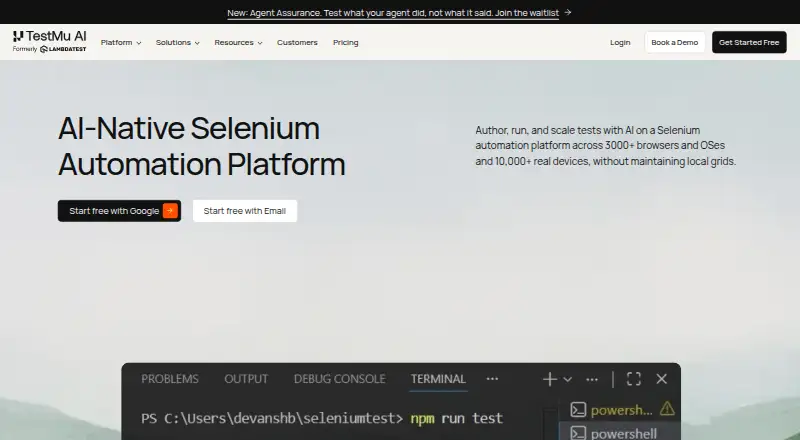
TestMu AI Web Automation is a cloud platform for running Selenium tests across browsers, operating systems, and real devices without maintaining local grids. The company describes coverage of 3,000+ browser and operating-system environments and 10,000+ real devices. It supports Selenium, Playwright, Cypress, Puppeteer, Appium, Espresso, XCUITest, and Jest. KaneAI can author, run, and maintain Selenium tests from natural-language scenarios and auto-heal broken locators at runtime. HyperExecute can split suites across runners, fail fast, and rerun failed tests; TestMu AI says it can execute suites up to 70% faster than a conventional cloud grid. Sessions automatically capture network and console logs, video, screenshots, and command logs. An encrypted tunnel supports testing locally hosted, staging, and firewalled web apps without a public URL. Listed integrations include Jira, Slack, CircleCI, GitHub, GitLab, and Bitbucket. The free plan includes 100 lifetime minutes, two parallel web and mobile automation sessions, and 100 accessibility tests per organization. Paid plans start at $29/mo (annual). TestMu AI says LambdaTest became TestMu AI on January 12, 2026.
Who it suits
TestMu AI Web Automation suits software teams that need to run automated tests across browsers, operating systems, or devices. Its tunnel and integrations may also suit teams testing private apps within established development workflows.
What it does well
- Supports eight listed test frameworks
- Captures logs, video, and screenshots automatically
- Tunnel supports locally hosted and firewalled app testing
- Free plan includes two parallel automation sessions
What to know first
- Free plan is limited to 100 lifetime minutes
- Lowest listed paid plan is Linux-only
- Enterprise pricing is custom and not listed
Limits
The free plan includes 100 lifetime minutes, two parallel web and mobile automation sessions, and 100 accessibility tests per organization. Paid plans listed are billed annually; the Linux-only desktop plan starts at $29 a month.
Plans
| Plan | Billed and limits | Price |
|---|---|---|
| Free | Free forever; 100 lifetime minutes · 2 parallel web and mobile automation sessions · 100 accessibility tests per organization | Free |
| Virtual Automation Cloud | Billed annually · Mobile browsers on emulators and simulators · virtual devices for app automation · Appium, Espresso, XCUI, and Detox | $139 a month |
| Real Device Plus Automation Cloud | Billed annually · Real-device web and app automation · Appium, Espresso, and XCUITest · geolocation testing in 120+ countries | $199 a month |
| Web Automation on Desktop (Linux Only) | Billed annually · Linux · latest and top 20 versions of Chrome, Firefox, and Microsoft Edge | $29 a month |
| Web Automation on Desktop | Billed annually · Multi OS · 3,000+ browser environments · Selenium and JavaScript frameworks | $79 a month |
As testmuai.com lists them, read 7 Oct 2026. The maker's own page has the final word.
Getting started
- Open the TestMu AI Web Automation website.
- Choose the Free plan or a paid automation plan.
- Select a supported framework, such as Selenium, Playwright, Cypress, or Appium.
- Connect an integration if needed, such as GitHub, Jira, or Slack.
- Use the encrypted tunnel when testing a locally hosted, staging, or firewalled web app.
TestMu AI Web Automation is a cloud testing platform for teams that need to run browser and app tests across many environments without maintaining their own grid. It is strongest for teams combining cross-browser coverage with mobile automation and test-debugging tools, but its free allowance is too small for sustained use.
Overview
Formerly LambdaTest Web Automation, TestMu AI brings test authoring, execution, and debugging into a service spanning more than 3,000 browser and operating-system environments and more than 10,000 real devices. Its framework range and private-app tunnel make it relevant to teams with varied testing stacks or staging environments. The trade-off is a paid ladder billed annually, with meaningful differences in operating-system and device coverage.
Key features
TestMu AI supports Selenium, Playwright, Cypress, Puppeteer, Appium, Espresso, XCUITest, and Jest. That breadth gives teams room to cover web and mobile work without limiting the service to one framework. KaneAI can author, run, and maintain Selenium tests from natural-language scenarios, and auto-heal broken locators at runtime; teams that prefer conventional code-based authoring can use that too.
HyperExecute distributes Selenium suites across runners, can fail fast, and reruns failed tests. TestMu AI claims execution up to 70% faster than a conventional cloud grid, which is attractive for large suites but should not be treated as a guaranteed result for every workload. Sessions automatically collect network and console logs, video, screenshots, and command logs, giving teams concrete material for investigating failures.
An encrypted tunnel supports testing locally hosted, staging, or firewalled web apps without exposing them at a public URL. Integrations include Jira, Slack, CircleCI, GitHub, GitLab, and Bitbucket. TestMu AI states it is SOC 2 Type 2, GDPR, and CCPA compliant, and that virtual-machine test data is wiped when a session ends.
Pricing
The free plan costs nothing, billed Free forever. It includes 100 lifetime minutes, two parallel web and mobile automation sessions, and 100 accessibility tests per organization. That is enough for limited evaluation, not a durable allowance for a team running frequent suites.
Web Automation on Desktop (Linux Only) costs $29 a month, billed annually. It covers Linux and the latest plus top 20 versions of Chrome, Firefox, and Microsoft Edge. This is the entry paid tier for teams whose desktop browser work can stay on Linux; it gives up the multi-OS scope of the next plan.
Web Automation on Desktop costs $79 a month, billed annually, and adds multi-OS coverage across 3,000+ browser environments for Selenium and JavaScript frameworks. It is the more suitable choice when browser and operating-system combinations are central to release confidence.
Virtual Automation Cloud costs $139 a month, billed annually. It adds mobile browsers on emulators and simulators, virtual devices for app automation, and support for Appium, Espresso, XCUI, and Detox. Real Device Plus Automation Cloud costs $199 a month, billed annually, for real-device web and app automation, Appium, Espresso, and XCUITest, plus geolocation testing in 120+ countries. The higher tier is better suited to teams that need real hardware or location-specific checks rather than virtual-device coverage alone.
Enterprise has custom pricing and adds SOC1/SOC2 security, SSO, IP whitelisting, custom data retention, dedicated support roles, private Slack, and on-premise options. Those controls make it the tier to consider for organizations with deployment or governance requirements beyond the standard plans.
Platforms
The listed platform range includes Android, iOS, Linux, macOS, Windows, web, API, and self-hosted use. Mobile web testing and a self-hosted runner are supported, while the paid plans distinguish virtual devices from real-device automation. That distinction matters: broad platform labels do not mean every plan includes every device type.
Who it's for
TestMu AI is a strong fit for QA and development teams that need to validate across browser versions and operating systems, run mobile tests, or debug failures with captured session evidence. The tunnel is particularly useful when the target app is private or still in staging. Teams with only occasional testing needs may find the free lifetime-minute cap too restrictive, while teams needing only Linux desktop coverage may not need to pay for the multi-OS plan.
Pros and cons
- Pro: Broad browser, device, and framework coverage can serve mixed web and mobile testing stacks without a locally maintained grid.
- Pro: Automatic logs, recordings, screenshots, and command traces give teams multiple ways to diagnose failed sessions.
- Pro: The encrypted tunnel supports private environments without requiring a public app URL.
- Con: The free plan has only 100 lifetime minutes, making it a narrow trial of regular automated use.
- Con: Paid prices are tied to annual billing, and the $29/mo plan is Linux-only rather than a general multi-OS entry point.
- Con: Real-device coverage sits at $199 a month billed annually, a substantial step above virtual-device testing.
Alternatives
For a broader comparison, see Test Automation Software, Cross-Browser Testing Software, Functional Testing Software, End-to-End Testing Software, and Browser Automation Tools.
TestingWhiz is another freemium option with a free Community Edition and a Node Locked plan. CloudQA may suit teams prioritizing local test execution and API testing: its free Kickstart plan includes unlimited API tests, seven days of history, and Chrome. HyperExecute is worth considering for a narrower execution-focused need; its free plan provides 300 testing minutes, up to two concurrent sessions, and Windows or Linux VMs. Codeception is a free, MIT-licensed option. Cucumber.js is free and installable as an npm development dependency. Firebase Cloud Messaging is a free alternative in a different category. BugBug may be preferable for local-only testing with a small free allowance of four suites, one user, one project, and 15 tests. Functionize offers a free plan with 800,000 credits per month and five parallel runs.
Verdict
Choose TestMu AI Web Automation if your team needs broad browser coverage, mobile automation, private-environment testing, and useful debugging captures in one service. Its strongest case is reducing the burden of maintaining a grid while supporting a varied framework stack. Look elsewhere if a 100-minute lifetime free allowance is all you need, if Linux-only coverage is insufficient at the entry price, or if your budget cannot accommodate annual billing for the device coverage you require.
Verdict
TestMu AI combines cross-environment execution with test authoring, debugging captures, and a tunnel for private apps. Check the free plan’s lifetime minutes and the operating-system scope of the $29/mo annual plan when assessing fit.
Questions
Is TestMu AI Web Automation free?
Yes. Its Free plan costs nothing and is billed Free forever. It includes 100 lifetime minutes, two parallel web and mobile automation sessions, and 100 accessibility tests per organization.
How much do paid plans cost?
The listed plans are $29 a month for Web Automation on Desktop (Linux Only), 79.00 USD for Web Automation on Desktop, 139.00 USD for Virtual Automation Cloud, and 199.00 USD for Real Device Plus Automation Cloud. Each is billed annually.
Which frameworks does it support?
It supports Selenium, Playwright, Cypress, Puppeteer, Appium, Espresso, XCUITest, and Jest.
Can I test an app that has no public URL?
Yes. An encrypted TestMu AI tunnel supports locally hosted, staging, and firewalled web apps without a public URL.
Which integrations are listed?
Listed integrations include Jira, Slack, CircleCI, GitHub, GitLab, and Bitbucket.
What happened to LambdaTest?
TestMu AI says LambdaTest became TestMu AI on January 12, 2026. The company was founded in 2017.
Facts from TestMu AI Web Automation (formerly LambdaTest Web Automation)'s own pages
- AI authoring
- KaneAI can author, run, and maintain Selenium tests from natural-language scenarios and auto-heal broken locators at runtime. · testmuai.com, 7 Oct 2026
- Company history
- TestMu AI says LambdaTest became TestMu AI on January 12, 2026, and that the company was founded in 2017. · testmuai.com, 7 Oct 2026
- Debugging
- Selenium sessions capture network logs, console logs, video recordings, screenshots, and command logs automatically. · testmuai.com, 7 Oct 2026
- Enterprise
- The pricing page says Enterprise offers custom pricing and lists SOC1/SOC2 security, SSO, IP whitelisting, custom data retention, dedicated support roles, private Slack, and on-premise options. · testmuai.com, 7 Oct 2026
- Execution
- HyperExecute can auto-split Selenium suites across runners, fail fast, and rerun failed tests; TestMu AI says it can execute suites up to 70% faster than a conventional cloud grid. · testmuai.com, 7 Oct 2026
- Founded
- 2017 · testmuai.com, 28 Sept 2026
- Frameworks
- The platform supports Selenium, Playwright, Cypress, Puppeteer, Appium, Espresso, XCUITest, and Jest. · testmuai.com, 7 Oct 2026
- Headquarters
- San Francisco, California, United States · testmuai.com, 28 Sept 2026
- Integrations
- The integrations page lists Jira, Slack, CircleCI, GitHub, GitLab, and Bitbucket among its integrations. · testmuai.com, 7 Oct 2026
- Local testing
- An encrypted TestMu AI tunnel supports testing locally hosted, staging, and firewalled web apps without a public URL. · testmuai.com, 7 Oct 2026
- Purpose
- The Selenium automation platform runs and scales tests across 3,000+ browsers and operating systems and 10,000+ real devices without maintaining local grids. · testmuai.com, 7 Oct 2026
- Security
- TestMu AI states that it is SOC 2 Type 2 compliant and GDPR and CCPA compliant, and that test data on virtual machines is wiped when a session ends. · testmuai.com, 7 Oct 2026
Where TestMu AI Web Automation (formerly LambdaTest Web Automation) stands on Freedom251
- Test Automation Software#15 of 45
- Cross-Browser Testing Software#9 of 25
- Functional Testing Software#15 of 38
- Testing And Qa#17 of 33
- Browser Automation Tools#33 of 63
- Software Testing Tools#18 of 33
- End-to-End Testing Software#16 of 29
- Regression Testing Software#16 of 29
- Automated Testing#22 of 34