Freedom251 › Test Automation Software

Codeception
What Codeception is
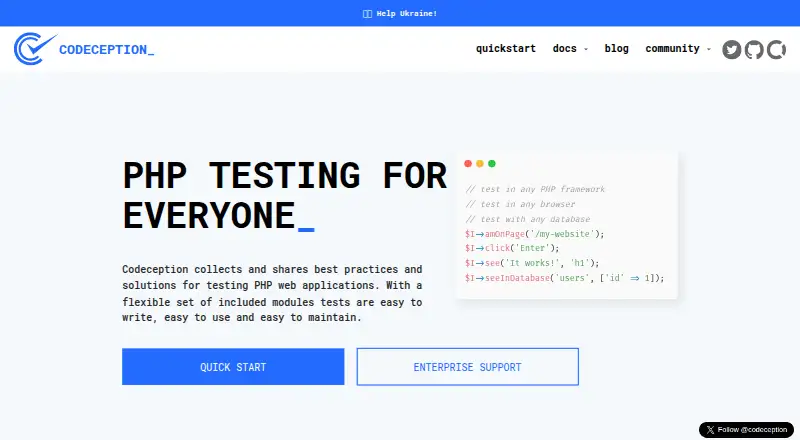
Codeception is a free, open-source PHP testing framework for web applications, licensed under MIT. It supports unit, functional, integration, acceptance, API, and browser testing. Tests express user actions through a high-level domain language; teams can also write user stories in Gherkin or use Codeception's Cest format. Browser tests can use Firefox, Chrome, Safari, Selenium WebDriver, or HTTP requests through PhpBrowser. REST and SOAP testing includes commands for JSON and XML responses, while data-driven database testing supports MySQL, PostgreSQL, MongoDB, Redis, and Memcache. Listed PHP framework integrations include Symfony, Laravel, Zend Framework, Yii, and Phalcon. Codeception can create local or remote code coverage reports in XML and HTML. Its WebDriver documentation includes Selenium, Sauce Labs, LambdaTest, and TestingBot integrations. The project lists support through Gitter, GitHub issues, Stack Overflow, and IRC, along with consulting, enterprise support, and training. It runs on Linux, macOS, Windows, or self-hosted environments; installation requires PHP 5.6 or newer with CURL enabled.
Who it suits
It suits PHP teams testing web applications across browser, API, database, and other testing levels. Installation requires PHP 5.6 or newer with CURL enabled.
What it does well
- Free and MIT licensed
- Covers unit through acceptance testing
- Supports REST and SOAP tests
- Produces XML and HTML coverage reports
What to know first
- Requires PHP 5.6 or newer
- CURL must be enabled
Plans
| Plan | Billed and limits | Price |
|---|---|---|
| OpenSource MIT Licensed | MIT licensed | Free |
As codeception.com lists them, read 2 Oct 2026. The maker's own page has the final word.
Getting started
- Open the Codeception website.
- Use a Linux, macOS, Windows, or self-hosted environment.
- Meet the PHP 5.6-or-newer and CURL installation requirements.
- Choose the test levels and browser or API approach for your application.
- Use the free MIT-licensed software.
Codeception is an open-source, BDD-styled PHP framework for testing web applications across acceptance, functional, API, unit, and integration levels. It suits PHP teams that want one user-oriented test language spanning browsers, services, databases, and framework-specific workflows. The trade-off is a developer-focused tool rather than a hosted, visual testing service.
Overview
Codeception organizes tests around user actions and a high-level domain language, making scenarios readable while still covering low-level PHP units and integrations. Its hybrid execution model supports local or remote runs, CI/CD integration, test scheduling, and cross-browser testing. Because it is MIT-licensed and free, it is a practical choice for teams that can own their PHP test setup and maintenance.
The framework covers a broad testing ladder: PHP unit tests, functional and integration checks, acceptance flows, REST and SOAP APIs, and browser tests. That breadth reduces the need to combine separate test frameworks, but it also means teams must design conventions across several test styles.
Key features
Browser and acceptance testing
Browser scenarios can run through Firefox, Chrome, Safari, Selenium WebDriver, or HTTP requests with PhpBrowser. WebDriver integrations documented for Selenium, Sauce Labs, LambdaTest, and TestingBot extend the execution options. This is a strong fit for teams that need real-browser coverage across environments; PhpBrowser is more appropriate when an HTTP-level check is enough and a full browser would add unnecessary overhead.
API and data checks
REST and SOAP commands handle JSON and XML responses, giving service teams a dedicated way to assert API behavior. Data-driven testing supports MySQL, PostgreSQL, MongoDB, Redis, and Memcache, so tests can include the persistence and caching layers instead of treating them as separate concerns.
Syntax, frameworks, and reporting
Gherkin user stories support teams that want conventional BDD scenarios, while Codeception's Cest format offers its own concise test structure. Integrations are listed for Symfony, Laravel, Zend Framework, Yii, and Phalcon, which can shorten setup for those PHP stacks. Local and remote code coverage reports can be generated in XML and HTML, useful for CI artifacts and review dashboards.
Official and community add-ons include a Chrome extension, Webception web runner, Appium, TestRail, Allure, ReportPortal, WireMock, and Docker Selenium Chrome. The range is valuable when a project needs specialized tooling, although add-on quality and maintenance can vary because the catalogue includes community contributions.
Pricing
Codeception has one published plan, OpenSource MIT Licensed, at free. It covers PHP unit, functional, integration, acceptance, REST API, SOAP API, and browser tests. There are no paid seats, usage quotas, or trial-period terms attached to this plan. Teams receive the software under the MIT license and can use it without a subscription, making it suitable for individual developers, open-source projects, and organizations that prefer self-managed tooling.
Commercial help is separate from the free software: SDCLabs provides official consulting, and enterprise support and trainings are offered. Those services are relevant when a company needs implementation guidance or structured enablement rather than another software tier.
Platforms
Codeception runs on Linux, macOS, Windows, and self-hosted environments. The self-hosted model gives teams control over browsers, databases, CI runners, and credentials, while placing installation and infrastructure responsibility on them. Installation requires PHP 5.6 or newer with CURL enabled, so older PHP estates must upgrade or isolate a compatible runner.
Who it's for
Choose Codeception for PHP web applications whose test strategy spans user journeys, APIs, databases, and framework behavior. It is especially well matched to Symfony, Laravel, Zend Framework, Yii, or Phalcon teams, and to organizations that need browser providers, coverage output, and CI execution without per-seat software fees.
Look elsewhere if the priority is a hosted visual workflow with minimal PHP involvement, or if your team does not want to maintain self-hosted runners and test dependencies. Codeception's flexibility rewards engineering ownership rather than replacing it.
Pros and cons
Pros
- Broad test coverage: one framework spans unit through acceptance testing, plus REST, SOAP, and browser targets.
- PHP ecosystem fit: documented integrations for five major PHP frameworks reduce friction in those stacks.
- Flexible execution: Selenium-based browsers, cloud WebDriver providers, PhpBrowser, hybrid runs, scheduling, and CI/CD support cover varied pipelines.
- No software charge: the MIT-licensed plan costs 0.00 USD and has no published seat or quota limits.
- Extensible reporting and add-ons: XML/HTML coverage and integrations such as Appium, Allure, TestRail, and WireMock broaden possible workflows.
Cons
- Infrastructure ownership: self-hosted execution leaves browser, PHP, database, and CI maintenance with your team.
- Version constraint: PHP 5.6 or newer with CURL is required, which can block legacy environments.
- Mixed add-on provenance: community add-ons expand capabilities but may require your team to assess fit and upkeep.
Alternatives
Test Automation Software is the broader category to browse when you want to compare additional automation products.
- Katalon Studio is a paid product with a free plan and trial, covering web, mobile, and desktop across hosted and self-hosted platforms; choose it when that broader platform reach and low-code/full-code authoring matter more than a PHP-only framework.
- TestingWhiz offers a free Community Edition plus paid licensing, with Android, iOS, browser-extension, desktop, Linux, and macOS coverage; pick it for a freemium test tool oriented beyond Codeception's PHP scope.
- TestMu AI Web Automation (formerly LambdaTest Web Automation) has a free plan with 100 lifetime minutes and two parallel web/mobile sessions; choose it when you need a cloud service with explicit parallel-session limits.
- CloudQA provides a free Kickstart plan with automated test creation, local execution, unlimited API tests, seven days of history, and Chrome; it suits teams prioritizing a hosted-style workflow and API allowance.
- HyperExecute offers 300 free testing minutes and up to two concurrent Windows or Linux VM sessions; choose it when metered cloud execution is preferable to maintaining your own runners.
- Cucumber.js is a free npm development dependency for Linux, macOS, Windows, and self-hosted use; pick it when JavaScript-based Gherkin testing, rather than PHP's wider test stack, is the requirement.
- Firebase Cloud Messaging is a no-cost service for Android, iOS, web, extension, and API environments; choose it for message delivery, not application test automation.
- Testim has a free Community plan per organization with documentation and Community Slack support; it is an alternative for teams wanting a product-led testing service.
Verdict
Codeception is the right choice for PHP teams that want one free, MIT-licensed framework covering user journeys, APIs, databases, browser sessions, and lower-level tests. Its main reason to choose it is breadth without subscription fees; its main reason to look elsewhere is the need for a managed visual platform that removes responsibility for PHP and test infrastructure.
Verdict
Codeception covers several testing levels and supports browser, API, database, and PHP framework workflows. Check the PHP and CURL requirements before installing it.
Questions
Is Codeception free?
Yes. Codeception is free and open-source under the MIT license.
Which platforms does it support?
The listed platforms are Linux, macOS, Windows, and self-hosted environments.
What kinds of testing does it support?
It supports unit, functional, integration, acceptance, REST API, SOAP API, and browser tests.
Which browsers can its browser tests use?
Browser tests can run with Firefox, Chrome, Safari, Selenium WebDriver, or HTTP requests through PhpBrowser.
What does installation require?
The installation requirements include PHP 5.6 or newer with CURL enabled.
What support options are available?
Support is offered through Gitter chat, GitHub issues, Stack Overflow, and the Codeception IRC channel. Official consulting, enterprise support, and training are also offered.
Facts from Codeception's own pages
- Add-ons
- Official and community add-ons include a Chrome extension, Webception web runner, Appium, TestRail, Allure, ReportPortal, WireMock, and Docker Selenium Chrome. · codeception.com, 2 Oct 2026
- API testing
- Codeception provides REST and SOAP testing with commands for JSON and XML responses. · codeception.com, 2 Oct 2026
- BDD syntax
- Codeception supports user stories in Gherkin format and has its own Cest test format. · codeception.com, 2 Oct 2026
- Browser testing
- Browser tests can run with Firefox, Chrome, Safari, Selenium WebDriver, or HTTP requests through PhpBrowser. · codeception.com, 2 Oct 2026
- Commercial services
- The project lists official consulting by SDCLabs and offers enterprise support and trainings. · codeception.com, 2 Oct 2026
- Coverage
- Codeception can generate local and remote code coverage reports, including XML and HTML output. · codeception.com, 2 Oct 2026
- Database testing
- Its data-driven testing supports MySQL, PostgreSQL, MongoDB, Redis, and Memcache. · codeception.com, 2 Oct 2026
- Framework integrations
- Supported PHP frameworks listed by Codeception include Symfony, Laravel, Zend Framework, Yii, and Phalcon. · codeception.com, 2 Oct 2026
- Installation requirement
- The installation page lists PHP 5.6 or newer with CURL enabled as requirements. · codeception.com, 2 Oct 2026
- License
- Codeception is released as open-source software under the MIT license. · codeception.com, 2 Oct 2026
- Purpose
- Codeception is a BDD-styled PHP testing framework for web applications. · codeception.com, 2 Oct 2026
- Support
- Support is offered through Gitter chat, GitHub issues, Stack Overflow, and the Codeception IRC channel. · codeception.com, 2 Oct 2026
- Testing levels
- It supports acceptance, functional, API, unit, and integration testing. · codeception.com, 2 Oct 2026
- User-centric tests
- Tests use a high-level domain language and represent user actions. · codeception.com, 2 Oct 2026
- WebDriver integrations
- The WebDriver module documents Selenium, Sauce Labs, LambdaTest, and TestingBot integrations. · codeception.com, 2 Oct 2026
Where Codeception stands on Freedom251
- Test Automation Software#5 of 45