Freedom251 › Functional Testing Software

WebdriverIO
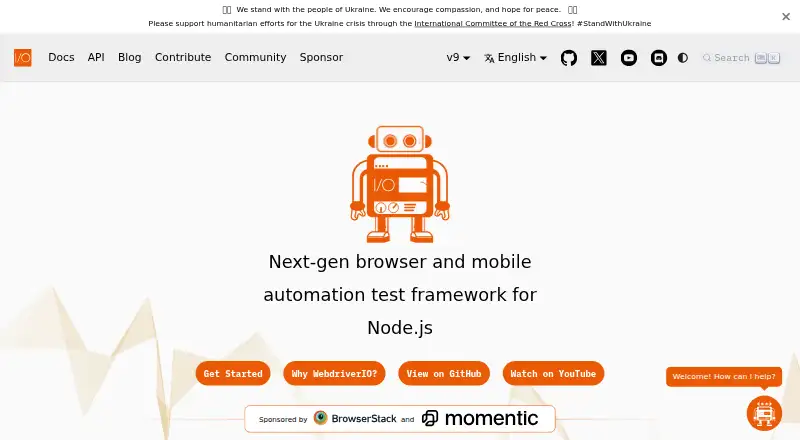
What WebdriverIO is
WebdriverIO is a free browser and mobile automation test framework for Node.js. It supports end-to-end tests as well as unit or component tests in real browsers and on mobile devices, using WebDriver and WebDriver BiDi. Through Appium, it can test native and hybrid mobile apps on emulators, simulators, or real devices, as well as smart TVs and other IoT devices. The framework waits for elements to appear before interacting with them. Its runner has built-in support for Mocha, Jasmine, and Cucumber.js, while the browser runner offers component-testing presets for Vue, Svelte, Solid, React, Preact, and Stencil. The CLI lists services including Sauce Labs, BrowserStack, TestingBot, Appium, LambdaTest, and Docker. WebdriverIO can also automate native desktop apps, including those built with Electron.js, and its homepage describes a Lighthouse service for PWA checks and frontend performance metrics. It requires Node.js 18.20.0 or higher. The project is open source and community-governed as part of the OpenJS Foundation. Its security guidance warns that Appium plugins or cloud-provider logging proxies may expose sensitive values despite masking.
Who it suits
WebdriverIO suits developers building browser, mobile, or component tests in Node.js. It may also fit teams automating native desktop apps or connecting tests to listed cloud services.
What it does well
- Supports WebDriver and WebDriver BiDi.
- Automatically waits for elements before interacting.
- Built-in support for three test frameworks.
- Tests native and hybrid apps through Appium.
- Free and open source.
What to know first
- Requires Node.js 18.20.0 or higher.
- Masking may be bypassed by plugins or logging proxies.
- getValue is not supported for masking.
Limits
WebdriverIO requires Node.js 18.20.0 or higher. Its security guidance says masking may be bypassed by Appium plugins or cloud-provider HTTP logging proxies, and getValue is not supported for masking.
Plans
| Plan | Billed and limits | Price |
|---|---|---|
| WebdriverIO | Open source automation framework · Node.js required | Free |
As webdriver.io lists them, read 30 Sept 2026. The maker's own page has the final word.
Getting started
- Visit the WebdriverIO website.
- Install or select Node.js 18.20.0 or higher.
- Add a listed service such as Appium, Sauce Labs, BrowserStack, TestingBot, LambdaTest, or Docker if needed.
- For native and hybrid mobile app testing, use Appium with an emulator, simulator, or real device.
Overview
WebdriverIO is a code-first automation framework for developers building and maintaining browser, mobile, and desktop tests. It suits teams comfortable with Node.js that want end-to-end and component testing across web and device targets. Standards-based browser automation and Appium mobile coverage make it versatile, but the Node.js requirement and limits on masking sensitive values call for care.
It is an open-source project with community governance under the OpenJS Foundation. Tests are authored in code, and a self-hosted runner is supported. WebdriverIO requires Node.js 18.20.0 or later and officially supports releases that are, or are expected to become, LTS releases. Find it among Browser Automation Tools, End-to-End Testing Software, GUI Testing Software and Functional Testing Software.
Key features
Browser and component testing
WebdriverIO automates browsers using WebDriver and WebDriver BiDi, providing a standards-based approach to cross-browser tests. Its scope includes end-to-end testing and unit or component tests in real browsers. Automatic waits for elements to appear reduce the timing logic developers need to write around interactions.
The test runner has built-in support for Mocha, Jasmine and Cucumber.js. For component work, the browser runner supplies presets for Vue, Svelte, Solid, React, Preact and Stencil. A Lighthouse service can check PWA validity and capture frontend performance metrics, extending the framework beyond interaction checks.
Device automation and integrations
Through Appium, WebdriverIO can automate native and hybrid mobile apps on emulators, simulators and real devices. The project also describes support for smart TVs and other IoT devices, and for native desktop apps, including those built with Electron.js. This breadth is useful for teams that want a common automation framework across several targets, though it does not remove the Node.js and Appium setup requirements.
The CLI lists services for Sauce Labs, BrowserStack, TestingBot, Appium, LambdaTest and Docker. That gives teams multiple integration routes, while the project directs users to its Discord server for support.
Security considerations
WebdriverIO recommends securely storing keys and passwords and masking sensitive values in logs and reports. Masking is not a guarantee: Appium plugins or cloud-provider HTTP logging proxies may bypass it, and getValue is not supported for masking. Teams handling credentials or other sensitive test data should account for these limitations in their test design and logging controls.
Pricing
WebdriverIO is free: its WebdriverIO plan costs nothing and provides an open-source automation framework. There is no free trial because the framework is already available at no charge. The trade-off is that this is a code-authored framework requiring Node.js, rather than a low-code testing product.
Platforms
WebdriverIO supports Android, iOS, Linux, macOS, Windows and web, as well as an extension platform. Its documented automation spans browsers, mobile devices and native desktop apps; mobile coverage includes emulators, simulators and real devices through Appium. A self-hosted runner is supported.
Who it's for
WebdriverIO is a strong fit for developers and QA teams with Node.js experience who need browser automation alongside mobile or component tests, and who value standards-based protocols and a self-hosted option. It is a less suitable choice for teams seeking GUI-based test authoring, those unable to meet the Node.js requirement, or projects that need masking alone to protect sensitive values across every logging path.
Pros and cons
- Pros: WebDriver and WebDriver BiDi support provide a standards-based foundation for browser automation.
- Pros: Appium extends automation to native and hybrid mobile apps, real devices, smart TVs and other IoT devices.
- Pros: Built-in runner support for Mocha, Jasmine and Cucumber.js, plus presets for six component frameworks, serves varied test setups.
- Pros: The open-source framework is free and supports a self-hosted runner.
- Cons: Node.js 18.20.0 or later is required, which rules it out for teams that cannot support that runtime.
- Cons: Masking has documented gaps, including Appium plugins, cloud-provider HTTP logging proxies and getValue.
Alternatives
Choose Katalon Studio if you want a product described as offering both low-code and full-code authoring, with web, mobile and desktop coverage.
Maestro is another option: its free Local plan runs on your own devices and includes its MCP, Viewer, Studio and CLI tools.
testRigor may suit teams considering a public open-source plan, where tests and results are public.
Consider Autify if its Aximo Individual User plan fits: it includes 2,000 one-time credits that do not expire, with concurrency of one web and one mobile.
Detox is a free, MIT-licensed open-source framework for readers comparing another no-cost option.
Nightwatch is a free open-source alternative that says there are no paywalls and everything works for everyone.
Cypress is worth considering if a capped free plan is preferable: Starter includes 10 users, 500 test results per month, 100 prompt executions per month and 30-day access to paid features.
Percy may suit screenshot-focused needs: its free plan allows 5,000 screenshots per month, with unlimited users and projects.
Verdict
Choose WebdriverIO if your team can work in Node.js and wants one free, code-first framework for standards-based browser automation with Appium mobile coverage and component testing. Look elsewhere if you need GUI-led authoring, cannot meet its runtime requirement, or require masking to reliably cover every sensitive value and logging path.
Verdict
WebdriverIO spans browser, mobile, component, and desktop automation within a Node.js framework. Its Node.js requirement and documented masking limitations are important considerations for setup and sensitive test data.
Questions
How much does WebdriverIO cost?
WebdriverIO is free. Its listed plan is free.
Is WebdriverIO open source?
Yes. It is an open-source project with community governance and is part of the OpenJS Foundation.
What does WebdriverIO test?
It supports end-to-end, unit, and component tests in browsers or on mobile devices. It can also automate native desktop apps, including Electron.js apps.
Can it test mobile apps?
Yes. Through Appium, it can automate native and hybrid mobile apps on emulators, simulators, or real devices, as well as smart TVs and other IoT devices.
What does WebdriverIO require?
It requires Node.js 18.20.0 or higher and officially supports Node.js releases that are or will become LTS releases.
What integrations and test runners does it support?
Its test runner has built-in support for Mocha, Jasmine, and Cucumber.js. Its CLI lists services including Sauce Labs, BrowserStack, TestingBot, Appium, LambdaTest, and Docker.
Facts from WebdriverIO's own pages
- Automation standards
- It supports automation through the WebDriver and WebDriver BiDi standards. · webdriver.io, 30 Sept 2026
- Auto-wait
- WebdriverIO automatically waits for elements to appear before interacting with them. · webdriver.io, 30 Sept 2026
- Component testing
- The browser runner offers presets for Vue, Svelte, Solid, React, Preact, and Stencil. · webdriver.io, 30 Sept 2026
- Desktop support
- The project describes using WebdriverIO to automate native desktop apps, including apps built with Electron.js. · webdriver.io, 30 Sept 2026
- Developer tools
- The homepage describes a Lighthouse service for checking PWA validity and capturing frontend performance metrics. · webdriver.io, 30 Sept 2026
- Governance
- WebdriverIO describes itself as an open-source project with community governance that is part of the OpenJS Foundation. · webdriver.io, 30 Sept 2026
- Integrations
- The CLI lists services including Sauce Labs, BrowserStack, TestingBot, Appium, LambdaTest, and Docker. · webdriver.io, 30 Sept 2026
- Mobile support
- WebdriverIO can automate native and hybrid mobile apps on emulators, simulators, or real devices through Appium. · webdriver.io, 30 Sept 2026
- Mobile testing
- It supports native mobile testing through Appium on real devices, smart TVs, or other IoT devices. · webdriver.io, 30 Sept 2026
- Purpose
- WebdriverIO is a browser and mobile automation test framework for Node.js. · webdriver.io, 30 Sept 2026
- Requirements
- WebdriverIO requires Node.js 18.20.0 or higher, and officially supports Node.js releases that are or will become LTS releases. · webdriver.io, 30 Sept 2026
- Security
- The security guidance recommends storing keys and passwords securely and masking sensitive values in logs and reports; it also describes limitations, including possible leaks from Appium plugins or cloud-provider HTTP logging. · webdriver.io, 30 Sept 2026
- Security limitation
- The security guide says masking may be bypassed by Appium plugins or cloud-provider HTTP logging proxies, and getValue is not supported for masking. · webdriver.io, 30 Sept 2026
- Support
- The project points users to its Discord support server for help. · webdriver.io, 30 Sept 2026
- Test frameworks
- The test runner has built-in support for Mocha, Jasmine, and Cucumber.js. · webdriver.io, 30 Sept 2026
- Test types
- It supports end-to-end tests and unit or component tests in a real browser or on a mobile device. · webdriver.io, 30 Sept 2026
- Web standards
- It supports the WebDriver and WebDriver BiDi protocols for cross-browser automation. · webdriver.io, 30 Sept 2026
Where WebdriverIO stands on Freedom251
- Functional Testing Software#17 of 38
- End-to-End Testing Software#17 of 29
- Regression Testing Software#17 of 29
- GUI Testing Software#20 of 34
- Browser Automation Tools#40 of 63
- Testing And Qa#21 of 33
- Automated Testing#23 of 34