Freedom251 › Revenue Planning Software

Clive
What Clive is
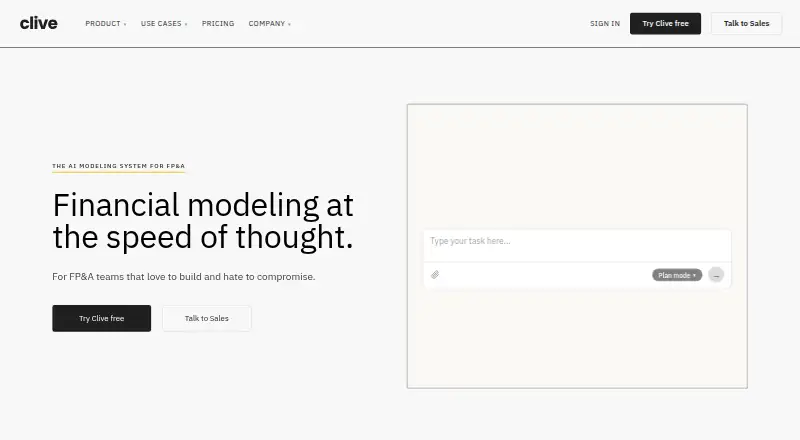
Clive is an AI modeling system for FP&A teams to build financial models, reports, and views. Users can describe a model or report in plain language, then edit the modeling blocks its AI co-builder assembles. Clive says its calculation engine returns the same answer for the same inputs. Finance and business teams can collaborate through real-time editing, comments, notifications, and version history, and build financial forecasts or scenario plans across segment, rep type, team, territory, account, industry, location, and region.
Clive connects to ERP, HRIS, CRM, data, and BI systems, along with Excel, Google Sheets, and CSV. Its integrations page lists more than 50 native connectors. Teams can schedule data pulls or refresh integrations on demand and monitor their status. A public API and MCP access support querying live model data and taking supported actions through connected tools.
The service is available on the web and by API. Plans include a free 1-week trial with monthly AI and compute credits, and paid plans from $224/mo (annual). Clive says customer data is encrypted in transit and at rest, hosted in AWS facilities in the USA, and excluded from partner and third-party use, including model training. Customers can configure retention; data is purged after contract termination. Clive is headquartered in New York, New York, United States.
Who it suits
Clive suits finance and business teams that build financial models, reports, views, forecasts, or scenarios together. Its plans address solo modelers, teams, and large organizations, with integrations for a range of business systems and spreadsheets.
What it does well
- Plain-language prompts produce editable modeling blocks.
- The engine returns consistent calculations for identical inputs.
- Real-time editing, comments, notifications, and version history support collaboration.
- More than 50 native connectors are listed.
- Scheduled or on-demand data refreshes include status monitoring.
- Customer data is encrypted in transit and at rest.
What to know first
- Starter begins at $224/mo (annual).
- The Free plan is a 1-week trial with 25 AI credits and 100 compute credits per month.
- Enterprise pricing is custom and not listed.
Limits
The Free plan lasts 1 week and includes 25 AI credits and 100 compute credits per month. Starter, the lowest listed paid plan, costs $224 a month billed annually and includes 100 AI credits and 2,000 compute credits per month.
Plans
| Plan | Billed and limits | Price |
|---|---|---|
| Free | one week · 25 AI credits/mo · 100 compute credits/mo · unlimited users and models · AI and MCP · multiplayer editing | Free |
| Professional | billed annually · 1,200 AI credits/mo · 25,000 compute credits/mo · SOC 2 report · custom LLMs · priority support | $2,000 a month |
| Starter | billed annually · 100 AI credits/mo · 2,000 compute credits/mo · unlimited users and models · AI and MCP · multiplayer editing | $224 a month |
| Growth | billed annually · 500 AI credits/mo · 10,000 compute credits/mo · SOC 2 report · unlimited users and models · AI and MCP | $960 a month |
| Enterprise | custom pricing · custom AI and compute credits · SOC 2 report · custom LLMs · premium support · SSO · public API | On request |
As cliveapp.ai lists them, read 14 Oct 2026. The maker's own page has the final word.
Getting started
- Open the Clive website.
- Start with the Free plan's 1-week trial, or choose a paid plan.
- Use the web service or access it through the API.
- Connect relevant business systems, spreadsheets, or CSV data.
- Describe a model or report in plain language to create editable modeling blocks.
Clive is an AI-assisted financial modeling workspace for finance and business teams building forecasts, reports, and scenarios. It is strongest for teams that need shared models connected to business data and sliced across multiple dimensions. The trade-off is a small free allowance and a substantial annual commitment for sustained use.
Overview
Clive combines a plain-language AI co-builder with a deterministic calculation engine: the AI assembles editable modeling blocks, while the engine returns the same result for the same inputs. That division makes AI useful for getting a model started without making the math itself variable. Financial forecasting and scenario planning are supported, with forecasts organized by segment, rep type, team, territory, account, industry, location, and region. This range suits teams that need to examine a plan through several business lenses; it may be more structure than a solo modeler needs.
Key features
Modeling and collaboration
Users can describe a model or report in plain language and then edit the blocks the co-builder creates. This can shorten setup while keeping the resulting model editable. Real-time multiplayer editing, comments, notifications, and version history support teams reviewing and revising shared forecasts; those features matter less to someone working alone.
Data connections and access
Clive says it has more than 50 native connectors across ERP, HRIS, CRM, data, and BI systems, alongside Excel, Google Sheets, and CSV. Teams can schedule integration pulls, refresh on demand, and monitor connection status. That combination is useful when forecasts depend on regularly updated operating data, though the value depends on the systems a team needs to connect.
A public API and MCP access support querying live model data and performing supported actions from connected tools. CRM data sync is also supported. This gives teams ways to bring model outputs into connected workflows, rather than limiting access to the modeling workspace.
Security and data handling
Clive states it holds a SOC 2 Type II attestation and continuously monitors more than 140 controls with Drata. Customer data is encrypted at rest and in transit, hosted in AWS facilities in the USA, and may not be used by partners or third parties for any purpose, including model training. Customers can configure retention, and data is purged after contract termination. These controls will matter to teams evaluating where financial data is hosted and how it is handled.
Pricing
The Free plan costs nothing and runs as a 1-week trial. It includes 25 AI credits per month and 100 compute credits per month. That is a useful short evaluation, but the limited monthly quotas make it a poor fit for ongoing modeling work.
Starter costs $224.00 per month, billed annually, and includes 100 AI credits per month, 2,000 compute credits per month, unlimited users, and unlimited models. It is the entry point for a team that needs continuing access and shared models, but the annual billing commitment and credit caps are important constraints. Growth costs $960.00 per month, billed annually, and raises the allowances to 500 AI credits and 10,000 compute credits per month; it also includes the SOC 2 report. It is a better fit for teams whose usage exceeds Starter’s quotas or that need the report.
Professional costs $2,000.00 per month, billed annually, with 1,200 AI credits and 25,000 compute credits per month, custom LLMs, and priority support. It targets heavier users needing those specific options, but is a major price step from Growth. Enterprise has custom pricing and offers custom AI and compute credits, SSO, a public API, and premium support, for organizations needing tailored capacity or those controls.
Platforms
Clive is available on the web and through an API. The API and MCP access can serve connected tools querying live model data or taking supported actions.
Who it's for
Clive is best suited to finance and business teams coordinating forecasts, scenarios, and reports across business dimensions, especially where integrations and collaborative editing are useful. Solo modelers can try the Free plan, but should consider whether its short trial and limited credits are enough to assess their needs before committing annually. Teams seeking a lightweight tool without broad integrations or collaboration may not need Clive’s wider workspace.
Pros and cons
- Pros: Editable AI-generated modeling blocks provide a natural-language starting point without surrendering control of the model.
- Pros: Deterministic calculations, scenario planning, and multiple forecast dimensions support repeatable, multi-angle planning.
- Pros: More than 50 native connectors, scheduled or on-demand refreshes, and collaboration tools suit shared models built on changing business data.
- Cons: The Free plan is a 1-week trial with low monthly AI and compute credits, limiting its usefulness beyond evaluation.
- Cons: Starter begins at $224.00 per month billed annually, while higher plans rise to $960.00 and $2,000.00 per month, making sustained use a significant commitment.
- Cons: Monthly credit quotas remain on the paid plans, so teams need to match their usage to the plan allowance.
Alternatives
For a broader category comparison, see Revenue Planning Software.
- Predict.ai is worth considering if a forever-free plan is more important than Clive’s finance modeling focus: its free tier includes 500 credits per month, one workspace, one seat, one goal per workspace, one shared deployment, and 1 GB of ingestion per month.
- Salesforce Sales Cloud is an alternative for readers comparing a freemium product with a free suite and a $25.00 per month Starter Suite billed monthly per user.
- ORAGO Planning is another paid planning option with API, self-hosted, web, and Windows platforms.
- Fintastic may suit organizations looking for an enterprise subscription with unlimited users and data and support included; pricing is custom.
- Kepion is another paid option, with product information and a demo available through sales.
- ModusCPG Scout is a paid web option for readers willing to book a demo for pricing.
- Pyplan Quota Planning is an alternative for teams comparing a planning product with plans that describe administrator, creator, and collaborator limits.
- Workday Adaptive Planning may be preferable for organizations seeking broad platform coverage, including mobile and desktop, and a 30-day free trial.
Verdict
Choose Clive if your finance or business team needs collaborative, connected forecasting and scenario planning, with editable AI-assisted model building and predictable calculations. Its integration and collaboration breadth are persuasive for shared planning work. Look elsewhere if a short trial and capped credits are not enough to establish fit, or if the annual entry price does not suit your budget.
Verdict
Choose Clive if your finance or business team needs collaborative modeling, forecasting, and scenario planning across multiple business dimensions. The free plan provides a brief trial with limited monthly credits; teams needing more capacity can consider paid plans starting at $224/mo (annual).
Questions
Is there a free plan?
Yes. The Free plan is a 1-week trial with 25 AI credits and 100 compute credits per month.
What does Clive cost?
Starter is $224 a month billed annually. Growth is $960 a month billed annually, and Professional is $2,000 a month billed annually. Enterprise pricing is custom.
What platforms does it support?
Clive is available on the web and by API.
What can it connect to?
Its integrations include ERP, HRIS, CRM, data and BI systems, Excel, Google Sheets, and CSV. The integrations page lists more than 50 native connectors.
Who makes Clive, and where is it based?
Clive is headquartered in New York, New York, United States.
Does Clive support scenario planning and forecasting?
Yes. It offers scenario planning and financial forecasting, with dimensions including segment, team, territory, account, industry, location, and region.
Facts from Clive's own pages
- AI co-builder
- Its AI co-builder accepts plain-language requests, assembles editable model blocks, analyzes data, builds reports and creates visualizations. · cliveapp.ai, 14 Oct 2026
- AI data use
- Clive states that partners and third parties are not allowed to use customer data for purposes such as model training. · cliveapp.ai, 14 Oct 2026
- AI privacy
- Clive says partners and third parties may not use customer data for any purpose, including model training. · cliveapp.ai, 7 Oct 2026
- API
- The public API is described as RESTful and supports create, update and delete actions, including record writes such as POST /v1/records. · cliveapp.ai, 14 Oct 2026
- API and MCP
- Clive offers a public API and MCP access for querying live model data and performing supported actions from connected tools. · cliveapp.ai, 7 Oct 2026
- API documentation
- The API page says developer documentation is available, but no public SDK names are listed there. · cliveapp.ai, 14 Oct 2026
- Audience
- Clive describes itself as designed for finance and business teams, with plans aimed at solo modelers, teams, and large organizations. · cliveapp.ai, 7 Oct 2026
- Auditability
- Clive provides version history, activity logs, undo and rollback so users can trace and reverse model changes. · cliveapp.ai, 14 Oct 2026
- Collaboration
- Clive supports real-time multiplayer editing, comments, notifications, and version history. · cliveapp.ai, 7 Oct 2026
- Company origin
- The same TechCrunch report says the founding team began developing the predecessor Vareto platform in 2020. · techcrunch.com, 14 Oct 2026
- Connector count
- Clive advertises more than 50 native connectors with scheduled synchronization, on-demand refresh and self-managed connection monitoring. · cliveapp.ai, 14 Oct 2026
- Data protection
- Customer data is encrypted at rest and in transit, and Clive says customer data is hosted in AWS facilities in the USA. · cliveapp.ai, 7 Oct 2026
- Data retention
- Customers can configure retention duration, and Clive says customer data is purged after contract termination. · cliveapp.ai, 14 Oct 2026
- Deterministic calculations
- Clive says its modeling math is computed by its engine, so the same inputs return the same answer. · cliveapp.ai, 7 Oct 2026
- Deterministic modeling
- The product uses records, variables, dimensions, mappings, metrics and scenarios as reusable modeling blocks whose calculations are intended to remain deterministic. · cliveapp.ai, 14 Oct 2026
- File and document capture
- Users can upload spreadsheets, PDFs, screenshots and other files for AI-assisted cleaning, mapping and structuring, and can create documents inside Clive. · cliveapp.ai, 14 Oct 2026
- Funding
- TechCrunch reported in October 2021 that the predecessor company Vareto had raised $24 million, including a $20 million GV Series A and a $4.2 million Menlo seed round. · techcrunch.com, 14 Oct 2026
- Gartner review praise
- A Gartner reviewer said onboarding was quick, with general-ledger mapping and an initial budget-versus-actuals import completed after a few meetings (Vareto listing). · gartner.com, 14 Oct 2026
- Headquarters
- TechCrunch described predecessor Vareto as Mountain View-based. · techcrunch.com, 14 Oct 2026
- Integrations
- Named connectors include Workday, NetSuite, SAP, Epicor, QuickBooks, BambooHR, Rippling, ADP, Paylocity, Salesforce, HubSpot, Snowflake, IBM, Excel, Google Sheets and CSV. · cliveapp.ai, 14 Oct 2026
- Legal entity
- The customer agreement identifies Clive, Inc. as a Delaware corporation. · cliveapp.ai, 14 Oct 2026
- Limit: connector gaps
- G2 reviewers reported that some HRIS systems lacked native configuration, requiring periodic CSV uploads (Vareto listing). · g2.com, 14 Oct 2026
- Limit: implementation complexity
- A G2 reviewer reported that the backend is complicated and may require vendor support for a successful implementation (Vareto listing). · g2.com, 14 Oct 2026
- Limit: planning maturity
- A G2 reviewer said the planning module needed further development relative to reporting capabilities (Vareto listing). · g2.com, 14 Oct 2026
Where Clive stands on Freedom251
- Revenue Planning Software#4 of 26
- Sales Capacity Planning Software#4 of 18