Freedom251 › Nintendo 3DS Emulators
Citra MMJ
What Citra MMJ is
Citra MMJ is a free, experimental open-source Nintendo 3DS emulator and debugger written in C++. It emulates part of the console's hardware and can run or debug homebrew applications. The project README also says it can run many commercial games, though some may not reach a playable state; its compatibility list treats “Okay” or better as playable.
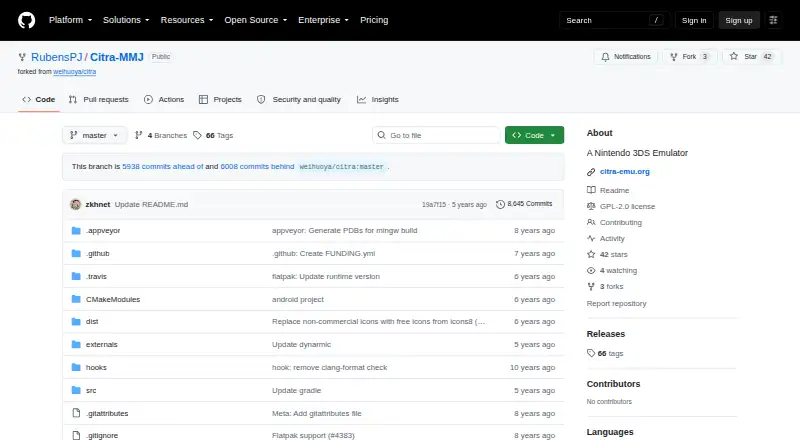
The README names Windows, Linux, and macOS as platforms with actively maintained builds. Citra MMJ is a public fork of weihuoya/citra, and the project is licensed under GPLv2 or any later version. Its README says most development takes place on GitHub. The repository has no releases, which matters to users looking for packaged releases there. For help, the project points users to an asking-for-help guide and directs developers to Discord or the citra-dev channel on freenode. Interface translation work is coordinated through Transifex and periodically upstreamed. The project says it accepts monetary donations and donated games or hardware to support development and infrastructure.
Who it suits
Citra MMJ may suit people looking to run or debug Nintendo 3DS homebrew on Windows, Linux, or macOS. Its stated support for some commercial games may also interest players willing to check compatibility.
What it does well
- Free and open source under GPLv2 or later
- Runs or debugs homebrew applications
- Actively maintained builds named for Windows, Linux, and macOS
- README says many commercial games can run
What to know first
- Some commercial games may not reach a playable state
- Repository has no releases
Limits
The emulator covers a subset of Nintendo 3DS hardware, and some commercial games may not reach a playable state. The repository’s Releases page has no releases.
Plans
| Plan | Billed and limits | Price |
|---|---|---|
| Free | Open-source Nintendo 3DS emulator; the repository has no releases | Free |
As github.com lists them, read 4 Oct 2026. The maker's own page has the final word.
Getting started
- Visit the project repository at https://github.com/RubensPJ/Citra-MMJ.
- Use a Windows, Linux or macOS platform.
- Consult the README’s asking-for-help guide if you need support.
Citra MMJ is an experimental, open-source Nintendo 3DS emulator and debugger for desktop computers. It suits developers and homebrew users who need to run or inspect 3DS software, as well as players willing to check compatibility title by title. Its free GPL licensing and three desktop builds are strong advantages, while uneven commercial-game results and the absence of packaged releases make it a poor choice for users seeking a turnkey library.
Overview
Citra MMJ emulates a subset of Nintendo 3DS hardware, so it is best understood as an experimental compatibility layer rather than a complete console replacement. Homebrew applications are an explicit use case: developers can run and debug their own software while investigating how it behaves. The same tooling can launch many commercial games, but some do not reach a playable state. The project treats “playable” as at least an “Okay” result on its compatibility list, making game-by-game checking essential before relying on it.
The emulator is written in C++ and licensed under GPLv2 or any later version. GitHub identifies RubensPJ/Citra-MMJ as a public fork of weihuoya/citra. Development is centered on GitHub, with a central repository linked for contributors. Users are directed to an asking-for-help guide; developers can use Discord or the citra-dev channel on freenode. Interface translation is coordinated through Transifex and periodically upstreamed. Contributions of money, games and hardware support development and infrastructure.
Key features
Homebrew execution and debugging
Running and debugging homebrew is Citra MMJ’s clearest strength. It is a sensible tool for 3DS developers, researchers and enthusiasts who value inspection and iteration over guaranteed commercial-game support.
Experimental commercial-game emulation
Many commercial titles can run, but compatibility is not uniform and some remain below a playable state. That makes the emulator attractive for selective experimentation, not for assuming that an entire physical or digital collection will work.
Open development and translation
GPL licensing permits use and modification under the license terms, while GitHub-based development and an upstream translation workflow give technically inclined users clear avenues to participate. These strengths matter more to contributors than to someone who simply wants a finished consumer application.
Pricing
Citra MMJ has one plan: Free at free. It is an open-source Nintendo 3DS emulator, with no paid tier or free trial. The free plan removes a financial barrier for developers and players, but price does not solve compatibility limitations, and the repository has no releases. Users should be prepared to obtain and build the software through the project rather than expecting a packaged release channel.
Platforms
Actively maintained builds are named for Windows, Linux and macOS. This desktop-only coverage fits users who already work on one of those operating systems and want a common emulator project across them. It does not serve people looking for an Android or iOS installation.
Who it's for
Citra MMJ is a good match for homebrew creators, emulator developers and technically confident 3DS enthusiasts who can evaluate compatibility per game. Its debugging focus and GPL license also suit people who want to study or modify an emulator. Choose another option if your priority is a polished, packaged installation, broad guaranteed commercial compatibility or mobile support.
Pros and cons
- Pros: Free, so experimentation costs nothing.
- Pros: Homebrew can be run and debugged, giving developers a practical 3DS workflow.
- Pros: Windows, Linux and macOS builds cover the major desktop operating systems.
- Pros: GPLv2-or-later licensing and GitHub-centered development support modification and contribution.
- Cons: It emulates only a subset of 3DS hardware, so behavior is not a full-console guarantee.
- Cons: Some commercial games never become playable, requiring compatibility checks before use.
- Cons: No repository releases are provided, which is inconvenient for users who want ready-made packages.
Alternatives
For a wider survey of systems, see Nintendo 3DS Emulators.
- Virtual Jaguar is free across desktop, mobile and web platforms, but requires a libretro frontend such as RetroArch.
- 3Beans is another free emulator option for Android, iOS, Linux, macOS and Windows.
- Choose Azahar for a free, open-source 3DS emulator with Android and iOS support in addition to desktop platforms.
- Panda3DS is a free open-source alternative whose official builds are not private or sponsor-limited.
- AzaharPlus is a free GPL-2.0 3DS emulator fork for Android, Linux and Windows.
- LunaDS targets iOS and macOS with a no-paywall free tier and optional 2.00 USD one-time supporter or donation purchases.
- Manic EMU is a free iOS and macOS option with a sideload plan and defined limits on fast-forward, save states and cheats.
- CitraVR is a free GPL-licensed beta for Meta Quest 2, Quest Pro, Quest 3 and Quest 3S.
Verdict
Choose Citra MMJ if you want a free desktop emulator with explicit homebrew debugging and the freedom of GPL-licensed code. Look elsewhere if dependable commercial-game play, mobile access or a ready-to-install release matters more than an experimental, developer-oriented workflow.
Verdict
Citra MMJ offers 3DS emulation and debugging, with homebrew use explicitly supported and commercial-game compatibility varying. The repository lists no releases, so it does not provide packaged releases there.
Questions
Is Citra MMJ free?
Yes. It is listed as free, and its license is GPLv2 or any later version.
Which platforms does it support?
The README names Windows, Linux and macOS as platforms with actively maintained builds.
Can it run commercial games?
The README says it can run many commercial games, although some do not reach a playable state.
Can it run homebrew applications?
Yes. It can run or debug homebrew applications.
Where can I find releases?
The repository’s Releases page states that it has no releases.
Facts from Citra MMJ's own pages
- Build platforms
- The README names Windows, Linux, and macOS as platforms with actively maintained builds. · github.com, 4 Oct 2026
- Commercial use cases
- The README says the emulator is useful for running and debugging homebrew applications. · github.com, 4 Oct 2026
- Compatibility
- The README defines playable compatibility as at least “Okay” on its game compatibility list. · github.com, 4 Oct 2026
- Contributions
- The README says monetary donations and donated games or hardware are accepted to support development and infrastructure. · github.com, 4 Oct 2026
- Development
- The README says most development happens on GitHub and links to a central repository. · github.com, 4 Oct 2026
- Emulation
- It emulates a subset of 3DS hardware and can run homebrew applications and many commercial games, though some may not reach a playable state. · github.com, 4 Oct 2026
- Game compatibility
- The README says it can run many commercial games, while noting some do not reach a playable state. · github.com, 4 Oct 2026
- Hardware coverage
- It emulates a subset of Nintendo 3DS hardware and can run or debug homebrew applications. · github.com, 4 Oct 2026
- Language
- The emulator is written in C++. · github.com, 4 Oct 2026
- License
- The README states that Citra is licensed under GPLv2 or any later version. · github.com, 4 Oct 2026
- Platforms
- The repository says builds are actively maintained for Windows, Linux, and macOS. · github.com, 4 Oct 2026
- Product
- The repository describes Citra as an experimental open-source Nintendo 3DS emulator and debugger written in C++. · github.com, 4 Oct 2026
- Release availability
- The repository’s Releases page states that it has no releases. · github.com, 4 Oct 2026
- Repository status
- GitHub identifies RubensPJ/Citra-MMJ as a public fork of weihuoya/citra. · github.com, 4 Oct 2026
- Support
- The README directs users seeking help to an asking-for-help guide and points developers to Discord or the citra-dev channel on freenode. · github.com, 4 Oct 2026
- Translation
- The README says interface translation work is coordinated through Transifex and periodically upstreamed. · github.com, 4 Oct 2026
- Translations
- The README says user-interface translation work is centralized on Transifex and periodically upstreamed. · github.com, 4 Oct 2026
Where Citra MMJ stands on Freedom251
- Nintendo 3DS Emulators#5 of 14