Freedom251 › Virtual Lab Software
ChemCollective Virtual Lab
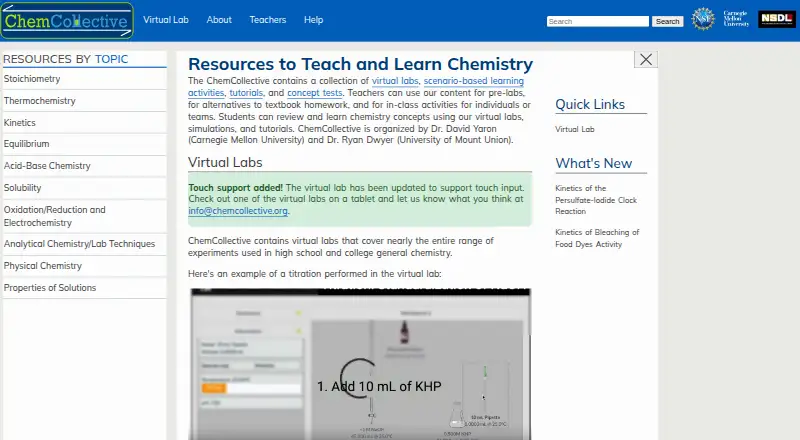
What ChemCollective Virtual Lab is
ChemCollective Virtual Lab is an online chemistry simulation that links chemical calculations with lab-style experiments. Students and educators can use its web activities immediately without licensing requirements. The lab provides hundreds of standard aqueous reagents for work in areas including acid-base chemistry, thermochemistry, solubility and redox chemistry. Teachers can use prepared virtual lab problems, tutorials, real-world scenarios, courses, visualizations, simulations and concept tests. Some lab activities vary the unknowns and automatically check answers, with hints and feedback available. Free classroom pages collect activity links, custom instructions and handouts, and track attempts on autograded problems. Instructors can modify activities or request custom classroom materials. The project is aimed at high school and college students and supports aqueous reactions. Downloadable Windows and Mac versions are also offered, though Java may be needed to run them. The Virtual Lab is free for educators and students. The site and its contents are licensed under Creative Commons Attribution 3.0 NonCommercial-NoDerivs.
Who it suits
The Virtual Lab suits high school and college chemistry students and educators who want browser-based activities or classroom materials. Teachers can use its autograded problems and classroom pages, while the current lab scope is aqueous reactions.
What it does well
- Web activities require no licensing.
- Includes hundreds of standard aqueous reagents.
- Autograded activities offer hints and feedback.
- Free classroom pages track problem attempts.
- Instructors can modify or request activities.
What to know first
- The Virtual Lab currently supports aqueous reactions.
- Downloaded Windows and Mac versions may require Java.
- Site content uses a NonCommercial-NoDerivs license.
Limits
The Virtual Lab currently supports aqueous reactions. Downloadable versions for Windows and Mac may require Java.
Plans
| Plan | Billed and limits | Price |
|---|---|---|
| ChemCollective Virtual Lab | Free to install, use, and distribute · free for educators and students | Free |
| Free access | free of charge · web activities · Windows and Mac downloads · educator and student use | Free |
As chemcollective.org lists them, read 29 Sept 2026. The maker's own page has the final word.
Getting started
- Open the ChemCollective website.
- Use the web activities without licensing requirements.
- Choose a prepared problem, tutorial, course or other teaching activity.
- Create a free custom classroom page to share activities, instructions and handouts.
- Download the Windows or Mac version if you want offline access; Java may be required.
Overview
ChemCollective Virtual Lab is a chemistry simulation for learners who want to work through lab-style problems alongside chemical computations. It is best suited to high school and college teaching, where its aqueous experiments and classroom activities can support core chemistry topics.
Its browser activities and classroom tools make it a practical free option for structured instruction. The main constraint is scope: it handles aqueous reactions, not chemistry beyond them.
Key features
The lab provides hundreds of standard aqueous reagents for experiments in acid-base chemistry, thermochemistry, solubility, and redox chemistry. That gives teachers material across several foundational topics, but courses needing non-aqueous or broader laboratory work will need another tool.
Teachers can use pre-written lab problems, tutorials, courses, visualizations, simulations, real-world scenarios, and concept tests. Autograded activities randomize unknowns and check student answers, with hints and feedback available. This makes assignments more repeatable while giving students guidance on their results.
Free custom classroom pages collect activities behind one link, with tailored instructions and handouts; teachers can also track attempts on autograded problems. Instructors may modify activities or request custom ones, a useful measure of flexibility for classroom use. The instructor guide invites users to contact the team for technical or curriculum support.
Pricing
ChemCollective Virtual Lab: free. It is free to install, use, and distribute, and is free for educators and students. Web activities can be used immediately without licensing requirements; there is no free trial because the product is free.
Platforms
Activities run on the web, and downloadable versions are offered for Windows and Mac; Java may be required for those desktop downloads. The platform listing also includes Android and iOS, though the described classroom activities are web-based.
Who it's for
This is a strong fit for chemistry teachers who want aqueous lab problems, reusable teaching materials, and simple classroom organization without a licensing barrier. Students can use the activities to approach chemistry through problem solving. It is less suitable for learners or courses requiring experiments outside aqueous reactions.
Pros and cons
- Free for educators and students: web activities need no licensing requirements, making classroom access straightforward.
- Useful teaching structure: randomized, autograded problems, hints, feedback, and attempt tracking support assigned work.
- Instructor flexibility: classroom pages, modifiable activities, and custom-activity requests can adapt materials to a course.
- Aqueous-only scope: the lab does not cover reactions beyond aqueous chemistry.
- Desktop caveat: downloaded Windows and Mac versions may require Java.
Alternatives
For a broader directory of options, browse Virtual Lab Software or Chemistry Simulation Software.
Choose Beyond Labz if you want free instructor access to teach, preview, and build assignments, with a one-time Chemistry plan also offered. Molecular Workbench is another free option, described as free and open-source. PraxiLabs may suit someone seeking a time-limited free introduction: its free plan provides one month of access to three simulations, basic real-time guidance, and English and Arabic interfaces.
LabXchange offers free educational resources for learners and educators worldwide, with grant funding supporting the platform. Amrita Virtual Lab offers free access under its Nodal Centre Program, with no registration fee for that program. Inq-ITS has tiered school and district plans priced by student count, including district-wide and multi-year options. VRLab Academy is a paid option with more than 240 experiments, instructor access, learner management, and LMS integration. WebLab-Deusto is an open-source alternative under the BSD 2-Clause license.
Verdict
ChemCollective Virtual Lab is a sound choice for teachers and students who need free, structured practice in aqueous chemistry, particularly when autograded assignments and classroom organization matter. Look elsewhere if your course needs lab simulations beyond aqueous reactions or a wider chemistry scope.
Verdict
ChemCollective Virtual Lab offers a free set of chemistry simulations and classroom resources, including autograded activities. Its scope is aqueous reactions, and downloaded desktop versions may require Java.
Questions
Is ChemCollective Virtual Lab free?
Yes. It is free for educators and students, with no licensing requirements for web activities.
Which platforms are supported?
Activities are available on the web, and downloadable versions are offered for Windows and Mac. Java may be required for the downloads.
What chemistry topics does it cover?
Experiments include acid-base chemistry, thermochemistry, solubility and redox chemistry, using aqueous reagents. The Virtual Lab currently supports aqueous reactions.
Can teachers track student activity?
Free custom classroom pages can track attempts on autograded problems. Those activities can randomize unknowns and provide hints and feedback.
Can instructors adapt the activities?
Yes. Instructors can modify activities or request custom activities for their classrooms.
What license applies to the site and its contents?
The ChemCollective site and its contents use the Creative Commons Attribution 3.0 NonCommercial-NoDerivs license.
Facts from ChemCollective Virtual Lab's own pages
- Audience
- The project aims to help high school and college students approach chemistry more like practicing scientists. · chemcollective.org, 29 Sept 2026
- Autograded problems
- Autograded Virtual Lab activities randomize unknowns and check student answers, with hints and feedback available for results. · chemcollective.org, 29 Sept 2026
- Autograded work
- Automatically graded activities randomize unknown solutions and provide hints and feedback. · chemcollective.org, 15 Oct 2026
- Awards
- ChemCollective received a MERLOT Classic Award in 2003 and a Science SPORE award in 2010. · chemcollective.org, 15 Oct 2026
- Built-in activities
- The software includes more than 50 activities and questions spanning topics such as stoichiometry, pKa, equilibrium and oxidation-reduction. · chemcollective.org, 15 Oct 2026
- Classroom pages
- Teachers can create free classroom pages with custom instructions, handouts and attempt tracking for autograded problems. · chemcollective.org, 15 Oct 2026
- Custom hosting
- An unofficial developer example shows custom labs hosted on GitHub Pages or another static host using HTML and JavaScript. · ryanpdwyer.github.io, 15 Oct 2026
- Customization
- Teachers can configure aqueous simulations, chemicals and which laboratory tools students can use. · chemcollective.org, 15 Oct 2026
- Developer documentation
- The developer page links JSDoc and library usage material, while the underlying lab repository is private and access is by request. · chemcollective.org, 15 Oct 2026
- Documentation
- Official help includes an introductory video, titration walkthrough and feature-by-feature user guide. · chemcollective.org, 15 Oct 2026
- Experiment coverage
- Experiments cover acid-base chemistry, thermochemistry, solubility and redox chemistry. · chemcollective.org, 15 Oct 2026
- Experiments
- It provides hundreds of standard aqueous reagents for experiments across topics including acid-base chemistry, thermochemistry, solubility, and redox chemistry. · chemcollective.org, 29 Sept 2026
- Founded
- 2000 · chemcollective.org, 23 Sept 2026
- Free use
- Educators and students can use the web activities and software without charge or licensing requirements. · chemcollective.org, 15 Oct 2026
- Gas simulation limit
- The user guide states that the Virtual Lab does not currently simulate gases. · chemcollective.org, 15 Oct 2026
- Headquarters
- Carnegie Mellon University lists the project at 5000 Forbes Avenue, Pittsburgh, Pennsylvania. · cmu.edu, 15 Oct 2026
- HTML5 transition
- A 2017 project news item announced an HTML5 Virtual Lab that removed Java for most activities and added spectrophotometer and Excel export support. · chemcollective.org, 15 Oct 2026
- Interface limits
- The guide says there is no Undo function and that the simulated solution temperature cannot exceed 99°C or boil. · chemcollective.org, 15 Oct 2026
- Kinetics
- The site added kinetics functionality, including a persulfate-iodide clock reaction activity. · chemcollective.org, 15 Oct 2026
- Learning evidence
- A Science study reported that virtual-lab homework explained about 24% of course-achievement variance in one lecture study. · researchgate.net, 15 Oct 2026
- Licence
- The site and contents use the Creative Commons Attribution-NonCommercial-NoDerivs 3.0 licence. · chemcollective.org, 15 Oct 2026
- License
- The ChemCollective site and its contents are licensed under Creative Commons Attribution 3.0 NonCommercial-NoDerivs. · chemcollective.org, 29 Sept 2026
- Limit: conceptual difficulty
- The same study found students struggled more with a virtual enthalpy problem than with comparable textbook problems. · researchgate.net, 15 Oct 2026
- Limit: idealized calorimetry
- Chemistry LibreTexts notes that the virtual calorimeter absorbs no heat, making simulated temperature changes higher than in real laboratory equipment. · chem.libretexts.org, 15 Oct 2026
Where ChemCollective Virtual Lab stands on Freedom251
- Virtual Lab Software#3 of 27
- Chemistry Simulation Software#4 of 33