Freedom251 › Virtual Lab Software
Concord Consortium Lab
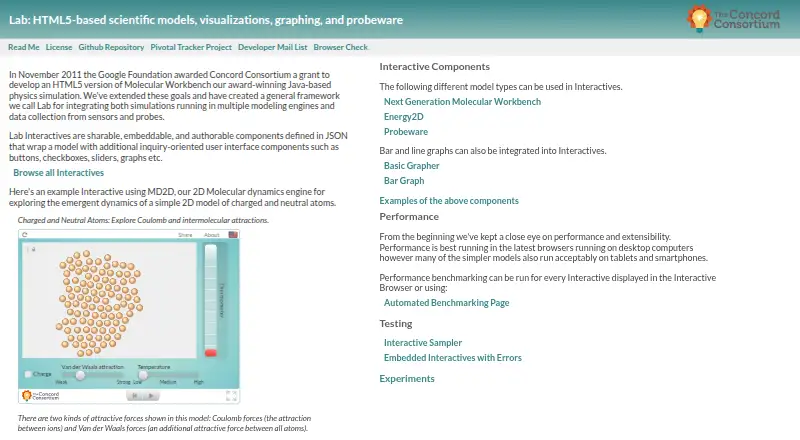
What Concord Consortium Lab is
Concord Consortium Lab is an open-source HTML5 framework for scientific models, visualizations, graphing, and probeware. It combines simulations from multiple modeling engines with data collected from sensors and probes. Authors define Lab Interactives in JSON, wrapping a model with inquiry controls such as buttons, checkboxes, sliders, and graphs. These components can be authored, shared, and embedded; bar and line graphs can be included. Listed model types include Next Generation Molecular Workbench, Energy2D, and Probeware. Lab requires SVG support, and its documentation lists iOS Safari and Chrome for Android among supported browsers. Concord says performance is strongest in the latest desktop browsers, while many simpler models also run acceptably on tablets and smartphones. The framework is distributed under Simplified BSD, MIT, or Apache 2.0 licenses, and downloadable tar.gz and zip archives are available. Locally hosted content must be served from a web server. Concord says student and teacher data are confidential, are not sold, and are not used for targeted advertising. The terms prohibit commercial use and automated access or integration of hosted Services without a separate written agreement; that restriction does not apply to independently deployed software under its license.
Who it suits
Lab suits educators and educational organizations building or using interactive STEM materials with models, graphs, and sensor or probe data. It can also suit developers working with its open-source framework and JSON-defined Interactives.
What it does well
- Open-source framework with multiple listed licenses
- Interactives can be authored, shared, and embedded
- Includes graphing and multiple scientific model types
- Student and teacher data are not sold or targeted for advertising
What to know first
- Requires SVG support
- Best performance is in the latest desktop browsers
- Locally hosted content must be served from a web server
- Hosted service terms restrict commercial use without a written agreement
Limits
The listed facts give no quota or seat limit for the free framework. Hosted Services prohibit commercial use and automated access or integration without a separate written agreement; this restriction does not apply to independently deployed software under its applicable license.
Getting started
- Visit the Lab website.
- Choose web, Android, or iOS access that fits your use.
- For local development, use the repository's development setup instructions.
- Download a tar.gz or zip project archive if you want a project distribution.
- Serve locally hosted content from a web server.
Verdict
Concord Consortium Lab provides a flexible framework for building and sharing model-based scientific interactives, with graphing and probeware support. Browser requirements and hosted-service terms are important considerations for deployment.
Questions
Is Concord Consortium Lab free?
Yes. Its pricing model is free, and a free plan is listed.
Is Lab open source?
Yes. The project is described as open source and is distributed under Simplified BSD, MIT, or Apache 2.0 licenses. The repository includes an MIT License.
Which platforms does Lab support?
The listed platforms are web, Android, and iOS. The framework requires SVG support, and documentation lists iOS Safari and Chrome for Android among supported browsers.
What can authors create with Lab?
Authors can define JSON Interactives that wrap models with inquiry controls such as buttons, checkboxes, sliders, and graphs. Interactives can include bar and line graphs and can be shared or embedded.
Who makes Concord Consortium Lab?
The Concord Consortium, a nonprofit research and development organization focused on advancing STEM inquiry through technology.
Can Lab be hosted locally?
Yes. Downloadable tar.gz and zip archives are described, and locally hosted content must be served from a web server.
Facts from Concord Consortium Lab's own pages
- Audience
- Concord says it provides educational software and resources to educators, schools, school districts, other educational institutions, parents, and guardians. · concord.org, 9 Oct 2026
- Data agreements
- Concord says it routinely enters into school data privacy agreements and follows the Student Data Privacy Consortium's National Data Privacy Agreement framework. · concord.org, 9 Oct 2026
- Download and local hosting
- A project distribution readme describes downloadable tar.gz and zip archives and says local content must be served from a web server. · lab.concord.org, 4 Oct 2026
- Examples
- The site demonstrates a 2D molecular dynamics engine for exploring charged and neutral atoms. · lab.concord.org, 9 Oct 2026
- Founded
- 1994 · lab.concord.org, 28 Sept 2026
- Graphing
- Bar and line graphs can be integrated into Interactives. · lab.concord.org, 9 Oct 2026
- Intended users
- Concord describes its work as creating research-based digital learning tools and STEM resources for students and partnering with publishers, districts, states, and education organizations. · concord.org, 4 Oct 2026
- Interactive authoring
- Lab Interactives are defined in JSON and wrap models with inquiry-oriented controls such as buttons, checkboxes, sliders, and graphs. · lab.concord.org, 4 Oct 2026
- Interactives
- Lab Interactives are sharable, embeddable, authorable JSON components that wrap a model with inquiry-oriented interface elements. · lab.concord.org, 9 Oct 2026
- License
- The Lab Framework repository includes an MIT License granting permission to use, copy, modify, merge, publish, distribute, sublicense, and sell copies subject to its terms. · github.com, 9 Oct 2026
- Licensing
- The Lab project is distributed under Simplified BSD, MIT, or Apache 2.0 licenses. · lab.concord.org, 4 Oct 2026
- Maker
- The Concord Consortium describes itself as a nonprofit research and development organization advancing STEM inquiry through technology. · concord.org, 4 Oct 2026
- Model framework
- Lab integrates simulations running in multiple modeling engines with data collection from sensors and probes. · lab.concord.org, 9 Oct 2026
- Model types
- The site lists Next Generation Molecular Workbench, Energy2D, and Probeware as model types for Interactives. · lab.concord.org, 9 Oct 2026
- Open source
- The Lab Framework repository describes it as open source and provides development setup instructions for running it locally. · github.com, 9 Oct 2026
- Performance
- Performance is best in the latest desktop browsers, while many simpler models run acceptably on tablets and smartphones. · lab.concord.org, 9 Oct 2026
- Platform requirement
- The Lab Framework requires SVG support; its documentation lists iOS Safari and Chrome for Android among supported browsers. · github.com, 9 Oct 2026
- Privacy
- Concord says student and teacher data are treated as confidential and are not sold or used for targeted advertising. · concord.org, 4 Oct 2026
- Privacy agreements
- Concord says it routinely enters data privacy agreements with schools and follows the Student Data Privacy Consortium’s NDPA framework. · concord.org, 4 Oct 2026
- Privacy framework
- Concord says student-data handling is governed by school and research-partner agreements and applicable laws including FERPA, COPPA, and state student privacy laws. · concord.org, 9 Oct 2026
- Purpose
- Lab is an HTML5 framework for scientific models, visualizations, graphing, and probeware. · lab.concord.org, 9 Oct 2026
- Sharing
- Lab Interactives are described as sharable, embeddable, and authorable. · lab.concord.org, 4 Oct 2026
- Student privacy
- Concord says it treats student and teacher data as strictly confidential, does not sell it, and does not use it for targeted advertising. · concord.org, 9 Oct 2026
- Use limits
- The terms prohibit commercial use and automated access or integration of the hosted Services absent a separate written agreement; they state this does not restrict independently deployed software under its applicable license. · concord.org, 9 Oct 2026
Where Concord Consortium Lab stands on Freedom251
- Virtual Lab Software#7 of 27