Freedom251 › Certificate Maker Software

Certifier
What Certifier is
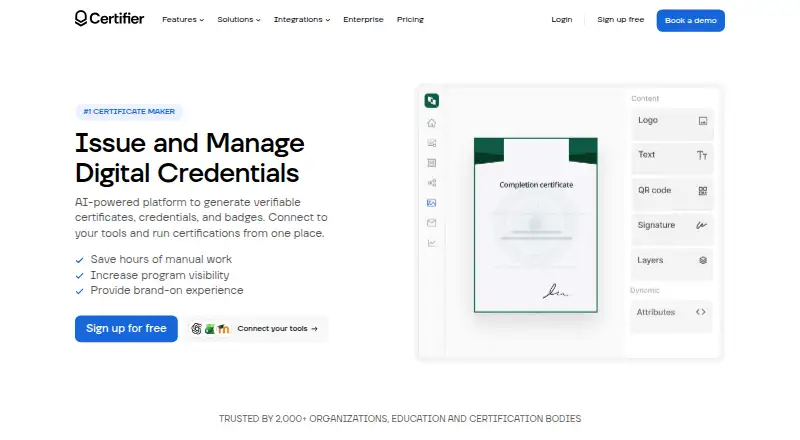
Certifier is a web and API platform for creating, issuing and managing digital certificates and badges that recognize achievements, skills and work. Organizations can customize credentials with logos, templates and uploaded backgrounds, then send hundreds at a time matched to recipients. Recipients and viewers can check credentials through unique links, QR codes, issuer checks or UUID-based verification. Its dashboard tracks published credentials, click-through rates, email opens and recipient interactions. The integrations page lists 57 apps, including Google Sheets, Canvas, Moodle, Zoom and ChatGPT, alongside connector-based options. An API is available for connecting credential workflows with apps and systems. The Starter plan is free forever and allows up to 250 credentials per year, one user, five templates and three forms. Professional costs $76.00 per month billed annually; the page also shows $89. Advanced costs $339.00 per month billed annually; the page also shows $399. Enterprise pricing is available by contacting sales. Certifier lists SSL encryption and GDPR-compliant data practices.
Who it suits
Certifier suits organizations in education, healthcare, associations, corporations and technology that need to issue and verify digital credentials. The pricing page describes Professional for small companies and Advanced for medium and large enterprises.
What it does well
- Free Starter plan allows 250 credentials per year
- Credentials can be issued in batches
- Recipients can verify credentials through links or QR codes
- Dashboard tracks opens and recipient interactions
- API and listed app integrations support connected workflows
What to know first
- Starter is limited to one user
- Starter includes five credential templates
- Professional is billed annually
- Enterprise pricing requires contacting sales
Limits
Starter is free forever and allows up to 250 credentials per year, one user, five credential templates, and three forms. The next listed plan, Professional, costs $76.00 per month billed annually.
Plans
| Plan | Billed and limits | Price |
|---|---|---|
| Starter | free forever · 250 credentials/year · 1 workspace · 1 user · basic integrations and API | Free |
| Advanced | billed annually · 7 users · custom credential domain · Pathways and stackable credentials · branded portals · custom roles · SAML SSO | $254 a month |
| Starter | billed annually · annual issuing limit selected at checkout · core certificate and badge creation | $49 a month |
| Professional | billed annually · 3 users · expiration and renewals · QR verification · bulk exports · custom email settings · LMS integrations | $76 a month |
| Certifier for Enterprise | Contact sales · Custom credential limit · Custom users and teams · SSO · Audit and activity log · Tailored integrations | On request |
| Enterprise | contact sales · custom limits · custom workspaces and roles · tailored integrations · custom SLAs and DPAs · full white-labeling | On request |
As certifier.io lists them, read 15 Oct 2026. The maker's own page has the final word.
Getting started
- Visit https://certifier.io/.
- Use the web platform or API.
- Start with the free Starter plan, available forever.
- Create credentials using templates, logos, or uploaded backgrounds.
- Connect an available integration or use the API to incorporate credential workflows.
Certifier is a credentialing platform for organizations that create and manage digital certificates and badges. It suits teams running recurring programs that need batch issuance, verification and engagement tracking. Its range of workflow tools is a strength, but growing beyond the free tier means weighing annual billing against strict user and template limits.
Overview
Certifier covers the credential lifecycle from branded design and recipient matching to delivery and verification. Organizations can add logos, use templates or upload backgrounds, then issue hundreds of credentials in a batch. That makes it more useful for cohorts, events and ongoing recognition programs than for occasional one-off certificates.
Recipients and viewers can verify credentials through unique links, QR codes, issuer checks or UUID-based verification. The dashboard tracks published credentials, click-through rates, email opens and recipient interactions, giving program managers signals about what happens after delivery. Expiry management and custom branding add useful controls for organizations maintaining credentials over time.
Key features
Design, issuing and verification
Flexible design options support branded certificates and badges, while batch delivery avoids matching and sending every credential individually. Verification methods give recipients and viewers several ways to check credentials. Starter's annual allowance of 250 credentials makes it a viable starting point for small programs, but not a durable fit for organizations whose annual volume quickly exceeds that cap.
Integrations and API
The integrations page lists 57 apps, including native connections for Google Sheets, Canvas, Moodle, Zoom and ChatGPT, plus connector-based options. API support is included among Starter features, so teams can explore integrating credential workflows without first buying a paid plan. The actual integration fit will depend on the systems an organization uses.
Security and support
Certifier describes SSL encryption and GDPR-compliant data practices. Advanced adds custom terms, an SLA, a DPA, and security and compliance support; Enterprise adds SSO and audit and activity logs. Advanced also includes premium customer support and a dedicated account manager, while Enterprise provides premier support. These additions matter most to organizations with formal procurement, compliance or account-management needs.
Pricing
Starter is free forever and allows up to 250 credentials per year. It includes 1 user, 5 credential templates and 3 forms, alongside API support. That combination is a useful low-risk option for a small issuer, but the credential cap and single-user seat constrain shared or higher-volume programs.
Professional costs $76 a month, billed annually; the pricing page also shows $89. It provides 3 users, 100 credential templates, 5 forms and 25 custom attributes. The plan is described for small companies, and its extra seats and template capacity suit a growing team, though annual billing and the fixed limits call for planning before committing.
Advanced costs $339 a month, billed annually; the page also shows $399. It raises capacity to 7 users, unlimited credential templates, 10 forms and unlimited custom attributes. Described for medium and large enterprises, it adds the terms, SLA, DPA and security and compliance support that can matter in more formal programs. Custom terms and dedicated account management make this a more substantial commitment than simply buying more seats.
Certifier for Enterprise has custom pricing through sales. It offers custom credential limits, users and teams, SSO, audit and activity logs, and tailored integrations. It is the option for organizations needing tailored capacity or enterprise controls rather than a fixed package. Paid plan prices are annual-billing prices; the free Starter plan is the alternative for issuers who want to avoid that commitment.
Platforms
Certifier is available on the web and through an API. That combination suits browser-based credential operations and organizations integrating issuance into their own apps or systems.
Who it's for
Certifier is a strong fit for education providers, healthcare organizations, associations, corporations and technology companies that issue credentials repeatedly and want both verification and engagement measures. Small companies can start with Professional, while medium and large enterprises may find Advanced's larger template and attribute capacity more relevant. A solo issuer with modest volume can begin on Starter. It is less compelling for occasional certificate creation or teams that cannot justify the annual paid-plan commitment as their volume or collaboration needs grow.
Pros and cons
- Pro: Batch issuance can send hundreds of matched credentials at once, reducing repetitive work for recurring cohorts and events.
- Pro: Verification options and engagement metrics extend the workflow beyond creating and sending a credential.
- Pro: Starter includes API support and permits 250 credentials per year without charge, giving smaller programs room to begin.
- Con: Starter is limited to 1 user and 5 templates, which can constrain shared administration and design variety.
- Con: Professional and Advanced are billed annually, and their listed seats—3 and 7 respectively—may not match larger teams without moving to custom Enterprise terms.
- Con: Enterprise pricing is custom, so organizations needing its controls must engage with sales rather than choose from a published price.
Alternatives
For a no-cost, open-source option that can run as a desktop app or self-hosted Docker server, consider OpenCred. CanCred Factory is another freemium alternative with Android, iOS, web and API platforms and a free trial. For personal use, Open Badge Passport is free and open source. POK may suit readers prioritizing its free Web2 plan, which offers unlimited digital credentials with no user caps, setup fees or expiration; blockchain verification is pay-as-you-go at $0.30 per use.
Certopus offers a free starter plan with 250 credentials, a two-event limit and one limited seat, making it another option for a small event-based program. CertSeal has a free plan capped at 100 certificates per year, one batch, one organization member and one workspace, with CSV import, email delivery and Zapier. European Digital Credentials for Learning is a free option whose Issuer, Viewer and Wallet components can be integrated into an organization's own infrastructure. IssueBadge starts with 20 free credits and no credit card or expiring trial, which may suit someone looking to begin with a small badge allowance.
Browse Credentialing Software or Certificate Maker Software for more options.
Verdict
Choose Certifier if your organization issues certificates or badges regularly and values batch delivery, multiple verification methods and post-issuance engagement tracking in one workflow. Starter makes it possible to begin with a small program, and the paid tiers add capacity and organizational controls. Look elsewhere if you need broad team access without moving to custom pricing, or if annual billing is a poor fit for your budget.
Verdict
Certifier combines credential design, batch issuance, verification and activity tracking. The free Starter plan has defined user and template limits, while paid plans add capacity at annual prices.
Questions
Is there a free plan?
Yes. Starter is free forever and allows up to 250 credentials per year, one user, five credential templates, and three forms.
How much do the paid plans cost?
Professional is $76.00 per month billed annually, and the page also shows $89. Advanced is $339.00 per month billed annually, and the page also shows $399. Enterprise pricing is available by contacting sales.
Which platforms does Certifier support?
Certifier lists web and API platforms.
Can recipients verify credentials publicly?
Yes. Credentials can be checked through unique links, QR codes, issuer checks, and UUID-based verification.
What integrations are available?
The integrations page lists 57 apps, including native integrations for Google Sheets, Canvas, Moodle, Zoom, and ChatGPT, as well as connector-based options.
Who makes Certifier, and where is it based?
The company is Certifier sp. z o.o., with its headquarters in Cracow, Poland.
Facts from Certifier's own pages
- Analytics
- Analytics report credential opens, downloads, views, shares and other recipient interactions. · certifier.io, 15 Oct 2026
- API
- The public API is REST styled, exchanges JSON, uses bearer access tokens and requires HTTPS with a Certifier-Version header. · developers.certifier.io, 15 Oct 2026
- App availability
- The reviewed official pages provide a browser application and API; no Certifier listing with ratings was found in the Apple App Store, Google Play or Chrome Web Store searches. · certifier.io, 15 Oct 2026
- Bulk issuance
- Users can generate personalized credentials in batches from CSV or Excel data and deliver them by email. · certifier.io, 15 Oct 2026
- Bulk issuing
- Certifier can send hundreds of certificates and badges in one go, matching credentials to recipients. · certifier.io, 29 Sept 2026
- Certification marks
- The company site displays ISO 9001, ISO 27001, and GDPR marks in its footer. · certifier.io, 29 Sept 2026
- Company location
- The site identifies the company as Certifier sp. z o.o. and lists its address in Cracow, Poland. · certifier.io, 29 Sept 2026
- Company profile
- LinkedIn lists Certifier as a privately held 11–50-person technology company founded in 2020 and headquartered in Kraków, Poland. · linkedin.com, 15 Oct 2026
- Credential formats
- The Starter plan supports PDF, PNG and JSON downloads, while credentials can also be accessed through unique online URLs. · certifier.io, 15 Oct 2026
- Credential lifecycle
- The product supports editing issued credentials, expiration dates, renewal reminders and credential status management. · certifier.io, 15 Oct 2026
- Design
- Its visual design tools support customizable certificates and badges, including logos, templates, and uploaded backgrounds. · certifier.io, 29 Sept 2026
- Design builder
- The visual editor supports branded layouts, editable text and graphics, uploaded backgrounds, logos, custom attributes and more than 3,000 templates. · certifier.io, 15 Oct 2026
- Documentation
- Certifier provides API reference documentation, a knowledge base, video tutorials and on-demand technical support. · certifier.io, 15 Oct 2026
- Enterprise security
- The Enterprise plan includes SSO and audit and activity logs, while the Advanced plan lists custom terms, SLA, DPA, and security and compliance support. · certifier.io, 29 Sept 2026
- Free allowance
- The Starter plan is free forever, and the pricing FAQ says it allows up to 250 credentials per year without cost. · certifier.io, 29 Sept 2026
- Funding
- A 5 October 2023 report says Certifier raised more than PLN 3 million (about USD 700,000) in seed funding from Movens Capital, FundingBox Deep Tech Fund, Black Pearls VC and DEPO Ventures. · mamstartup.pl, 15 Oct 2026
- Headquarters
- Cracow, Poland · certifier.io, 23 Sept 2026
- Integrations
- Certifier advertises more than 5,000 Zapier connections plus Make, Pipedream, Google Sheets, Moodle, Canvas, Teachable, HubSpot and other connectors. · certifier.io, 15 Oct 2026
- Legal entity
- The contact page identifies the maker as Certifier sp. z o.o., KRS 0000863560, with its EU headquarters at Dolnych Młynów 3/1, Kraków. · certifier.io, 15 Oct 2026
- Licence
- Certifier’s hosted product documentation does not publish an open-source licence or source-code repository; it is described as a commercial SaaS service. · certifier.io, 15 Oct 2026
- Limit: Capterra reviewers
- One reviewer found initial setup confusing, while another wanted self-managed email templates instead of changing them through Certifier staff. · capterra.com, 15 Oct 2026
- Limit: G2 reviewers
- Reported drawbacks include a laggy editor, some emails landing in spam, limited styling options and pricing that feels high for low-volume use. · g2.com, 15 Oct 2026
- Praise: Capterra reviewers
- Capterra reviewers highlight bulk certificate creation, white-label branding, helpful support and reduced manual work. · capterra.com, 15 Oct 2026
- Praise: G2 reviewers
- Reviewers repeatedly praise batch issuance, attractive templates, ease of setup, responsive support and time saved versus manual certificate work. · g2.com, 15 Oct 2026
Where Certifier stands on Freedom251
- Certificate Maker Software#4 of 28
- Credentialing Software#6 of 31