Freedom251 › Credentialing Software
POK
What POK is
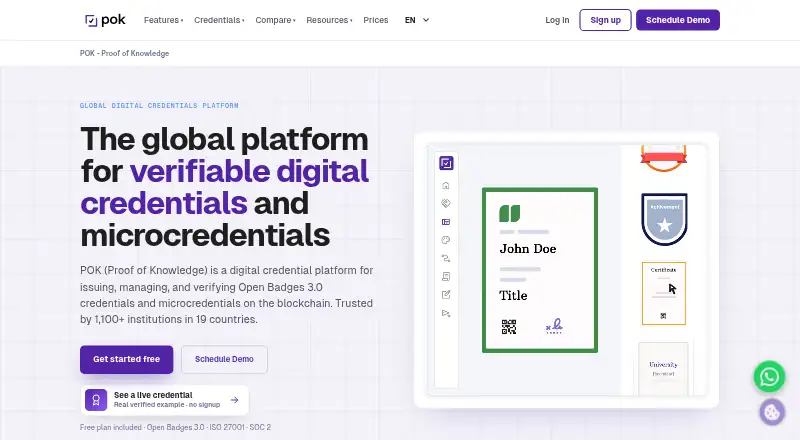
POK (Proof of Knowledge) helps organizations issue, manage and verify Open Badges 3.0 digital credentials and microcredentials on blockchain. It is intended for universities, training centers, companies, governments and other organizations certifying academic or professional achievements. Each credential has a unique link and QR code leading to a public page that shows the issuer, holder, date, skills and real-time status. A visual editor supports template design with backgrounds, logos, typefaces, signatures, custom attributes, dynamic API images, paper formats and previews. Credentials can be issued in bulk from Excel or CSV files; the free plan has no user limit or added bulk-issuance cost. Learning-system connections can trigger credentials when learners complete courses, with optional minimum-grade rules. POK connects named learning systems through LTI 1.3 and Sana through xAPI, and supports custom LTI, API keys, REST API and webhooks for other systems. It supports Open Badges 3.0, W3C Verifiable Credentials, ELM/Europass and the TrustEd Credentials Framework. The free plan has unlimited credentials, no user caps, setup fees or expiration. Blockchain verification costs $0.30 per credential; the annual license is $3,000 a year for up to 50,000 credentials.
Who it suits
POK suits universities, training providers, companies, governments and other organizations issuing academic or professional credentials. It may fit teams that need bulk issuance, learning-system automation or publicly verifiable credentials.
What it does well
- Free plan has unlimited digital credentials.
- No user caps or setup fees on the free plan.
- Bulk issuance from Excel or CSV files.
- Public credential pages show issuer, holder and status.
- Integrates with named learning systems and APIs.
What to know first
- Blockchain verification costs $0.30 per credential.
- Annual blockchain license costs $3,000 a year.
- Annual license covers up to 50,000 credentials per year.
- NFT Ownership pricing varies by prepaid pack.
Limits
The Free Web2 plan provides digital credentials without user caps, setup fees, or expiration. Blockchain verification costs $0.30 per credential on the pay-as-you-go plan, or $3,000.00 per year for up to 50,000 credentials; both include free-plan features.
Plans
| Plan | Billed and limits | Price |
|---|---|---|
| Free Web2 | unlimited digital credentials · no user caps · no setup fees · no expiration | Free |
| Blockchain Verify pay-as-you-go | per credential · no minimum · cryptographic blockchain verification · free-plan features included | $0.30, paid once |
| Blockchain Verify annual license | annually · up to 50,000 credentials per year · free-plan features included | $3,000 a year |
| NFT Ownership | per credential, prepaid packs · $1.50 at 1,000 credentials · $1.10 at 10,000 · $0.80 at 100,000 · no credit expiration | On request |
As pok.tech lists them, read 1 Oct 2026. The maker's own page has the final word.
Getting started
- Open the POK website.
- Choose the Free Web2 plan for digital credentials, or select a blockchain verification plan.
- Create credential templates with the visual editor.
- Issue credentials individually or import an Excel or CSV file for bulk issuance.
- Connect a supported learning system if you want course completion to trigger issuance.
POK is a credentialing platform for organizations that issue academic or professional achievements as digital badges and certificates. It is best suited to institutions that need high-volume issuance, learning-system automation and independently verifiable credentials. Its unlimited free digital-credential plan is generous; blockchain verification adds a per-credential or annual cost.
Overview
POK creates and manages Open Badges 3.0 credentials and microcredentials, with public verification pages and blockchain-backed options. Each credential has a unique link and QR code leading to a page that displays the issuer, holder, date, skills and current status. That gives recipients a way to share credentials and gives viewers a direct route to check their validity.
POK reports more than 1,100 institutions across 19 countries and more than 1.5 million credentials issued. Founded in 2023, it describes itself as a distributed team building verifiable-credential infrastructure.
Key features
Design and issuance
The visual editor supports logos, backgrounds, typefaces, signatures, custom attributes, dynamic images from an API, paper formats and previews. These options give organizations room to align credentials with their identity and use cases. Bulk issuance from Excel or CSV files can handle hundreds or thousands of credentials; the free plan has no user limit or added bulk-issuance cost, making it practical for large cohorts without a per-user fee.
Integrations and standards
POK connects with Moodle, Canvas, Blackboard, D2L Brightspace and Open edX through LTI 1.3, and with Sana through xAPI. Other systems can connect through custom LTI, API keys, REST API and webhooks. LMS integrations can issue credentials automatically when learners complete courses, with an optional minimum-grade rule. This is a strong fit for organizations that want credentials tied to course completion rather than a separate manual process.
Supported standards include 1EdTech Open Badges 3.0, W3C Verifiable Credentials, the European Learning Model (ELM/Europass) and the 1EdTech TrustEd Credentials Framework. POK states that it is ISO 27001 and SOC 2 certified and GDPR-compliant. Blockchain credentials use Polygon and LacNet public blockchains and, POK says, remain independently verifiable if the company ceases to operate.
Branding and credential management
White-label options include a custom domain, logo, colors, email branding, credential pages and wallet exports. Digital certificates and badges, public verification, expiry management, custom branding and API access are supported. The range is useful to organizations seeking a branded credential experience; buyers should weigh the blockchain charges separately if that verification is central to their program.
Pricing
POK uses a freemium model. Free Web2 costs nothing and includes unlimited digital credentials, no user caps, no setup fees and no expiration. It is the clearest starting point for organizations that need digital issuance and public verification without blockchain verification.
Blockchain Verify pay-as-you-go costs $0.30, paid once, billed per credential, with no minimum. It adds cryptographic blockchain verification and includes free-plan features. This keeps entry costs low for occasional blockchain credentials, but the total rises with issuance volume.
Blockchain Verify annual license costs $3,000 a year, billed annually, and covers up to 50,000 credentials per year alongside free-plan features. It suits organizations with predictable volume near that cap; smaller or uneven programs may prefer pay-as-you-go, while volume above the cap would need another arrangement.
NFT Ownership has custom pricing and is billed per credential through prepaid packs. Pack rates are $1.50 at 1,000 credentials, $1.10 at 10,000 and $0.80 at 100,000, with no credit expiration. This is a separate ownership-focused option, and its prepaid structure favors buyers able to commit to a pack.
Platforms
POK is available on Android, iOS and web, and offers an API. The combination supports mobile and browser access alongside system integrations.
Who it's for
Universities, training centers, companies and governments certifying academic or professional achievements are POK's stated audience. It is particularly compelling for institutions issuing large batches, using an LMS, or needing credentials that can be checked outside the issuing organization. A smaller program that only needs digital credentials can stay on the free plan; one that requires blockchain verification should compare the per-credential cost with its expected volume.
Pros and cons
- Pro: Unlimited free digital credentials with no user cap or expiration make broad issuance possible without a recurring license.
- Pro: Bulk imports and LMS completion automation reduce manual work for recurring programs.
- Pro: Public verification pages and blockchain options give recipients shareable credentials with independent validation pathways.
- Pro: Multiple credential standards and white-label controls suit organizations with interoperability and branding needs.
- Con: Blockchain verification is not included in the free Web2 plan and costs $0.30 per credential or $3,000 a year.
- Con: The annual blockchain license caps issuance at 50,000 credentials per year, so high-volume buyers must account for that limit.
- Con: NFT Ownership relies on prepaid credential packs, which may be a poor fit for buyers unwilling to commit to a volume.
Alternatives
Browse Credentialing Software for more options. CanCred Factory is another freemium option with a free trial and Android, iOS, web and API platforms; consider it if you want to compare a service provided as CanCred.ca since 2016. Certifier offers a free-forever Starter plan capped at 250 credentials per year, one user, five templates and three forms, making it a fit for smaller programs that can work within those limits. Certopus has a free starter tier with 250 credentials, two events and one limited seat, a fit for event-led issuance within those caps. CertSeal offers 100 certificates per year, one batch and one organization member on its free plan, suitable for a small, tightly scoped program. IssueBadge starts with 20 free credits and no expiring trial, an option for a low-volume first run. Openbadges.me limits its free Starter plan to 10 badge recipients, which may fit a small recipient group. Sertifier allows up to 25 recipients with unlimited credentials on its free plan, a useful distinction for programs with few recipients and repeated credentials. SimpleCert provides 50 introductory credits on its free plan, so it may suit a limited initial issuance.
Verdict
Choose POK if your organization needs scalable digital credentials, bulk or LMS-triggered issuance, and a path to public or blockchain verification. Its no-cap free Web2 plan is a meaningful advantage for digital issuance; the main reason to look elsewhere is if blockchain verification is essential but its per-credential or annual pricing does not fit your volume or budget.
Verdict
POK combines credential design, bulk issuance and public verification with learning-system integrations. The free plan covers digital credentials, while blockchain verification has separate per-credential and annual pricing.
Questions
Is POK free?
Yes. Free Web2 is listed as free and includes unlimited digital credentials, no user caps, no setup fees, and no expiration.
How much does blockchain verification cost?
Pay-as-you-go costs $0.30 per credential. The annual license costs $3,000.00 per year and covers up to 50,000 credentials per year.
Which platforms and integrations does POK support?
POK lists Android, iOS, web, and API. It connects Moodle, Canvas, Blackboard, D2L Brightspace, and Open edX through LTI 1.3, Sana through xAPI, and other systems through custom LTI, API keys, REST API, and webhooks.
Which credential standards does POK support?
POK supports 1EdTech Open Badges 3.0, W3C Verifiable Credentials, the European Learning Model (ELM/Europass), and the 1EdTech TrustEd Credentials Framework.
Can credentials be issued automatically?
Yes. LMS integrations can issue a credential when a learner completes a course, with optional minimum-grade rules.
Who makes POK?
POK describes itself as a distributed team building infrastructure for verifiable credentials. It says it was founded in 2023.
Facts from POK's own pages
- Audience
- POK is intended for universities, training centers, companies, governments, and other organizations certifying academic or professional achievements. · pok.tech, 1 Oct 2026
- Automation
- LMS integrations can issue a credential automatically when a learner completes a course, with optional minimum-grade rules. · pok.tech, 1 Oct 2026
- Blockchain
- POK NFT credentials are issued on the Polygon and LacNet public blockchains and remain independently verifiable if POK ceases to operate. · pok.tech, 1 Oct 2026
- Bulk issuance
- Institutions can issue hundreds or thousands of credentials from Excel or CSV files, and the free plan has no user limit or additional bulk-issuance cost. · pok.tech, 1 Oct 2026
- Company
- POK describes itself as a distributed team building infrastructure for verifiable credentials and says it was founded in 2023. · pok.tech, 1 Oct 2026
- Founded
- 2023 · pok.tech, 28 Sept 2026
- Integrations
- POK connects Moodle, Canvas, Blackboard, D2L Brightspace, and Open edX through LTI 1.3, Sana through xAPI, and other systems through custom LTI, API keys, REST API, and webhooks. · pok.tech, 1 Oct 2026
- Product
- POK (Proof of Knowledge) issues, manages, and verifies Open Badges 3.0 digital credentials and microcredentials on blockchain. · pok.tech, 1 Oct 2026
- Scale
- POK reports more than 1,100 institutions in 19 countries and more than 1.5 million credentials issued. · pok.tech, 1 Oct 2026
- Security
- POK states that it is ISO 27001 and SOC 2 certified and GDPR-compliant. · pok.tech, 1 Oct 2026
- Standards
- POK supports 1EdTech Open Badges 3.0, W3C Verifiable Credentials, the European Learning Model (ELM/Europass), and the 1EdTech TrustEd Credentials Framework. · pok.tech, 1 Oct 2026
- Support contact
- POK lists [email protected] and a WhatsApp phone number (+52 1 55 1277 8857) for contact. · pok.tech, 1 Oct 2026
- Template designer
- The visual editor supports backgrounds, logos, typefaces, signatures, custom attributes, dynamic API images, paper formats, and previews. · pok.tech, 1 Oct 2026
- Verification
- Each credential has a unique link and QR code opening a public verification page showing issuer, holder, date, skills, and real-time status. · pok.tech, 1 Oct 2026
- White label
- POK offers white-label customization including custom domain, logo, colors, email branding, credential pages, and wallet exports. · pok.tech, 1 Oct 2026
Where POK stands on Freedom251
- Credentialing Software#13 of 31