Freedom251 › Infrastructure as Code Tools
CDK8s
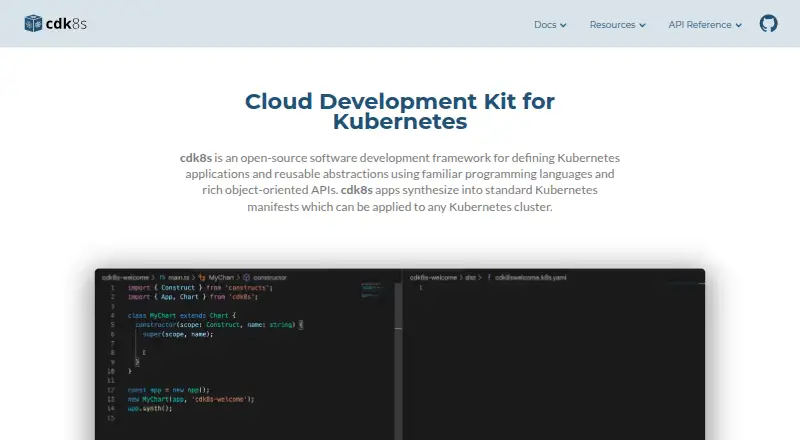
What CDK8s is
CDK8s is a free, open-source framework for defining Kubernetes applications and reusable abstractions in a general-purpose programming language. It supports TypeScript, JavaScript, Python, Java, and Go, using object-oriented APIs to build application definitions. The framework can import objects from Kubernetes API versions and custom resource definitions, then combine them into higher-level constructs that can be shared through package managers.
CDK8s synthesizes those definitions into standard Kubernetes YAML manifests. It runs locally in a development environment and can define applications for Kubernetes clusters in any cloud or on premises. Applying the generated manifests is a separate deployment step; the documentation describes using kubectl or a GitOps tool such as Flux. It also describes using cdk8s charts in an AWS CDK application and applying them with the EKS construct library.
The CLI can be installed with Homebrew, npm, or Yarn. The project identifies itself as a Cloud Native Computing Foundation Sandbox Project made at AWS. Community links cover issues, Stack Overflow, Slack, and a mailing list, and the project invites contributions. The cdk8s+ libraries are actively maintained for only the three latest Kubernetes releases.
Who it suits
CDK8s suits developers who want to define Kubernetes applications in TypeScript, JavaScript, Python, Java, or Go and reuse higher-level constructs. It can serve workloads for cloud or on-premises clusters, with deployment handled separately through tools such as kubectl or Flux.
What it does well
- Supports five general-purpose programming languages.
- Imports Kubernetes API objects and custom resource definitions.
- Creates reusable constructs shareable through package managers.
- Generates standard Kubernetes YAML manifests.
- Runs locally and supports cloud or on-premises clusters.
What to know first
- Does not apply generated manifests to a cluster.
- cdk8s+ libraries are maintained only for the three latest Kubernetes releases.
Limits
The free, open-source framework generates manifests but does not apply them to a cluster. cdk8s+ libraries are actively maintained only for the three latest Kubernetes releases.
Plans
| Plan | Billed and limits | Price |
|---|---|---|
| Open-source cdk8s | No charge stated; open-source framework · Defines and synthesizes Kubernetes manifests; does not apply them to a cluster | Free |
As cdk8s.io lists them, read 4 Oct 2026. The maker's own page has the final word.
Getting started
- Install the CLI with Homebrew, npm, or Yarn.
- Define an application using a supported language.
- Import Kubernetes API objects or custom resource definitions as needed.
- Synthesize the application into Kubernetes YAML manifests.
- Apply the manifests with kubectl or a GitOps tool such as Flux.
Verdict
Choose CDK8s if you want to define Kubernetes applications with familiar programming languages and compose reusable abstractions. Look elsewhere if you need the framework itself to apply manifests to a cluster or need cdk8s+ maintenance beyond the three latest Kubernetes releases.
Questions
How much does CDK8s cost?
CDK8s is free and open source; the listed plan is free.
Which languages does it support?
The listed languages are TypeScript, JavaScript, Python, Java, and Go.
What does CDK8s produce?
It synthesizes application definitions into standard Kubernetes YAML manifests.
Does CDK8s deploy to a cluster?
It generates manifests but does not apply them. The documentation describes applying them with kubectl or a GitOps tool such as Flux.
Can I import existing Kubernetes resources?
Yes. Users can import objects from Kubernetes API versions and custom resource definitions.
Where can CDK8s run?
It runs locally in a development environment and can define applications for Kubernetes clusters in any cloud or on premises.
Facts from CDK8s's own pages
- Cluster compatibility
- The project says cdk8s can define applications for Kubernetes clusters in any cloud or on premises, and runs locally in the development environment. · cdk8s.io, 4 Oct 2026
- Community and support
- The site provides community support links for issues, Stack Overflow, Slack, and a mailing list, and invites contributions. · cdk8s.io, 4 Oct 2026
- Deployment workflow
- cdk8s generates manifests but does not apply them to a cluster; the docs describe applying them with kubectl or a GitOps tool such as Flux. · cdk8s.io, 4 Oct 2026
- Installation
- The CLI installation page lists Homebrew, npm, and Yarn installation methods. · cdk8s.io, 4 Oct 2026
- Integrations
- The docs describe using cdk8s charts in an AWS CDK application and applying them with the EKS construct library. · cdk8s.io, 4 Oct 2026
- Kubernetes resources
- Users can import objects from Kubernetes API versions and custom resource definitions. · cdk8s.io, 4 Oct 2026
- Kubernetes version limit
- cdk8s+ libraries are actively maintained only for the three latest Kubernetes releases. · cdk8s.io, 4 Oct 2026
- Manifest output
- cdk8s synthesizes applications into standard Kubernetes YAML manifests that can be applied to Kubernetes clusters. · cdk8s.io, 4 Oct 2026
- Programming languages
- The site lists TypeScript, JavaScript, Python, Java, and Go as supported languages. · cdk8s.io, 4 Oct 2026
- Project affiliation
- The homepage identifies cdk8s as a Cloud Native Computing Foundation Sandbox Project and says it is made at AWS. · cdk8s.io, 4 Oct 2026
- Reusable abstractions
- Constructs support composing higher-level abstractions with object-oriented classes, and can be shared through package managers. · cdk8s.io, 4 Oct 2026
- What it does
- cdk8s is an open-source framework for defining Kubernetes applications and reusable abstractions with familiar programming languages and object-oriented APIs. · cdk8s.io, 4 Oct 2026
Where CDK8s stands on Freedom251
- Infrastructure as Code Tools#9 of 31