Freedom251 › Infrastructure as Code Tools

AWS Controllers for Kubernetes
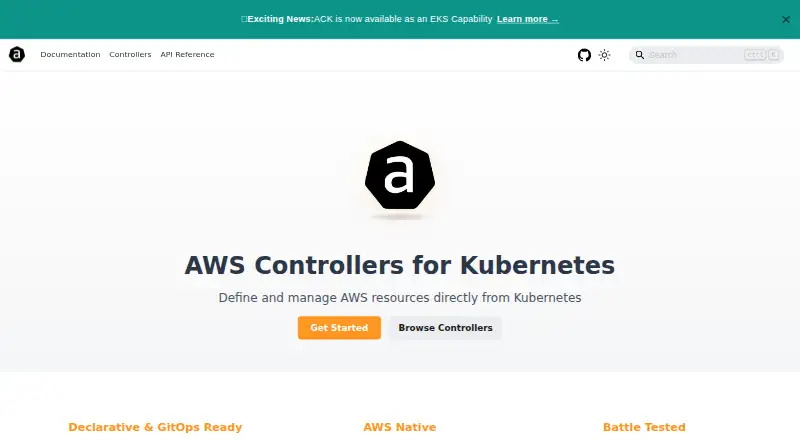
What AWS Controllers for Kubernetes is
AWS Controllers for Kubernetes (ACK) brings AWS resource management into Kubernetes. Teams describe the AWS resources they want through Kubernetes custom resources, and ACK periodically checks those declarations against the actual state in AWS, correcting drift. Its documentation lists 74 service controllers, including S3, RDS, Lambda, and DynamoDB. The approach supports declarative, version-controlled infrastructure alongside application workloads, as well as management across AWS accounts and regions. ACK can work with read-only resources and read-only adoption, which supports migrations from other infrastructure-as-code tools.
Amazon EKS users can use EKS Capabilities, where AWS handles installation and upgrades and provides automatic updates, scaling, and tuning. Alternatively, a self-managed Helm installation supports EKS, GKE, AKS, on-premises Kubernetes clusters, and local development. That route is listed as free for Kubernetes 1.20 or later on any Kubernetes cluster. EKS Capability billing is hourly, with charges based on enabled capabilities and each ACK resource managed. Controllers use AWS IAM permissions to access resources; configuration uses YAML or JSON, and state management is self-hosted.
Who it suits
ACK suits teams managing AWS infrastructure through Kubernetes and wanting declarative, version-controlled resource definitions with drift correction. EKS users seeking AWS-managed controller operations can choose EKS Capabilities, while teams needing version or configuration control, or using other Kubernetes environments, can use Helm.
What it does well
- Manages AWS resources through Kubernetes custom resources.
- Reconciles actual AWS state with declared desired state.
- Documentation lists 74 service controllers, including S3 and RDS.
- Supports management across AWS accounts and regions.
- Self-managed Helm installation works on several Kubernetes environments.
- Read-only adoption can support infrastructure-tool migrations.
What to know first
- EKS Capability billing includes hourly capability and resource charges.
- Managed EKS Capability requires Amazon EKS.
- Self-managed installation requires Kubernetes 1.20 or later.
Limits
Self-managed ACK is listed as free. EKS Capability charges are hourly and include a base rate for each enabled capability plus usage charges for each ACK resource managed; it requires Amazon EKS and has no minimum commitment or upfront fees.
Plans
| Plan | Billed and limits | Price |
|---|---|---|
| Self-managed ACK | Helm installation · Kubernetes 1.20+ · any Kubernetes cluster | Free |
| ACK EKS Capability | Hourly for each enabled capability and each ACK resource managed · Requires Amazon EKS · no minimum commitment or upfront fees | On request |
As aws-controllers-k8s.github.io lists them, read 9 Oct 2026. The maker's own page has the final word.
Getting started
- Open the ACK documentation website.
- Choose EKS Capabilities if you use Amazon EKS and want managed controller operations.
- Otherwise, use the self-managed Helm installation on Kubernetes 1.20 or later.
- Define AWS resources using Kubernetes custom resources in YAML or JSON.
- Authorize controller access with AWS IAM permissions.
Verdict
Choose ACK if you want Kubernetes declarations to manage AWS resources and correct drift, especially across accounts or regions. EKS users who want AWS to operate controller installation and updates can choose EKS Capabilities; teams seeking version and configuration control can self-manage with Helm. The managed option has hourly capability and resource charges, while self-managed ACK is listed as free.
Questions
Is ACK free?
Self-managed ACK is listed as free. EKS Capability billing is hourly and includes capability and managed-resource charges.
Which platforms can run ACK?
Self-managed Helm installation works on EKS, GKE, AKS, on-premises clusters, and local development environments. EKS Capabilities requires Amazon EKS.
What AWS services does ACK cover?
The documentation lists 74 service controllers, including S3, RDS, Lambda, and DynamoDB.
Can ACK detect configuration drift?
Yes. It periodically reconciles desired resource state with actual AWS state and corrects drift.
Can ACK help adopt existing resources?
ACK supports read-only resources and read-only adoption, including to facilitate migration from other infrastructure-as-code tools.
How does ACK authorize access to AWS resources?
ACK uses AWS IAM permissions to authorize controller access.
Facts from AWS Controllers for Kubernetes's own pages
- AWS services
- The documentation lists 74 controllers for AWS services, including S3, RDS, Lambda, and DynamoDB. · aws-controllers-k8s.github.io, 9 Oct 2026
- Cross-account and region
- ACK supports managing resources across AWS accounts and regions. · aws-controllers-k8s.github.io, 9 Oct 2026
- Founded
- 2006 · aws-controllers-k8s.github.io, 28 Sept 2026
- GitOps
- ACK supports declarative, version-controlled infrastructure management alongside applications. · aws-controllers-k8s.github.io, 9 Oct 2026
- Installation options
- Amazon EKS users can choose the managed EKS Capabilities installation, while self-managed Helm installation works on EKS, GKE, AKS, on-premises clusters, and local development environments. · aws-controllers-k8s.github.io, 9 Oct 2026
- Intended users
- The documentation recommends EKS Capabilities for EKS users seeking a managed experience and self-managed installation for users needing version and configuration control or running other Kubernetes environments. · aws-controllers-k8s.github.io, 9 Oct 2026
- Managed operations
- With EKS Capabilities, AWS manages controller installation and upgrades, and provides automatic updates, auto-scaling, and auto-tuning. · aws-controllers-k8s.github.io, 9 Oct 2026
- Permissions
- ACK uses AWS IAM permissions to authorize controller access to AWS resources. · aws-controllers-k8s.github.io, 9 Oct 2026
- Pricing
- EKS Capability charges are hourly and include a base rate for each enabled capability plus usage charges; ACK usage is counted per resource managed. · aws.amazon.com, 9 Oct 2026
- Purpose
- ACK lets users define and manage AWS resources directly from Kubernetes using Kubernetes custom resources. · aws-controllers-k8s.github.io, 9 Oct 2026
- Reconciliation
- ACK periodically reconciles desired resource state with actual state in AWS and corrects drift. · docs.aws.amazon.com, 9 Oct 2026
- Resource adoption
- ACK supports read-only resources and read-only adoption to facilitate migration from other infrastructure-as-code tools. · docs.aws.amazon.com, 9 Oct 2026
- Support channels
- The documentation links to the aws-controllers-k8s Slack channel and GitHub Discussions for community participation. · aws-controllers-k8s.github.io, 9 Oct 2026
Where AWS Controllers for Kubernetes stands on Freedom251
- Infrastructure as Code Tools#5 of 31