Freedom251 › Internal Developer Platforms

Kusion
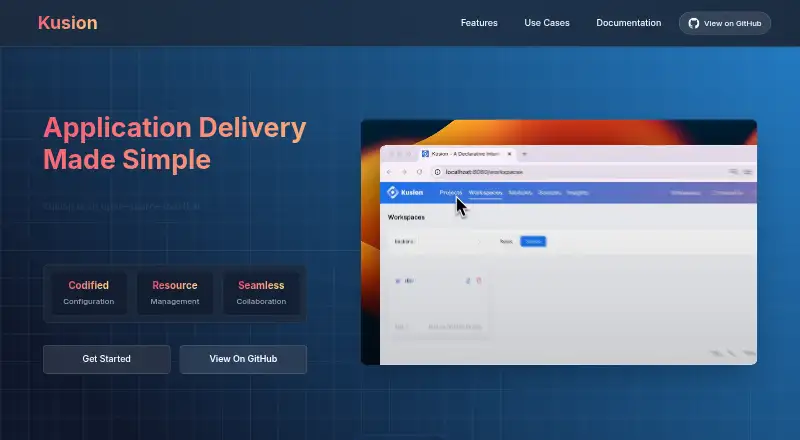
What Kusion is
Kusion is a free, open-source platform orchestrator for internal developer platforms. Its AppConfiguration lets developers define application workloads and resource dependencies without putting environment-specific values in the specification. Workload, accessory, pipeline, and dependency concepts sit in one infrastructure-independent declarative model. The workflow is Write, Generate, then Apply, with a three-way diff preview before changes are applied. Kusion currently operates on Kubernetes, Terraform, and on-premises infrastructure. Platform engineers can create reusable modules to standardize deployments and support developer self-service. A built-in delivery pipeline can be extended with plugin-based steps managed by platform owners. The overview describes security and compliance support through base models, third-party policy-as-code guardrails, and automatic injection of accessory secrets into workloads. External secret-store guides cover AWS, Alibaba Cloud, and Viettel Cloud. Kusion is a lightweight client-side solution with APIs for integration and automation. It supports AWS, AliCloud, Azure, and Google Cloud, and offers self-hosted execution. The project describes itself as early and rapidly iterated; help is available through Slack or GitHub issues.
Who it suits
Kusion suits application developers defining workloads and platform engineers maintaining application infrastructure. It is also relevant to teams standardizing deployments with reusable modules.
What it does well
- Free and open source.
- Three-way diff preview before applying changes.
- Reusable modules support developer self-service.
- Works with Kubernetes, Terraform, and on-premises infrastructure.
- Supports AWS, AliCloud, Azure, and Google Cloud.
What to know first
- The project describes itself as early and rapidly iterated.
- External secret-store guides cover AWS, Alibaba Cloud, and Viettel Cloud.
Plans
| Plan | Billed and limits | Price |
|---|---|---|
| Kusion | Open source platform orchestrator · project page provides a Helm installation command | Free |
As kusion.kusionstack.io lists them, read 4 Oct 2026. The maker's own page has the final word.
Getting started
- Visit the Kusion website.
- Install the CLI using the method for macOS, Linux, or Windows.
- Use the project page's Helm installation command if installing the platform that way.
- Write an AppConfiguration describing the workload and its resource dependencies.
- Generate and review the three-way diff, then apply the changes.
Kusion is an open-source platform orchestrator for teams building an internal developer platform. It best suits platform engineers standardizing application deployments and developers who want to describe workloads without managing environment-specific values in every configuration. Its unified workflow and reusable modules are compelling, though the project’s early status matters for teams choosing infrastructure tooling.
Overview
Kusion brings application workloads, dependencies, accessories, and delivery pipelines into a declarative AppConfiguration. Developers describe what an application needs without embedding environment-specific values; platform engineers can provide reusable modules that standardize deployments and support self-service. That division can reduce repeated configuration across teams, while making the quality and coverage of the platform’s modules important to the experience.
The documented workflow is Write, Generate, and Apply, with a three-way diff preview before changes are applied. That preview gives teams a chance to review proposed changes before execution. Kusion currently applies operations to Kubernetes, Terraform, and on-premises infrastructure, and supports AWS, AliCloud, Azure, and Google Cloud.
Key features
Reusable configuration and delivery
AppConfiguration combines workload, accessory, pipeline, and dependency concepts in an infrastructure-independent specification. Platform owners can build reusable modules and customize delivery with plugin-based pipeline steps. This suits organizations that want centrally maintained deployment patterns without requiring every application team to author the same infrastructure setup.
Guardrails and secrets
Kusion describes security and compliance support through base models, third-party policy-as-code guardrails, and automatic injection of accessory resource secrets into workloads. Its documented external secret-store integrations include AWS, Alibaba Cloud, and Viettel Cloud. These controls are useful for teams aiming to bake policy and secret handling into shared deployment patterns, though the documented integrations may not cover every provider a team uses.
Client-side and extensible
Kusion is designed as a lightweight, pure client-side solution with APIs for integration and automation, alongside an expanding model ecosystem. That approach may suit teams wanting to integrate orchestration into their own workflows; teams seeking a mature, broad model ecosystem should weigh the project’s early status.
Pricing
Kusion is free and open source. The Kusion plan costs nothing and is described as an open-source platform orchestrator; the project page provides a Helm installation command. Self-hosted execution is supported, so teams can run it in their own environment rather than choosing a paid hosted tier. There are no paid plan tiers to compare.
Platforms
Kusion supports API, Linux, macOS, self-hosted use, web, and Windows. The CLI installation page covers macOS, Linux, and Windows. Its listed supported clouds are AWS, AliCloud, Azure, and Google Cloud.
Who it's for
Kusion is a fit for application developers and platform engineers who need a shared way to describe workloads, standardize infrastructure patterns, and manage delivery. It is less compelling for teams that need an established project with a longer track record: Kusion describes itself as an early project being iterated on quickly. Users can seek support through Slack or GitHub issues.
Pros and cons
Pros
- One declarative model across deployment concerns: workloads, dependencies, accessories, and pipelines come together in AppConfiguration.
- Review before execution: the three-way diff preview provides a checkpoint before changes are applied.
- Reusable platform patterns: modules and customizable pipeline plugins let platform owners standardize deployments while supporting developer self-service.
- Free and self-hostable: the open-source plan has no listed charge, and self-hosted execution is supported.
Cons
- Early project status: fast iteration may be a concern for teams that prioritize a mature infrastructure platform.
- Secret-store coverage is bounded: documented external integrations name AWS, Alibaba Cloud, and Viettel Cloud, which may not suit every environment.
- Platform patterns require ownership: reusable modules and plugin-based pipeline steps depend on platform engineers to create and maintain them.
Alternatives
Infrastructure as Code Tools is a useful starting point for comparing the wider category. Choose Terraform instead if a freemium tool with a free plan, free trial, and stated caps of 500 managed resources, one concurrent remote run, and one concurrent agent run is a better fit. AWS CloudFormation is a free service for CloudFormation itself, with underlying AWS resources billed separately; consider it when that distinction fits your deployment needs.
Cloudify offers a free community plan with no time limit, but requires Docker or VM setup and access to a cloud provider to run workloads. Pulumi may suit a single-user workflow: its free plan includes one user and unlimited projects, stacks, environments, updates, and history, with up to 500 workflow minutes. Terramate offers a free Community plan capped at two users and 1,000 resources, with 30-day data retention and community support.
AWS CDK costs nothing to use, though deployed AWS resources may incur charges. OpenTofu is another free, open-source infrastructure-as-code tool. Terragrunt is an alternative with a free plan capped at 25 infrastructure units.
Verdict
Choose Kusion if your team wants an open-source orchestrator that connects declarative application configuration, reusable platform modules, and delivery workflows, especially when platform engineers can maintain shared patterns. Its reviewable apply flow and self-hosted option strengthen that case. Look elsewhere if your infrastructure work depends on a more established project or secret-store integrations beyond those Kusion documents.
Verdict
Kusion brings application configuration, reusable platform modules, and delivery workflows into one orchestrator. Its early project status is worth considering when evaluating it for infrastructure work.
Questions
How much does Kusion cost?
The Kusion plan is listed as free, and the pricing note describes it as open source.
Which platforms can I use?
The listed platforms are API, Linux, macOS, self-hosted, web, and Windows; CLI installation methods are listed for macOS, Linux, and Windows.
What infrastructure does Kusion operate on?
Kusion currently applies operations to Kubernetes, Terraform, and on-premises infrastructure.
Can Kusion use external secret stores?
Its secrets guide documents support for AWS, Alibaba Cloud, and Viettel Cloud.
How can users get help?
The documentation directs users to Slack or GitHub issues for help and feedback.
Facts from Kusion's own pages
- Application specification
- AppConfiguration lets developers describe an application workload and its resource dependencies without supplying environment-specific values. · kusionstack.io, 4 Oct 2026
- Cloud secret integrations
- The secrets guide documents external secret-store support for AWS, Alibaba Cloud, and Viettel Cloud. · kusionstack.io, 4 Oct 2026
- Configuration model
- AppConfiguration brings workload, accessory, pipeline, and dependency concepts together in an infrastructure-independent declarative specification. · kusionstack.io, 4 Oct 2026
- Extensibility
- Kusion describes itself as a lightweight, pure client-side solution with APIs for integration and automation and an expanding model ecosystem. · kusionstack.io, 4 Oct 2026
- Founded
- 2020 · kusion.kusionstack.io, 28 Sept 2026
- Installation
- The Kusion CLI installation page lists macOS, Linux, and Windows installation methods. · kusionstack.io, 4 Oct 2026
- Intended users
- Kusion is intended to help application developers and platform engineers who maintain application infrastructure. · kusionstack.io, 4 Oct 2026
- Pipeline customization
- Kusion provides a built-in delivery pipeline and supports customized pipeline steps implemented as plugins managed by platform owners. · kusionstack.io, 4 Oct 2026
- Product
- Kusion describes itself as an intent-driven platform orchestrator at the core of an internal developer platform. · kusionstack.io, 4 Oct 2026
- Project status
- The project overview calls Kusion an early project that is being iterated on quickly. · kusionstack.io, 4 Oct 2026
- Reusable modules
- Kusion modules are reusable building blocks made by platform engineers to standardize deployments and enable developer self-service. · kusionstack.io, 4 Oct 2026
- Security
- The overview describes built-in security and compliance support through base models, third-party policy-as-code guardrails, and automatic injection of accessory resource secrets into workloads. · kusionstack.io, 4 Oct 2026
- Support
- The documentation directs users to Slack or GitHub issues for help and feedback. · kusionstack.io, 4 Oct 2026
- Supported infrastructure
- The overview says Kusion currently applies operations to Kubernetes, Terraform, and on-premises infrastructures. · kusionstack.io, 4 Oct 2026
- Workflow
- The documented workflow has Write, Generate, and Apply steps, with a three-way diff preview before changes are applied. · kusionstack.io, 4 Oct 2026
Where Kusion stands on Freedom251
- Internal Developer Platforms#5 of 27
- Infrastructure as Code Tools#7 of 31