Freedom251 › Infrastructure as Code Tools

OpenTofu
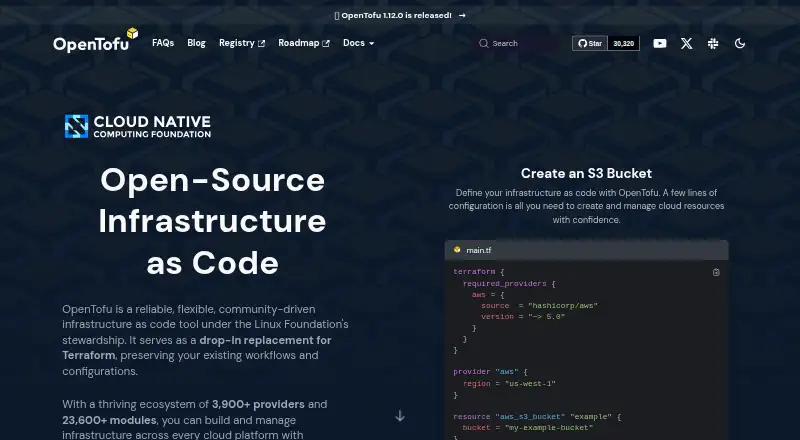
What OpenTofu is
OpenTofu is a free infrastructure-as-code tool for describing cloud and on-premises resources in human-readable HCL configuration. Its workflow moves from writing configuration to generating an execution plan and applying approved changes in dependency order. Presented as a Terraform drop-in replacement, it is intended to preserve existing configurations and workflows. Providers connect it to services and APIs, including AWS, Azure, Google Cloud Platform, Kubernetes, Helm, GitHub, Splunk, and Datadog. Reusable modules and a public registry support configurable infrastructure collections. OpenTofu records infrastructure in a state file, uses a dependency graph to determine changes, and can create or modify independent resources in parallel. Client-side state encryption supports key providers such as PBKDF2, AWS KMS, GCP KMS, and OpenBao. Provider installation can use registries, local mirrors, or caches, including for air-gapped environments. OCI registries support modules and secondary provider installation, but not primary provider installation. The Linux Foundation hosts and maintains the community-driven open-source project. Its listed plan is free.
Who it suits
OpenTofu suits teams defining and managing cloud or on-premises infrastructure through configuration, including those seeking a Terraform-compatible workflow. It is also suited to self-hosted or air-gapped environments that need configurable provider installation options.
What it does well
- Free open-source tool with a listed free plan.
- Terraform-compatible workflows and configurations.
- Client-side state encryption supports several key providers.
- Independent resources can be created or modified in parallel.
- Providers can be installed from mirrors or caches.
What to know first
- OCI is not yet the primary provider source.
- Changes depend on maintaining an infrastructure state file.
Plans
| Plan | Billed and limits | Price |
|---|---|---|
| OpenTofu | open-source infrastructure as code tool | Free |
As opentofu.org lists them, read 30 Sept 2026. The maker's own page has the final word.
Getting started
- Visit the OpenTofu website.
- Install OpenTofu using an official method for Linux, macOS, or Windows.
- Write infrastructure configuration in HCL.
- Generate an execution plan and review the proposed changes.
- Apply approved changes in dependency order.
Verdict
OpenTofu combines configuration-based infrastructure management with state tracking, reusable modules, and broad provider support. Its OCI provider installation remains secondary, rather than primary.
Questions
How much does OpenTofu cost?
OpenTofu is free. The listed plan is free.
Is OpenTofu open source?
Yes. It is a community-driven open-source project maintained under the Linux Foundation.
Which systems can run OpenTofu?
Official installation methods cover Linux distributions, macOS, Windows, FreeBSD, and OCI container images.
What providers does OpenTofu support?
Listed examples include AWS, Azure, Google Cloud Platform, Kubernetes, Helm, GitHub, Splunk, and Datadog. Providers can also connect to other cloud platforms, SaaS providers, and APIs.
Can OpenTofu replace Terraform?
It is presented as a drop-in replacement for Terraform that preserves existing workflows and configurations.
Where can I get support?
The project directs users to community Slack, GitHub discussions, issues, RFC discussions, and contributions.
Facts from OpenTofu's own pages
- Community support
- The project directs users to community Slack, GitHub discussions, issues, RFC discussions, and contributions. · opentofu.org, 30 Sept 2026
- Founded
- 2023 · opentofu.org, 28 Sept 2026
- Governance
- OpenTofu is hosted and maintained under the Linux Foundation as a community-driven, impartial open-source project. · linuxfoundation.org, 30 Sept 2026
- Modules
- OpenTofu supports reusable modules for configurable collections of infrastructure and provides a public registry of modules and providers. · opentofu.org, 30 Sept 2026
- OCI integration
- OpenTofu supports OCI registries for modules and as a secondary provider installation source, but not yet as the primary provider source. · opentofu.org, 30 Sept 2026
- Parallel execution
- OpenTofu builds a resource dependency graph and creates or modifies non-dependent resources in parallel. · opentofu.org, 30 Sept 2026
- Project scale
- The official website reports an ecosystem of more than 3,900 providers and 23,600 modules. · opentofu.org, 30 Sept 2026
- Provider installation
- Providers can be installed from registries, local mirrors, or caches, and OpenTofu supports workflows for air-gapped environments. · opentofu.org, 30 Sept 2026
- Providers
- Providers let OpenTofu manage cloud platforms, SaaS providers, and other APIs, with examples including AWS, Azure, GCP, Kubernetes, Helm, GitHub, Splunk, and Datadog. · opentofu.org, 30 Sept 2026
- Purpose
- OpenTofu is an infrastructure as code tool for defining cloud and on-premises resources in human-readable configuration files. · opentofu.org, 30 Sept 2026
- State encryption
- Built-in client-side state encryption supports key providers including PBKDF2, AWS KMS, GCP KMS, and OpenBao. · opentofu.org, 30 Sept 2026
- State tracking
- OpenTofu stores infrastructure state in a state file that acts as the source of truth for determining required changes. · opentofu.org, 30 Sept 2026
- Supported systems
- Official installation methods cover Linux distributions, macOS, Windows, FreeBSD, and OCI container images. · opentofu.org, 30 Sept 2026
- Terraform compatibility
- OpenTofu is presented as a drop-in replacement for Terraform that preserves existing workflows and configurations. · opentofu.org, 30 Sept 2026
- Workflow
- Its core workflow consists of writing configuration, generating an execution plan, and applying approved changes in dependency order. · opentofu.org, 30 Sept 2026
Where OpenTofu stands on Freedom251
- Infrastructure as Code Tools#8 of 31
- Cloud Orchestration Software#10 of 27
- Infrastructure Automation#9 of 24
- Data Center Automation#9 of 22
- Orchestration / Provisioning Software#12 of 27
- Cli Tools#15 of 32
- IT Configuration Management Software#13 of 27