Freedom251 › Nonprofit Case Management Software
CaseLight
by CaseLight
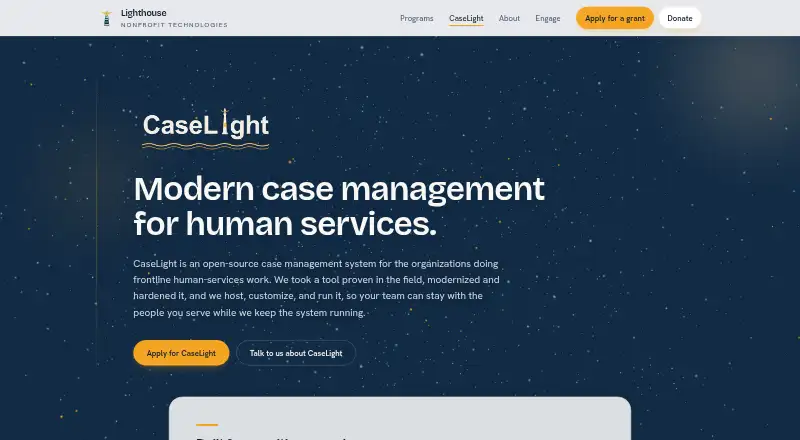
What CaseLight is
CaseLight is an open-source case management system for organizations providing frontline human services. It keeps records for clients and families, including program enrollment, assessments, case notes, and case history. Its reporting and monitoring and evaluation tools help organizations turn frontline records into information funders request.
Organizations can run CaseLight on Linux through self-hosting, or ask Lighthouse about managed hosting, deployment, and customization. The self-hosting quickstart requires Docker and Docker Compose on a Linux host. Lighthouse bases its service pricing on organization size and offers managed hosting with patching, backups, and an in-kind service-level agreement. The product has a free plan and paid pricing available on request.
CaseLight is a modernized fork of OSCaR and is released under the AGPL-3.0 license. Its maker says each organization has an isolated database, sensitive fields are encrypted at rest, traffic uses HTTPS, and staff sign in with MFA, including passkeys. An append-only audit log records who viewed or changed records. The current pilot does not include the Khmer locale, the Thredded community forum, or the v1 mobile API.
Who it suits
CaseLight suits organizations doing frontline human-services work that need to track clients, families, program enrollment, assessments, and case history. It may also fit organizations that need reporting for funders and can self-host on Linux or arrange managed hosting with Lighthouse.
What it does well
- Tracks clients, families, enrollment, assessments, notes, and case history.
- Reporting and monitoring tools turn frontline records into funder data.
- AGPL-3.0 licensed and available as a free plan.
- Append-only audit log records record views and changes.
- Managed hosting includes patching, backups, and an in-kind service-level agreement.
What to know first
- Self-hosting requires Docker and Docker Compose on Linux.
- The current pilot omits Khmer, Thredded, and the v1 mobile API.
- Paid service pricing is available on request.
Limits
The current pilot does not include the Khmer locale, the Thredded community forum, or the v1 mobile API.
Plans
| Plan | Billed and limits | Price |
|---|---|---|
| Managed hosting | Priced to organization size | On request |
| Deployment and customization | Custom build, fields, and workflows; priced to organization size | On request |
As lighthousent.org lists them, read 11 Oct 2026. The maker's own page has the final word.
Getting started
- Visit the CaseLight website.
- Choose the free plan or ask Lighthouse about paid pricing and managed services.
- For self-hosting, prepare a Linux host with Docker and Docker Compose.
- Use the project quickstart to set up the self-hosted system.
CaseLight is an open-source case-management system for frontline human-services organizations. It suits nonprofits that need structured client records, program tracking and funder-oriented reporting, especially those able to run Linux infrastructure or work with Lighthouse on managed hosting. Its security controls and customization options are substantial, but the current pilot omits several components some deployments may expect.
Overview
CaseLight records clients and families, program enrollment, assessments, case notes and case history in one system. Reporting and monitoring-and-evaluation tools turn those frontline records into information funders request, which makes the product more relevant to grant-funded service providers than to general-purpose customer relationship teams.
The system is a modernized fork of OSCaR, a case-management platform designed by social workers and used in child-protection and social-services work. CaseLight is released under the AGPL-3.0 license; Lighthouse says its code is public and welcomes contributions. That licensing model supports organizations wanting control over their deployment and the ability to adapt the software, while placing obligations on organizations that distribute modified versions.
Key features
Case records and reporting
Client and family profiles, enrollment, assessments, notes and change history cover the core record-keeping needs of human-services programs. Built-in reporting and monitoring-and-evaluation functions connect those records to funder reporting, reducing the need to reconstruct outcomes from separate spreadsheets.
Security and accountability
Each organization gets an isolated database, sensitive fields are encrypted at rest and traffic uses HTTPS. Staff authenticate with multi-factor authentication, including passkeys; accounts lock after repeated failed attempts and idle sessions time out. An append-only audit log records who viewed or changed information, giving supervisors a durable accountability trail for sensitive casework.
Customization and support
Lighthouse offers deployment and customization for an organization’s own build, fields and workflows. Managed hosting includes secure infrastructure, patching, backups and an in-kind service-level agreement. This is a practical route for nonprofits without Linux operations staff, while organizations with technical capacity can retain more control through self-hosting.
Pricing
CaseLight uses paid services with pricing based on organization size, and the product page does not publish fixed rates.
| Plan | Price | What it includes |
|---|---|---|
| Managed hosting | Custom pricing | Lighthouse-managed hosting with secure infrastructure, patching, backups and an in-kind service-level agreement. |
| Deployment and customization | Custom pricing | A custom build with organization-specific fields and workflows, priced to organization size. |
There is a free plan, but its published limits are not given. Readers needing a predictable budget should request a quote and confirm what the free offering covers before committing. Managed hosting fits organizations that want operational responsibility handled externally; deployment and customization fits teams whose programs require tailored forms or workflows.
Platforms
CaseLight runs on Linux, supports self-hosting and is accessible on the web. The project quickstart requires Docker and Docker Compose on a Linux host, so self-hosting is best suited to organizations comfortable maintaining that stack. Lighthouse’s managed option removes much of that infrastructure work.
The current pilot does not include the Khmer locale, the Thredded community forum or the v1 mobile API. Organizations serving Khmer-speaking users or depending on those components should treat that scope as a deployment constraint.
Who it's for
Lighthouse says it works with 501(c)(3) nonprofits and equivalent mission-driven organizations. CaseLight is a strong fit for human-services agencies that need auditable records and funder reporting, and for teams that value AGPL-licensed software they can adapt. It is less suitable when a ready-made mobile API, Khmer interface or a broad catalog of third-party integrations is essential; the product page does not list third-party integrations.
Pros and cons
Pros
- Purpose-built records: Client, family, enrollment, assessment and case-note tracking matches frontline service workflows.
- Funder-oriented reporting: Monitoring and evaluation features connect case records to reporting requirements.
- Strong controls for sensitive data: Isolated databases, encryption at rest, HTTPS, MFA, passkeys, lockouts, timeouts and an append-only audit log support accountable handling of case information.
- Flexible operating model: Organizations can self-host on Linux or buy managed hosting and customization.
- Open source: AGPL-3.0 licensing and public code support inspection and organization-specific changes.
Cons
- Unpublished prices: Both listed service plans require a quote, making cost comparison difficult.
- Technical self-hosting requirement: The quickstart depends on Docker and Docker Compose on Linux.
- Pilot omissions: Khmer, the Thredded forum and the v1 mobile API are not included in the current pilot.
- Integration uncertainty: No third-party integrations are listed.
Alternatives
Primero is the better starting point for teams wanting a freemium, open-source self-managed deployment with Android, iOS, API and web access; its DIY tier is free when billed annually.
CareTogether CMS is an AGPL-3.0 alternative spanning Linux, macOS, Windows, self-hosting, web and API platforms.
Collaborate suits organizations seeking paid custom pricing based on organization size, user count and modules without per-seat licensing.
In-Form is a freemium option developed by Homeless Link for organizations working with people who become homeless in England.
SKAS is a paid Android, iOS and web product with pricing available on request.
Bonterra Penelope is a paid Android, iOS, API and web product whose pricing is provided on request.
CaseWorthy is a paid Android, iOS, API and web alternative.
Bonterra ETO is a paid web-based alternative.
For broader comparisons, see Nonprofit Case Management Software and Case Management Software.
Verdict
Choose CaseLight if your nonprofit needs human-services case records, auditable access and reporting aligned with funder requirements, with the option of Linux self-hosting or Lighthouse-managed operations. Look elsewhere if your rollout depends on Khmer support, the Thredded forum, the v1 mobile API, published prices or confirmed third-party integrations.
Verdict
Choose CaseLight if your organization needs human-services case records and funder-oriented reporting, with Linux self-hosting or Lighthouse managed services. Organizations that need Khmer, the Thredded forum, or the v1 mobile API should account for those pilot omissions.
Questions
Is CaseLight open source?
Yes. It is released under the AGPL-3.0 license and is a modernized fork of OSCaR.
Is there a free plan?
Yes, CaseLight has a free plan. Paid pricing is available on request.
What platforms does it support?
The listed platforms are Linux and self-hosted. The self-hosting quickstart requires Docker and Docker Compose on a Linux host.
Can Lighthouse host CaseLight?
Yes. Lighthouse offers managed hosting, deployment, and customization, with pricing based on organization size. Managed hosting includes patching, backups, and an in-kind service-level agreement.
What security measures does CaseLight describe?
The maker says each organization has an isolated database, sensitive fields are encrypted at rest, traffic uses HTTPS, and staff sign in with MFA, including passkeys. An append-only audit log records who viewed or changed records.
Facts from CaseLight's own pages
- Access controls
- Staff sign in with multi-factor authentication, including passkeys; accounts lock after repeated failed attempts and idle sessions time out. · lighthousent.org, 11 Oct 2026
- Audience
- Lighthouse says it works with 501(c)(3) nonprofits and equivalent mission-driven organizations. · lighthousent.org, 11 Oct 2026
- Audit log
- An append-only audit log records who viewed or changed information. · lighthousent.org, 11 Oct 2026
- Audit trail
- CaseLight keeps an append-only audit log of who viewed or changed records. · lighthousent.org, 4 Oct 2026
- Customization
- Lighthouse offers deployment and customization for an organization's own build, fields, and workflows. · lighthousent.org, 11 Oct 2026
- Foundation
- CaseLight is a fork of OSCaR, a case-management system designed by social workers and used in child-protection and social-services work. · lighthousent.org, 11 Oct 2026
- Headquarters
- Los Osos, California, United States · lighthousent.org, 28 Sept 2026
- Hosting and customization
- Lighthouse offers managed hosting and deployment and customization, with pricing based on organization size. · lighthousent.org, 4 Oct 2026
- Hosting and support
- Lighthouse says managed hosting includes secure infrastructure, patching, backups, and an in-kind service-level agreement. · lighthousent.org, 11 Oct 2026
- Integrations
- The product page does not list third-party integrations. · lighthousent.org, 4 Oct 2026
- Notable scope limit
- The project documentation says the current pilot does not include the Khmer locale, the Thredded community forum, or the v1 mobile API. · github.com, 4 Oct 2026
- Open source
- CaseLight is released under the AGPL-3.0 license, and the maker says its code is public and contributions are welcome. · lighthousent.org, 11 Oct 2026
- Origin and license
- CaseLight is a modernized fork of OSCaR and is released under the AGPL-3.0 license. · lighthousent.org, 4 Oct 2026
- People and casework
- It tracks clients and families, program enrollment, assessments, case notes, and case history. · lighthousent.org, 4 Oct 2026
- Pricing limits
- The maker says hosting and customization are priced to organization size and does not publish fixed prices on the CaseLight page. · lighthousent.org, 11 Oct 2026
- Purpose
- CaseLight is an open-source case management system for organizations doing frontline human-services work. · lighthousent.org, 11 Oct 2026
- Records
- It tracks clients and families, program enrollment, assessments, case notes, and an audit history of changes. · lighthousent.org, 11 Oct 2026
- Reporting
- Its reporting and monitoring and evaluation features turn frontline records into data funders request. · lighthousent.org, 11 Oct 2026
- Security
- The hosted service gives each organization an isolated database, encrypts sensitive fields at rest, and forces traffic over HTTPS. · lighthousent.org, 11 Oct 2026
- Self-hosting
- The project’s quickstart requires Docker and Docker Compose on a Linux host. · github.com, 4 Oct 2026
- Support
- Lighthouse offers managed hosting with patching, backups, and an in-kind service-level agreement. · lighthousent.org, 4 Oct 2026
Where CaseLight stands on Freedom251
- Nonprofit Case Management Software#1 of 32
- Case Management Software#12 of 177