Freedom251 › Payment Processing Software

BitPay
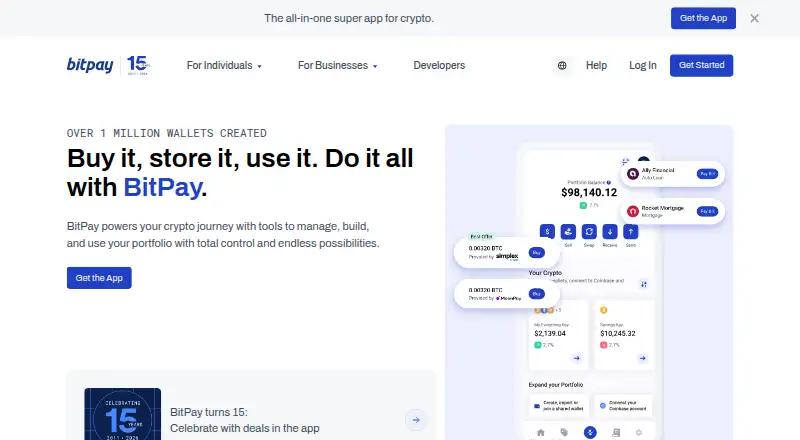
What BitPay is
BitPay gives businesses tools to accept cryptocurrency payments and send cryptocurrency payouts. Merchants can take payments online, in stores, or through email billing, with options for ecommerce, donations, and retail. Payment links and recurring billing are supported, and BitPay lists integrations and plugins for Shopify, WooCommerce, Magento, BigCommerce, and other ecommerce platforms. Developers can connect with BitPay REST APIs and SDKs or official libraries for Java, Node, PHP, C#, and Python.
BitPay converts customer cryptocurrency payments to local currency and initiates bank settlement the next business day. Businesses can choose settlement in fiat, cryptocurrency, or a combination. Supported payment methods include Bitcoin, Bitcoin Cash, Litecoin, Dogecoin, XRP, Polygon, Ethereum, Base, Optimism, Arbitrum, Solana, and supported stablecoins. Merchant processing fees vary by monthly transaction volume: 2% + 25¢* below $500,000 USD, 1.5% + 25¢* from $500,000 to $999,999 USD, and 1% + 25¢* at $1,000,000 USD or more. The free BitPay Wallet is available for mobile and desktop; it supports buying, selling, swapping, and storing cryptocurrency, gift card purchases, and bill payments. BitPay was founded in 2011 and is headquartered in Atlanta, Georgia, United States.
Who it suits
BitPay suits businesses that want to accept cryptocurrency across online, in-person, and email billing channels, with settlement choices and ecommerce integrations. Developers can use its APIs, SDKs, or language libraries, while individuals can use the free self-custody wallet for cryptocurrency and bill-related features.
What it does well
- Accepts payments online, in stores, and through email billing.
- Settlement can be in fiat, cryptocurrency, or a mix.
- Lists plugins for Shopify, WooCommerce, Magento, and BigCommerce.
- Offers REST APIs, SDKs, and libraries for five languages.
- Free wallet app supports buying, selling, swapping, and storing.
What to know first
- Merchant processing fees vary with monthly transaction volume.
- BitPay Bill Pay is available only to US residents.
- The self-custody wallet leaves cryptocurrency control with the user.
Limits
Merchant processing fees are 2% + 25¢* below $500,000 USD in monthly volume, 1.5% + 25¢* from $500,000 to $999,999 USD, and 1% + 25¢* at $1,000,000 USD or more. Bill Pay is currently limited to US residents.
Plans
| Plan | Billed and limits | Price |
|---|---|---|
| Under $500,000 monthly transaction volume | Less than $500,000 USD monthly transaction amount | On request |
| $500,000–$999,999 monthly transaction volume | $500,000–$999,999 USD monthly transaction amount | On request |
| At least $1,000,000 monthly transaction volume | At least $1,000,000 USD monthly transaction amount | On request |
| BitPay Wallet | free wallet download · mobile and desktop wallet | Free |
| Crypto acceptance — $1,000,000+ monthly volume | per transaction · monthly transaction volume of at least $1,000,000 | $125 a month |
| Crypto acceptance — $500,000–$999,999 monthly volume | per transaction · monthly transaction volume $500,000–$999,999 | $1.53 a month |
| Crypto acceptance — under $500,000 monthly volume | per transaction · monthly transaction volume below $500,000 · higher fees may apply to high-risk industries | $225 a month |
| BitPay merchant processing | Unlimited monthly transactions · fee based on cumulative monthly volume: < $500,000 USD: 2% + 25¢* · $500,000 - $999,999 USD: 1.5% + 25¢* · ≥ $1,000,000 USD: 1% + 25¢* | On request |
As bitpay.com lists them, read 20 Sept 2026. The maker's own page has the final word.
Getting started
- Visit the BitPay website.
- Choose merchant processing or the free BitPay Wallet.
- For merchant processing, select the monthly transaction volume tier that fits your business.
- Connect through a listed ecommerce plugin, REST API, SDK, or supported language library.
- Use the wallet on a supported mobile or desktop platform if you want its personal cryptocurrency features.
BitPay combines cryptocurrency payment processing for businesses with a self-custody wallet for individuals. It is best for merchants that want to accept crypto through several channels and choose how proceeds are settled. Its broad payment options are useful, but merchants should weigh volume-based fees and wallet users must manage their own custody.
Overview
Founded in 2011, BitPay lets businesses accept cryptocurrency and send crypto payouts. It can convert customer payments to local currency and initiate bank settlement the next business day, or let a business settle in fiat, cryptocurrency, or a mix. That flexibility suits companies with different treasury preferences; the transaction fee still varies with monthly volume.
Key features
Merchant payments
Merchants can accept payments online, in-store, or through email billing, using tools for ecommerce, donations, and retail. Payment links and recurring billing add collection options, and payouts are daily. Supported methods include Bitcoin, Bitcoin Cash, Litecoin, Dogecoin, XRP, Polygon, Ethereum, Base, Optimism, Arbitrum, Solana, and supported stablecoins. This range makes BitPay relevant to businesses whose customers use different crypto assets, rather than merchants seeking conventional card processing alone.
Plugins and integrations for Shopify, WooCommerce, Magento, BigCommerce, and other ecommerce platforms can connect payments with an existing store. Developers can build through REST APIs and SDKs or use official Java, Node, PHP, C#, and Python libraries. Those options suit both storefront operators and teams wanting a more tailored integration, though the API route requires development work.
Wallet and security
The separate BitPay Wallet supports buying, selling, swapping, and storing cryptocurrency, as well as buying gift cards and paying bills. It is self-custody: users control their cryptocurrency, which gives them direct responsibility rather than handing custody to the wallet provider. Bill Pay is available only to US residents, limiting that feature for the rest of BitPay's global audience.
BitPay's Trust Center lists SOC 3, SOC 1 Type 2, SOC 2 Type 2, NY DFS cybersecurity requirements, and DORA information. US merchant accounts are subject to business verification, and the compliance process includes KYC and AML checks. Support is directed through the Support Center and BitBot interface.
Pricing
The BitPay Wallet costs free and is the straightforward choice for individuals who want its mobile or desktop wallet features. BitPay merchant processing has no published plan price; its fee is based on cumulative monthly transaction volume, with unlimited monthly transactions:
- Under $500,000 USD monthly volume: 2% + 25¢ per transaction.
- $500,000–$999,999 USD monthly volume: 1.5% + 25¢ per transaction.
- At least $1,000,000 USD monthly volume: 1% + 25¢ per transaction.
The lower-volume tier carries the highest percentage fee, while the percentage falls as volume rises; each tier still includes the 25¢ component. Businesses should compare the applicable rate against their expected monthly volume before choosing BitPay. The merchant tiers are based on transaction amount, not separate feature packages, so the published distinction is the fee rate rather than a different toolset.
Platforms
BitPay lists Android, iOS, web, and API support, as well as Linux, macOS, and Windows. The wallet app is available for iOS, Android, Mac, Windows, and Linux, giving desktop users an option alongside mobile access.
Who it's for
BitPay is a strong fit for merchants that want crypto payments across online, retail, and email billing, need ecommerce integrations or developer tools, and value settlement in fiat, crypto, or both. The free wallet also suits individuals comfortable taking responsibility for custody. It is a weaker fit for businesses seeking a published flat merchant price, for users who need Bill Pay outside the United States, or for anyone who does not want self-custody.
Pros and cons
- Pros: Merchants can choose among multiple payment channels and settlement currencies, including next-business-day bank settlement after conversion to local currency.
- Pros: Ecommerce plugins, APIs, and language-specific libraries offer several routes to connect BitPay to a business's existing setup.
- Pros: The wallet is free and supports buying, selling, swapping, storage, gift cards, and bill payments.
- Cons: Processing fees vary by monthly volume and include a 25¢ charge per transaction, so the cost structure may not suit merchants who want a single flat rate.
- Cons: Bill Pay is restricted to US residents, and self-custody puts control and responsibility for cryptocurrency with the user.
Alternatives
Payment Processing Software and Crypto Payment Processors are useful starting points for comparing providers across those categories.
Choose Helcim instead if you want payment processing with no account monthly fees and interchange-plus transaction rates that vary by volume. Airwallex Payments is an alternative for online card and local payment acceptance, with a free Explore plan and processing fees that apply. Checkout Page may suit a smaller sales operation: its Free plan caps sales at $3,000 per 30 days and one team member, while Launch costs $29 a month.
Kill Bill is worth considering if a self-hosted, open-source core and control of infrastructure and data are priorities. Mollie offers pay-as-you-go pricing in euros, with no contract or commitment and stated rates for consumer cards. For invoice-focused businesses, PayPal Invoicing lets users create and send invoices without setup or subscription fees, with transaction fees when customers pay. Privacy.com is a different option for managing merchant-locked and single-use cards, with its Personal plan including 12 new cards per month. CashNotify may be more relevant for monitoring one Stripe or PayPal account on its free plan.
Verdict
Choose BitPay if your business needs several cryptocurrency payment channels, flexible settlement, or ecommerce integrations, or if you want a free self-custody wallet across mobile and desktop. Its main advantage is the combination of merchant payment options and settlement choice; look elsewhere if volume-based fees do not fit your costs, you need Bill Pay outside the United States, or you would rather not manage wallet custody yourself.
Verdict
Choose BitPay if your business needs several cryptocurrency payment channels, flexible settlement, or ecommerce integrations. Its free wallet is also suited to people who want self-custody tools across mobile and desktop. Look elsewhere if you need Bill Pay outside the United States or prefer not to manage wallet custody yourself.
Questions
Does BitPay have a free plan?
Yes. The BitPay Wallet is listed as free. Merchant processing fees are volume-based.
What does merchant processing cost?
The listed fee is 2% + 25¢* below $500,000 USD monthly volume, 1.5% + 25¢* from $500,000 to $999,999 USD, and 1% + 25¢* at $1,000,000 USD or more.
Which platforms does BitPay support?
The listed platforms are Android, API, iOS, Linux, macOS, web, and Windows. The wallet app is available for iOS, Android, Mac, Windows, and Linux.
Which cryptocurrencies can businesses accept?
Listed methods include Bitcoin, Bitcoin Cash, Litecoin, Dogecoin, XRP, Polygon, Ethereum, Base, Optimism, Arbitrum, Solana, and supported stablecoins.
Is the BitPay Wallet self-custody?
Yes. BitPay describes the wallet as self-custody, with users responsible for controlling their cryptocurrency.
Where can users get BitPay support?
BitPay directs users to its Support Center and offers assistance through the BitBot support interface.
Facts from BitPay's own pages
- API
- The REST API covers invoices, refunds, bills, exchange rates and ledgers, with signed BitAuth requests using secp256k1 identities. · developer.bitpay.com, 15 Oct 2026
- Bill pay
- The consumer app supports cryptocurrency bill payments, including credit-card and mortgage bills, subject to geographic restrictions. · bitpay.com, 15 Oct 2026
- Company facts
- LinkedIn lists BitPay as privately held, founded in 2011, headquartered in Atlanta and employing 51–200 people. · linkedin.com, 15 Oct 2026
- Company history
- BitPay says it was founded in 2011. · bitpay.com, 7 Oct 2026
- Company legal entities
- BitPay Inc. provides payment processing, BitPay B.V. operates in the Netherlands and BitPay Software LLC provides the wallet. · bitpay.com, 15 Oct 2026
- Compliance
- BitPay says US merchant accounts are subject to business verification and its compliance process includes KYC and AML checks. · developer.bitpay.com, 7 Oct 2026
- Developer options
- Developers can integrate through BitPay REST APIs and SDKs, or use official libraries including Java, Node, PHP, C#, and Python. · bitpay.com, 7 Oct 2026
- Documentation
- Developer documentation includes getting-started guides, ecommerce plugins, checkout integration, webhooks, SDK references and a changelog. · developer.bitpay.com, 15 Oct 2026
- Email billing
- The billing tool creates one-time or recurring invoices that merchants email to customers. · developer.bitpay.com, 15 Oct 2026
- Founded
- 2011 · bitpay.com, 28 Sept 2026
- Founders
- Crunchbase identifies Anthony Gallippi and Stephen Pair as BitPay founders and gives May 1, 2011 as the founding date. · crunchbase.com, 15 Oct 2026
- Funding
- LinkedIn says BitPay raised more than $70 million from investors including Index Ventures, Aquiline, Menlo Ventures, Founders Fund and Richard Branson. · linkedin.com, 15 Oct 2026
- Gift cards
- The wallet offers crypto purchases of gift cards from more than 250 brands. · play.google.com, 15 Oct 2026
- Headquarters
- Atlanta, Georgia, United States · bitpay.com, 28 Sept 2026
- In-store payments
- BitPay Checkout provides QR-based retail acceptance through iOS and Android devices. · developer.bitpay.com, 15 Oct 2026
- Integrations
- BitPay lists integrations and plugins for Shopify, WooCommerce, Magento, BigCommerce, and other ecommerce platforms. · bitpay.com, 7 Oct 2026
- Licence
- The BitPay wallet is open source and maintained by BitPay; public BitPay repositories include MIT-licensed wallet and client components. · support.bitpay.com, 15 Oct 2026
- Limit: customer support
- Reviewers repeatedly report slow or ineffective support, long waits and difficulty getting help with payment problems. · g2.com, 15 Oct 2026
- Limit: outages
- IsDown records incidents including XRP invoice disablement in August 2026, DOGE disablement in August 2026 and 42 incidents since March 2021. · isdown.app, 15 Oct 2026
- Limit: transaction failures
- Trustpilot reviewers allege delayed or stuck funds, withdrawal failures, network errors, refund disputes and weak support responses; these are user reports rather than verified findings. · trustpilot.com, 15 Oct 2026
- Limit: verification and access
- Reviews complain that account approval can take weeks and that strict KYC or payment-source checks can block use. · softwareadvice.com, 15 Oct 2026
- Notable limit
- BitPay Bill Pay is currently available only to US residents. · support.bitpay.com, 7 Oct 2026
- Notable outage news
- IsDown lists a roughly seven-hour XRP invoice-payment disablement on August 26, 2026. · isdown.app, 15 Oct 2026
- Online checkout
- Merchants can accept crypto through hosted checkout, payment buttons, invoices or integrations for Shopify, WooCommerce, Magento and BigCommerce. · bitpay.com, 15 Oct 2026
Where BitPay stands on Freedom251
- Payment Processing Software#1 of 71
- Crypto Payment Processors#1 of 20
- Crypto Wallets software#1 of 20