Freedom251 › Utility Billing Software

Billingly
What Billingly is
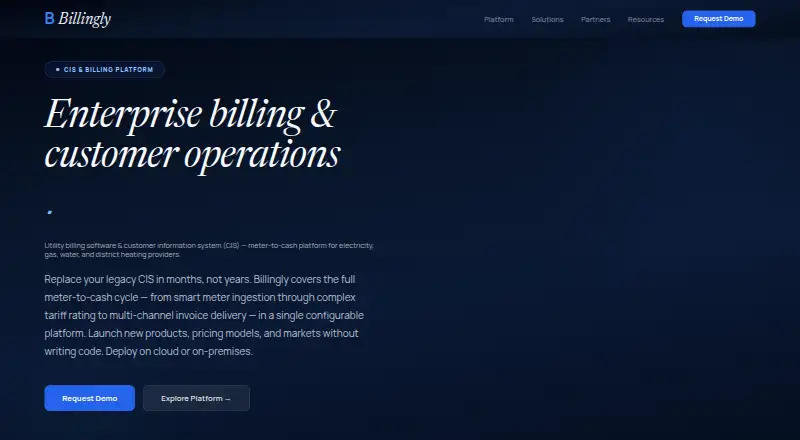
Billingly is a configurable utility billing and customer information system for providers that manage recurring services. It covers meter-to-cash operations for electricity, gas, water, district heating, and other service types. Its billing engine handles periodic mass invoicing, consumption charges, corrections, invoice grouping, and delivery by email, paper, or e-invoice. Providers can define pricing, corrections, and invoice lines with configurable expression-language formulas. Customer and contract tools include customer records, network infrastructure hierarchies, contract lifecycle management, and automated supplier switching workflows. Meter readings enter through an asynchronous MDM pipeline that uses REST requests and S3 staging, with retries and forecast fallback. Billingly lists REST APIs, MDM and national address registry integrations, financial system exports, and pre-built Amazon S3 and SQS connectors. It can be deployed as SaaS or on-premises and is available through web, API, and self-hosted options. The company states that it has ISO 27001 security compliance, role-based access controls, structured audit logging, GDPR compliance, and an EU-only data residency option. It also says its AI reporting assistant generates SQL internally without sending customer data to external AI services. Pricing is available by request; demos and tailored walkthroughs can be requested from the team.
Who it suits
Billingly suits utility and recurring-service providers that need to manage metering, tariffs, customer contracts, supplier switching, and invoicing in one system. It may also suit organizations that need SaaS or on-premises deployment and integrations with meter data, address registries, or financial systems.
What it does well
- Handles billing for electricity, gas, water, and district heating.
- Supports mass invoicing, consumption charges, corrections, and invoice grouping.
- Offers configurable formulas for pricing and invoice lines.
- Includes contract lifecycle tools and automated supplier switching.
- Can be deployed as SaaS or on-premises.
- Lists ISO 27001 compliance and an EU-only data residency option.
What to know first
- Pricing is available only by request.
- The listed deployment choices are SaaS or on-premises.
Getting started
- Visit the Billingly website.
- Request a demo or talk to the sales team.
- Ask the team for tailored technical documentation or a walkthrough.
- Discuss SaaS or on-premises deployment and the integrations needed.
Billingly is a configurable utility billing and customer information system for operators handling metered and recurring services. It suits utilities and other service providers that want billing, customer, contract, and meter data in one operating platform. Its strongest case is broad operational coverage with flexible deployment; organizations wanting transparent plan prices should expect a sales-led purchase.
Overview
Billingly covers meter-to-cash work for electricity, gas, water, district heating, and other recurring services. It is also aimed at energy retailers, telecom and internet providers, waste-management organizations, and SaaS businesses. The platform combines invoicing with customer records, network infrastructure hierarchies, contract lifecycle management, and connection and metering-point data. That breadth can replace several disconnected systems, while smaller providers with straightforward recurring invoices may find its scope unnecessary.
Mixed billing models, rate management, meter-data import, payment processing, and a customer account portal make it suitable for both consumption-based and recurring charges. Teams should nevertheless map its contract and customer workflows to their own operating model before committing.
Key features
Billing and tariff control
The billing engine handles periodic mass invoicing, consumption charges, corrections, invoice grouping, and delivery by email, paper, or e-invoice. Configurable expression-language formulas let operators encode pricing rules, adjustments, and invoice lines rather than relying on fixed tariff templates. This is valuable for complex or changing rate structures, but it places responsibility on the organization to govern and maintain those formulas.
Customer, contract, and network data
Customer records bring together contacts, contracts, premises, connection points, metering points, properties, and GDPR consents. Network hierarchies, contract lifecycle management, and automated supplier-switching workflows extend the system beyond invoicing. Providers managing many relationships and service locations gain a unified operational view; a billing-only team may be paying for capabilities it does not use.
Meter-data pipeline
Readings enter through an asynchronous MDM pipeline using REST requests and S3 staging. Retries and forecast fallback are designed to keep processing moving when readings arrive late or fail, which matters for recurring billing runs. The approach is integration-oriented, so implementation teams need suitable meter-data and operational expertise.
Integrations, security, and reporting privacy
REST APIs, MDM and national address-registry integrations, financial-system exports, and pre-built Amazon S3 and SQS connectors support connected utility operations. Billingly states ISO 27001 security compliance, role-based access controls, and structured audit logging. Its AI reporting assistant generates SQL internally from a reporting dataset that excludes or masks personal information; customer data is not sent to external AI services. GDPR support includes an EU-only data-residency option, useful for organizations with strict regional requirements.
Scale and support
The provider cites 99.9% platform uptime, runs of more than 600,000 invoices, and 200 concurrent users. These figures indicate an intended fit for substantial billing operations, although organizations should validate that the stated capacity matches their own workload. Tailored demos, technical documentation, and walkthroughs can be requested from the team.
Pricing
Billingly uses paid, custom pricing. Product pages direct prospective customers to request a demo or speak with sales rather than presenting plan prices, so budget approval requires a conversation tailored to deployment and scope. This model can suit utilities with distinctive tariff, integration, or residency requirements, but it makes direct comparison and early cost estimation difficult. There is no free tier or published trial term to evaluate in the stated offering.
Platforms
Billingly is offered through a web interface and API, with self-hosted deployment alongside SaaS. SaaS reduces infrastructure ownership, while self-hosting can accommodate organizations that need tighter control over environment and data location. Teams should decide which operating model fits their security, integration, and support responsibilities.
Who it's for
Billingly is a strong candidate for electricity, gas, water, and district-heating providers managing metered consumption, complex tariffs, and large invoice batches. Energy retailers, telecom and ISP operators, waste-management services, and SaaS businesses can also consider it when customer, contract, and recurring-service data must stay connected. It is less compelling for a small provider seeking a simple, low-cost invoicing application with immediately visible pricing.
Pros and cons
Pros
- Broad meter-to-cash coverage: billing, customer, contract, network, and meter data are handled in one platform.
- Flexible tariff logic: expression-language formulas can represent pricing, corrections, and invoice-line rules.
- Operational resilience: asynchronous meter-data intake includes retries and forecast fallback.
- Deployment choice: SaaS and self-hosted options support different infrastructure and residency needs.
- Integration and privacy controls: APIs, S3/SQS connectors, role-based access, audit logs, ISO 27001 compliance, and an EU-residency option support regulated operations.
Cons
- Custom pricing: buyers cannot calculate subscription cost from published plans.
- Implementation breadth: tariff formulas and extensive data workflows require capable administration and integration planning.
- Potentially excessive scope: simple recurring-service providers may not need the full customer, network, and meter-data system.
Alternatives
For a wider comparison, browse Utility Billing Software.
- Cadebill is a paid API, web, and Windows option from MCL Systems, a telecommunications and business-process software firm; choose it when that platform mix and maker focus better match your environment.
- CivicPlus Utility Billing is a paid Android, iOS, and web product with custom pricing; pick it when mobile access across those platforms is a priority.
- CUBIC Utility Billing is a paid web and Windows alternative for teams preferring those clients.
- MuniBilling charges a setup and training fee plus a recurring monthly amount based on service locals billed; consider it when that usage-based commercial structure fits.
- AMCS Utility Billing is a paid web-based alternative.
- Cogsdale CSM Utility Billing is a paid Android and iOS product sold through a demo-led process.
- CUSI Utility Billing offers paid web and Windows deployment, with hosted UB4 or on-premise UMS options.
- gWorks Utility Billing is a paid web service priced by customized quote based on community size and selected solutions.
Verdict
Choose Billingly when a utility or recurring-service operator needs configurable billing tied closely to customer, contract, network, and meter data, with SaaS or self-hosted deployment. Its tariff flexibility, integration options, and stated scale are the main reasons to shortlist it. Look elsewhere if published prices, a lightweight billing scope, or a quick self-serve purchase matters more than enterprise-oriented configurability.
Verdict
Utility providers should consider Billingly when they need configurable billing alongside customer, contract, and meter data operations. Its integrations and SaaS or on-premises deployment options support different operating setups. Organizations seeking published plan prices should look elsewhere or request pricing from the company.
Questions
How much does Billingly cost?
Pricing is available on request. The company directs prospective customers to request a demo or talk to sales.
What services does Billingly support?
It is presented for electricity, gas, water, district heating, and other recurring service providers.
Can Billingly be self-hosted?
Yes. Billingly states that it can be deployed as SaaS or on-premises, and lists self-hosted, web, and API platforms.
Which integrations does Billingly list?
It lists REST APIs, MDM and national address registry integrations, financial system exports, and pre-built Amazon S3 and SQS connectors.
What security and data residency statements does Billingly make?
The company says it has ISO 27001 security compliance, role-based access controls, structured audit logging, GDPR compliance, and an EU-only data residency option.
Facts from Billingly's own pages
- AI reporting privacy
- For AI reporting, the site says customer data is not sent to external AI services and the model works from a reporting dataset that excludes or masks personal information. · billingly.com, 9 Oct 2026
- Billing
- The billing engine supports mass invoicing, fixed and consumption-based charges, corrections, invoice grouping, and email, paper, and e-invoice delivery. · billingly.com, 9 Oct 2026
- Compliance
- The site states that Billingly is ISO 27001 security compliant and supports GDPR, including an EU-only data residency option. · billingly.com, 9 Oct 2026
- Customer and contract operations
- The platform includes customer records, network infrastructure hierarchies, contract lifecycle management, and automated supplier switching workflows. · billingly.com, 8 Oct 2026
- Customer and network data
- Its customer information system brings together customer records, contacts, contracts, premises, connection points, metering points, properties, and GDPR consents. · billingly.com, 9 Oct 2026
- Data residency
- The site lists GDPR compliance with an EU-only data residency option. · billingly.com, 8 Oct 2026
- Deployment
- The platform can be deployed on cloud or on-premises. · billingly.com, 9 Oct 2026
- Industries
- The platform is presented for electricity, gas, water, district heating, and other recurring service providers. · billingly.com, 8 Oct 2026
- Integrations
- Billingly lists REST APIs, MDM and national address registry integrations, financial system exports, and pre-built Amazon S3 and SQS connectors. · billingly.com, 8 Oct 2026
- Intended users
- The platform is presented for utilities and service providers, including energy retailers, water utilities, district heating providers, telecom and ISP operators, waste management, and SaaS businesses. · billingly.com, 9 Oct 2026
- Meter data
- The platform integrates with external meter data management systems through a REST API and an asynchronous pipeline for readings and corrections. · billingly.com, 9 Oct 2026
- Other integrations
- The site lists national address registry APIs, financial system exports, Amazon S3, and Amazon SQS among its integration capabilities. · billingly.com, 9 Oct 2026
- Performance claims
- The homepage lists 99.9% platform uptime, capacity for 600K+ invoices per run, and 200 concurrent users. · billingly.com, 8 Oct 2026
- Pricing
- The opened maker pages direct prospective customers to request a demo and do not state plan prices. · billingly.com, 9 Oct 2026
- Privacy
- Billingly states that its AI reporting assistant generates SQL internally and does not send customer data to external AI services. · billingly.com, 8 Oct 2026
- Product
- Billingly is a utility billing and customer information system covering meter-to-cash operations for electricity, gas, water, and district heating providers. · billingly.com, 9 Oct 2026
- Security
- The site says the platform uses role-based access controls, maintains an audit trail of AI reporting queries, and is built following Security and Privacy by Design principles. · billingly.com, 9 Oct 2026
- Support
- The site invites prospective customers to request a tailored demo and says its team will follow up with scheduling details. · billingly.com, 9 Oct 2026
- Tariffs
- Pricing rules are defined with configurable formulas, and the site says business users can update them without platform development. · billingly.com, 9 Oct 2026
Where Billingly stands on Freedom251
- Utility Billing Software#5 of 26