Freedom251 › Fixed Asset Management Software

AssetAccountant
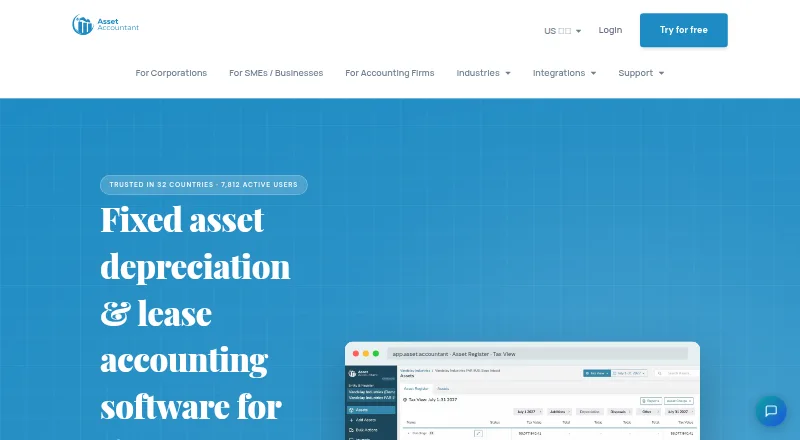
What AssetAccountant is
AssetAccountant is cloud-based fixed-asset depreciation and lease-accounting software for businesses, corporations and accounting firms. It calculates tax and accounting depreciation side by side using methods such as MACRS, GDS, ADS, DDB, straight-line and units of use. Its lease tools automate payment schedules, interest accruals and right-of-use amortization, with support for ASC 842 and IFRS 16. Users can manage multiple companies, funds or clients under one login. Reports cover depreciation schedules, disposals, tax reconciliations and movement summaries. Native integrations include Xero, QuickBooks Online, Sage Intacct and Microsoft Dynamics 365; journal exports are available for other ERP systems including SAP, Oracle, MYOB and NetSuite. The free plan covers up to 10 assets and excludes leases. The listed Lite plan costs $6,100 a month, Basic costs $121,004 a month and Standard costs $181,006 a month, each billed monthly per 100 assets. Premium has annual quote pricing for more than 1,000 assets or complex requirements. A 30-day trial is listed. The company says it is ISO 27001 certified and hosts the platform on Microsoft Azure.
Who it suits
AssetAccountant suits businesses and US CPA firms handling fixed-asset registers, including firms managing multiple client records. It is relevant to organizations that need depreciation calculations, lease accounting or reporting across multiple entities.
What it does well
- Calculates tax and accounting depreciation side by side
- Supports ASC 842 and IFRS 16
- Manages multiple companies, funds or clients
- Integrates natively with four named accounting platforms
- Free plan includes up to 10 assets
What to know first
- Free plan excludes leases
- Free plan is limited to 10 assets
- Paid plans are billed per 100 assets
- Premium pricing requires an annual quote
Limits
The free plan covers up to 10 assets and excludes leases. Lite, Basic and Standard are billed monthly per 100 assets; Premium is for more than 1,000 assets or complex requirements and uses annual pricing by quote.
Plans
| Plan | Billed and limits | Price |
|---|---|---|
| Free | Free forever · Up to 10 assets · Includes all features and integrations except leases | Free |
| Lite | All paid plans billed monthly, per 100 assets · Xero and QuickBooks Online integrations · Automated journals · IRS MACRS · Section 179 · Bonus depreciation | $6,100 a month |
| Premium | Annual pricing for >1,000 assets / complex requirements · Standard plus weekly calendars · Sage Intacct and Microsoft Dynamics integrations · Multiple assets per loan | On request |
| Basic | All paid plans billed monthly, per 100 assets · Lite plus classifications, custom fields, attachments, partial acquisitions and disposals, asset finance loans | On request |
| Standard | All paid plans billed monthly, per 100 assets · Basic plus bulk actions, consolidations, impairments, components, WIP/CIP · ASC 842 · Right-of-use assets | On request |
As asset.accountant lists them, read 29 Sept 2026. The maker's own page has the final word.
Getting started
- Open the AssetAccountant website.
- Choose the free plan or review the paid plans.
- Use the 30-day trial if you want to try the service.
- Access the cloud platform on the web or through its API.
- Connect a listed accounting integration or use journal exports for another ERP.
Overview
AssetAccountant is cloud software for fixed-asset depreciation and lease accounting, aimed at businesses and accounting firms, including US CPA firms managing client registers. Its strongest case is bringing tax and book depreciation, leases, and multiple entities into one system; the free plan is better treated as a small-register starting point than a full evaluation of lease workflows.
Key features
Tax and accounting depreciation are calculated side by side, with methods including MACRS, GDS, ADS, DDB, straight-line, and units of use. That range suits organizations that need tax schedules as well as accounting records, rather than a basic asset list. Reports cover depreciation schedules, disposals, tax reconciliations, and movement summaries, giving finance teams several ways to review activity and balances.
Lease accounting automates payment schedules, interest accruals, and right-of-use amortization for ASC 842 and IFRS 16. This is a substantial reason to consider AssetAccountant if leases belong in the same process as fixed assets, but the free plan excludes leases, so that capability requires a paid plan.
Native integrations include Xero, QuickBooks Online, Sage Intacct, and Microsoft Dynamics 365. Journal exports support other ERP workflows, including SAP, Oracle, MYOB, and NetSuite. Multiple companies, funds, or clients can sit under one login, a useful fit for accounting firms handling several registers. The company says the service is ISO 27001 certified and hosted on Microsoft Azure; it also advertises 24/7 customer-success coverage, free implementation support, and an average first response within 48 minutes.
Pricing
The Free plan costs nothing and is free forever. It includes all features and integrations except leases, but caps the register at 10 assets. That is enough for a small register, not a broad portfolio or a lease-accounting assessment.
Paid plans are billed monthly per 100 assets. Lite costs $6,100 a month and adds Xero and QuickBooks Online integrations, automated journals, IRS MACRS, Section 179, and bonus depreciation. It fits users focused on core depreciation and those two accounting connections, but does not include the added asset-management tools in higher tiers.
Basic costs $121,004 a month and adds classifications, custom fields, attachments, partial acquisitions and disposals, and asset finance loans to Lite. It is the more relevant step for teams that need richer records or financing details. Standard costs $181,006 a month and adds bulk actions, consolidations, impairments, components, WIP/CIP, ASC 842, and right-of-use assets. That makes Standard the clearest fit for organizations combining lease accounting with more involved asset workflows.
Premium has custom pricing, billed annually, for more than 1,000 assets or complex requirements. It adds weekly calendars, Sage Intacct and Microsoft Dynamics integrations, and multiple assets per loan to Standard. Consider it when the stated scale or requirements call for those additions; otherwise, the lower tiers define the published plan options. The maker also offers a 30-day trial.
Platforms
AssetAccountant is a cloud deployment available through the web and an API. The API may suit connected workflows, while web access keeps the core product cloud-based.
Who it's for
AssetAccountant is best suited to businesses and accounting firms that need tax and book depreciation, and especially to firms managing multiple client registers. It is also a stronger candidate when lease accounting under ASC 842 or IFRS 16 must accompany asset accounting. A very small register can start on Free, but organizations with more than 10 assets, lease needs, or complex requirements should assess the paid tiers against their volume and integration needs.
Pros and cons
- Pro: Side-by-side tax and accounting depreciation covers a broad set of methods, including US tax methods such as MACRS.
- Pro: Lease schedules and right-of-use accounting make it relevant beyond fixed-asset depreciation alone.
- Pro: Multi-entity management and a mix of native integrations and journal exports support firms and businesses with varied accounting systems.
- Con: Free is limited to 10 assets and excludes leases, sharply narrowing its usefulness for larger registers or lease evaluation.
- Con: Premium is an annual quote for more than 1,000 assets or complex needs, so users at that scale must seek custom pricing.
Alternatives
For a broader comparison, browse Fixed Asset Management Software.
AssetFrog is worth considering if a 50-asset free plan or mobile and desktop platform coverage matters more than AssetAccountant’s stated lease-accounting scope. Fixed Asset Register is another option to compare for a free plan and trial. AssetCenter offers a free tier with 25 assets and no reports, or a paid 250-asset Starter plan. xAssets ITAM may suit a one-user endpoint-management need, with a free cloud-hosted Express Edition for 100 endpoints per user. AssetComply offers a free plan for up to 100 assets. Minty Assets has a free 50-asset Starter plan for one company with straight-line or no depreciation, and a $9 a month Pro plan billed annually. AssetsTrak is a paid alternative. MeltX FAM is another paid option.
Verdict
Choose AssetAccountant if your business or firm needs tax and accounting depreciation together, with multi-entity registers and lease accounting available in the paid tiers. Its breadth of depreciation methods, lease workflows, and accounting connections is the strongest reason to choose it. Look elsewhere if you need a free system for more than 10 assets or need leases without moving beyond Free.
Verdict
AssetAccountant combines depreciation and lease accounting with multi-entity management and accounting integrations. The free plan is narrow for asset volume and excludes leases, so check the listed plan terms against your register and accounting needs.
Questions
Is there a free plan?
Yes. The Free plan is free forever and covers up to 10 assets.
Does the free plan include lease accounting?
No. Lease features are excluded from the Free plan.
How much do paid plans cost?
The listed pricing note says paid plans start at $6. Paid plans are billed monthly per 100 assets; Premium uses annual pricing by quote.
Which platforms does AssetAccountant support?
The listed platforms are web and API. The service is described as cloud-based.
Which accounting integrations are available?
Native integrations include Xero, QuickBooks Online, Sage Intacct and Microsoft Dynamics 365. Journal exports are listed for SAP, Oracle, MYOB and NetSuite, among other ERPs.
Does it support lease accounting standards?
Yes. Lease accounting supports ASC 842 and IFRS 16.
Facts from AssetAccountant's own pages
- Audience
- The US offering is presented for businesses and US CPA firms, including firms managing multiple client registers. · asset.accountant, 29 Sept 2026
- Company history
- AssetAccountant says it was formed in February 2019 and released its initial fixed asset depreciation MVP in June 2020. · asset.accountant, 29 Sept 2026
- Depreciation
- It calculates tax and accounting depreciation side by side using methods including MACRS, GDS, ADS, DDB, straight-line and units of use. · asset.accountant, 29 Sept 2026
- Founded
- 2019 · asset.accountant, 23 Sept 2026
- Free plan limit
- The free plan is for up to 10 assets and excludes leases. · asset.accountant, 29 Sept 2026
- Integrations
- Native integrations include Xero, QuickBooks Online, Sage Intacct and Microsoft Dynamics 365, with journal exports for other ERPs including SAP, Oracle, MYOB and NetSuite. · asset.accountant, 29 Sept 2026
- Lease accounting
- The software automates lease payment schedules, interest accruals and right-of-use amortization and supports ASC 842 and IFRS 16. · asset.accountant, 29 Sept 2026
- Multi-entity
- Users can manage multiple companies, funds or clients under one login. · asset.accountant, 29 Sept 2026
- Paid plan limits
- The maker says Premium is for more than 1,000 assets or complex requirements and uses annual pricing by quote. · asset.accountant, 29 Sept 2026
- Product
- AssetAccountant is cloud-based fixed asset depreciation and lease accounting software for accounting firms, corporations and businesses. · asset.accountant, 29 Sept 2026
- Reporting
- Reports include depreciation schedules, disposal reports, tax reconciliations and movement summaries. · asset.accountant, 29 Sept 2026
- Security
- The company says it is ISO 27001 certified and the platform is hosted on Microsoft Azure. · asset.accountant, 29 Sept 2026
- Support
- The maker advertises 24/7 customer success coverage, free implementation support and an average first response within 48 minutes. · asset.accountant, 29 Sept 2026
Where AssetAccountant stands on Freedom251
- Fixed Asset Management Software#3 of 27