Freedom251 › Secrets Scanning Software

Arnica Secrets Security
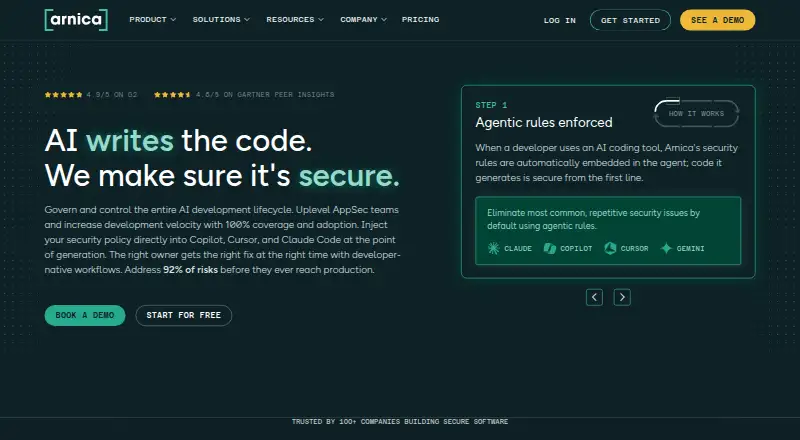
What Arnica Secrets Security is
Arnica Secrets Security detects and validates hardcoded secrets in code repositories. For newly pushed secrets it validates, it can mitigate exposure by rewriting commits and removing the secret from Git history. Severity reflects validation context, including whether credentials belong to highly privileged or development accounts. The product scans codebases daily and revalidates secrets when code changes and during scheduled scans. It integrates with GitHub, GitLab, Azure DevOps, and Bitbucket, with alerts through Slack and Microsoft Teams and tickets through Jira or Azure DevOps Boards. Teams can configure regex-based detectors, ignored paths, and policies for scanning and resolution workflows. Arnica says it does not persist source-code snippets containing detected secrets and encrypts collected customer data at rest with tenant separation. Its cloud infrastructure is hosted on AWS, with TLS 1.2 or 1.3 in transit and AES 256 at rest. Pricing is per identity per year: Free costs nothing, Business is $300 a year, and Enterprise is $600 a year. Free-tier ingestion runs every seven days; premium plans run in real time. A 14-day trial is available.
Who it suits
Arnica suits teams scanning code repositories for exposed credentials and managing secret-resolution workflows. It connects with four listed source-control platforms and supports configurable detection policies.
What it does well
- Detects and validates hardcoded secrets
- Can remove validated secrets from Git history
- Supports four listed VCS platforms
- Offers configurable regex-based detectors
- Includes a 14-day trial
What to know first
- Free-tier ingestion runs every seven days
- Business costs $300 per identity per year
- Enterprise costs $600 per identity per year
Limits
The Free plan ingests data every seven days. Business is listed at $300 per identity per year, and Enterprise at $600 per identity per year.
Plans
| Plan | Billed and limits | Price |
|---|---|---|
| Free | Per Identity / Year · Weekly automated reports · SAST, SCA, IaC, licensing, and reputation scans · Secrets scanning · SSO · Customer success | Free |
| Business | Per Identity / Year · 30 AI credits per identity · Real-time scanning · Slack and Microsoft Teams ChatOps · Zero new secret policy enforcement · Real-time secrets mitigation | $300 a year |
| Enterprise | Per Identity / Year · 100 AI credits per identity · Custom code risk and secret rules · Arnica API · On-premise instance support · Jira integration | $600 a year |
As arnica.io lists them, read 5 Oct 2026. The maker's own page has the final word.
Getting started
- Visit https://www.arnica.io/.
- Choose the Free plan or a paid plan; a 14-day trial is available.
- Connect a supported VCS provider: GitHub, GitLab, Bitbucket, or Azure DevOps.
- Configure detectors, ignored paths, and scanning or resolution policies as needed.
- Set up Slack or Microsoft Teams alerts, or ticketing through Jira or Azure DevOps Boards.
Overview
Arnica Secrets Security is a secrets-scanning tool for teams managing code across repositories and development workflows. It is best suited to organizations that want validated findings connected to policy enforcement and remediation. Its standout advantage is the path from detection to removing validated, newly pushed secrets from Git history; the main trade-off is that real-time ingestion requires a paid plan.
Key features
Arnica scans codebases daily and revalidates secrets when code changes and during scheduled scans. It uses validation context—including whether credentials belong to a highly privileged or development account—to assign severity. That can help teams focus response on credentials with greater potential impact instead of treating every match alike.
For newly pushed secrets it validates, Arnica can automatically mitigate by rewriting commits and removing secrets from Git history. Business adds real-time secrets mitigation and a policy to prevent new secrets. This makes the product more than a detection feed, although the described remediation applies to validated secrets.
Teams can create regex-based detectors, exclude paths and configure scanning and resolution policies. Arnica supports GitHub, GitLab, Azure DevOps and Bitbucket, with alerts through Slack and Microsoft Teams and tickets through Jira or Azure DevOps Boards. Pull-request scanning and push protection are supported, giving teams several points to catch or route findings.
Arnica says it does not persist source-code snippets containing detected secrets. It encrypts customer data at rest with AES 256 and in transit with TLS 1.2 or 1.3, uses tenant separation, and hosts its cloud infrastructure on AWS. It also states that it is SOC 2 Type 2 compliant, with annual third-party examination of its controls. Enterprise includes support for an on-premise instance, and on-prem deployment is an add-on.
Pricing
Arnica uses per-identity annual billing. It defines billable identities as users and other contributing entities with code contributions or pull-request activity in the previous 90 days, with duplicates removed across organizations. That definition matters for teams estimating costs: the billable population is not limited to named users.
| Plan | Price | What it includes |
|---|---|---|
| Free | free, billed Per Identity / Year | Weekly automated reports; SAST, SCA, IaC, licensing and reputation scans; secrets scanning; SSO; customer success. |
| Business | $300 a year, billed Per Identity / Year | 30 AI credits per identity; real-time scanning; Slack and Microsoft Teams ChatOps; Zero new secret policy enforcement; real-time secrets mitigation. |
| Enterprise | $600 a year, billed Per Identity / Year | 100 AI credits per identity; custom code risk and secret rules; Arnica API; on-premise instance support; Jira integration. |
The free plan includes secrets scanning and SSO, but data ingestion runs every seven days, making it a poor fit when teams need current findings between weekly updates. Business is the practical step up for real-time scanning, mitigation and ChatOps. Enterprise adds custom rules, API access, Jira integration and on-premise instance support; choose it when those capabilities matter. A 14-day trial is available, and paid pricing starts at $300 a year.
Platforms
Arnica is available through API, self-hosted and web deployments. Its supported version-control systems are GitHub, GitLab, Bitbucket and Azure DevOps. Teams needing an on-premise instance should note that this is tied to Enterprise support and is also treated as an add-on.
Who it's for
Arnica suits development and security teams that need repository secret detection, contextual prioritization and a defined route to mitigation. It is a stronger fit for teams ready to pay for real-time ingestion and policy enforcement than for those content with weekly data updates. Its regex rules, ignored paths and workflow policies also make it useful where teams need to tailor detection and resolution to their codebase.
Pros and cons
- Pro: Validation context informs severity, helping teams distinguish findings tied to privileged credentials from lower-impact cases.
- Pro: Newly pushed validated secrets can be removed from Git history through commit rewriting, extending response beyond alerting.
- Pro: Repository integrations, chat alerts and ticketing connect detection with existing development and response workflows.
- Con: Free ingestion runs every seven days, so it does not provide the timely coverage of the premium real-time plans.
- Con: Identity-based annual billing includes contributing entities active in the last 90 days, not just registered users, which teams need to account for when sizing a plan.
Alternatives
For a wider application-security posture management search, browse Application Security Posture Management Software. For a focused category comparison, see Secrets Scanning Software.
- Conviso Platform is worth considering if its free tier’s caps of five contributing developers, five assets, ten users and two integrations suit a smaller deployment; its Developers plan is $19 a month, billed $2,040 charged per year.
- OWASP DefectDojo is an option for teams seeking an open-source community edition that is free forever, with support through OWASP Slack and GitHub, or a self-hosted and Linux platform.
- Phoenix Security may fit teams whose needs align with its free tier of up to 1000 assets, two premium users plus guests, dashboard reporting and community support.
- SecurStack is a more bounded free option for teams that can work within 500 scan credits per month, three users and ten projects, with SAST, SCA and secrets scanning.
- Strobes ASPM is an alternative for teams that can use a free plan capped at 100 assets, 500 tasks per month and one connector, with ASM, RBVM and ASPM.
- OX Security is a paid alternative with a broader stated scope, including SAST, SCA, secrets and PII, SBOM, IaC, CI/CD, container scanning, and IDE and CLI coverage; pricing is custom.
- Foxnode ASPM is another free ASPM option with API, Linux, self-hosted and web platforms.
- Ivanti Neurons for Zero Trust Access is a paid alternative for teams looking for named-user licensing and broad platform support; pricing is custom.
Verdict
Choose Arnica if your team wants secret findings ranked with credential context and a remediation path that can remove validated new exposures from Git history. Its strongest case is the combination of configurable detection, repository integrations and real-time mitigation on paid plans. Look elsewhere if weekly ingestion is too slow for your free-tier needs or if your primary requirement is a broader ASPM platform rather than secrets management.
Verdict
Arnica combines secret detection, validation, and mitigation with repository integrations and configurable policies. Free ingestion is weekly, while premium plans provide real-time ingestion.
Questions
Is there a free plan?
Yes. Free costs nothing per identity and includes secrets scanning, SSO, and customer success.
How much do the paid plans cost?
Business costs $300 a year per identity. Enterprise costs $600 a year per identity.
Is a free trial available?
Yes, a 14-day trial is available.
Which platforms and VCS providers are supported?
The listed platforms are API, self-hosted, and web. Supported VCS providers are GitHub, GitLab, Bitbucket, and Azure DevOps.
What integrations are available?
The product lists GitHub, GitLab, Azure DevOps, and Bitbucket integrations. Alerts can go through Slack and Microsoft Teams; tickets can go through Jira or Azure DevOps Boards.
Can Arnica be deployed on-premise?
Enterprise includes support for an on-premise instance. Arnica's pricing comparison marks on-prem deployment as an add-on.
Facts from Arnica Secrets Security's own pages
- Compliance
- Arnica states that it is SOC 2 Type 2 compliant and describes annual third-party examination of its controls. · arnica.io, 5 Oct 2026
- Customization
- Teams can configure custom regex-based secret detectors, ignored paths, and policies for scanning and resolution workflows. · arnica.io, 5 Oct 2026
- Data handling
- Arnica says it does not persist source-code snippets containing detected hardcoded secrets, and encrypts collected customer data at rest with tenant separation. · docs.arnica.io, 5 Oct 2026
- Deployment
- The Enterprise plan includes support for an on-premise instance, and Arnica's pricing comparison marks on-prem deployment as an add-on. · arnica.io, 5 Oct 2026
- Encryption and hosting
- Arnica says its cloud infrastructure is hosted on AWS and customer data is encrypted in transit with TLS 1.2 or 1.3 and at rest with AES 256. · arnica.io, 5 Oct 2026
- Free-tier limit
- Arnica says data ingestion runs every seven days on the free plan and runs in real time on premium plans. · arnica.io, 5 Oct 2026
- Identity billing
- Arnica defines billable identities as users and other contributing entities with code contributions or pull-request activity in the last 90 days, with duplicates removed across organizations. · arnica.io, 5 Oct 2026
- Integrations
- The secrets product page lists GitHub, GitLab, Azure DevOps, and Bitbucket integrations, with alerts through Slack and Microsoft Teams and tickets through Jira or Azure DevOps Boards. · arnica.io, 5 Oct 2026
- Product
- Arnica detects and validates hardcoded secrets and can automatically mitigate newly pushed validated secrets by rewriting commits and removing them from Git history. · arnica.io, 5 Oct 2026
- Scheduled scans
- Arnica scans the codebase daily and revalidates secrets on code changes and scheduled scans. · arnica.io, 5 Oct 2026
- Support
- The Free plan includes customer success, and Enterprise includes support for an on-premise instance. · arnica.io, 5 Oct 2026
- Validation
- Arnica assigns secret severity using validation context, including whether credentials belong to a highly privileged or development account. · arnica.io, 5 Oct 2026