Freedom251 › Application Security Posture Management Software

Phoenix Security
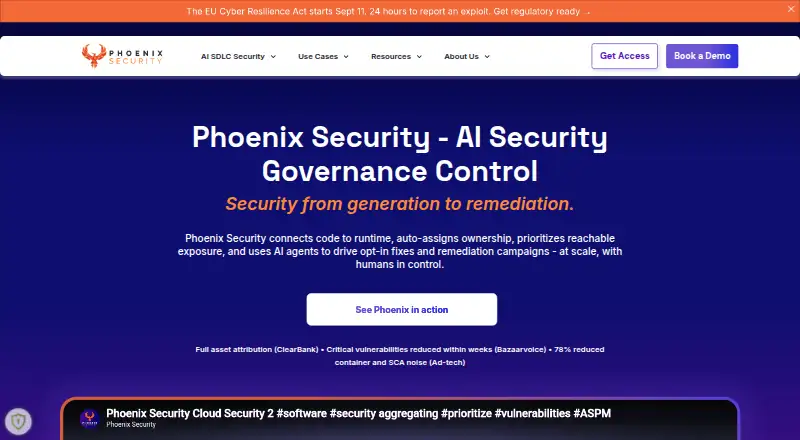
What Phoenix Security is
Phoenix Security is a cloud platform for security governance that connects code findings with runtime exposure, maps ownership, and helps teams prioritize risk. It brings findings from SAST, SCA, containers, cloud, runtime, and ticketing into a normalized, deduplicated model. Phoenix says it ranks deployed, running, reachable exposure using threat intelligence and business context. Its AI agents can prepare minimum-impact fix plans, open pull requests with user opt-in, run remediation campaigns, and measure risk reduction. Listed connections include Microsoft Defender for Cloud, Lacework, Sysdig, Google Cloud SCC, and Aikido; the company says it integrates with security tools across application, infrastructure, cloud, and container technology stacks. Phoenix Free includes up to 1,000 assets, two premium users plus guests, community support, and dashboard reporting. Professional costs £1,495/mo and lists 5,000 asset credits, 10 security admins plus guests, and 300 or more users; add-on fees may apply for threat-intelligence feeds. Enterprise pricing is by contact and lists dedicated hosting and bring-your-own encryption key.
Who it suits
Phoenix Security may suit security teams that need to consolidate findings, map ownership, and prioritize reachable exposure. Its Professional tier is described for growing and medium enterprises with a concise security team, while Enterprise is intended for larger teams.
What it does well
- Combines findings across code, cloud, containers, runtime, and ticketing.
- Maps ownership and prioritizes reachable exposure.
- Free tier includes up to 1,000 assets.
- AI remediation pull requests require user opt-in.
What to know first
- Professional costs £1,495/mo.
- Professional may add fees for threat-intelligence feeds.
- Enterprise pricing is available by contact.
Limits
Phoenix Free includes up to 1,000 assets and two premium users plus guests. Professional lists 5,000 asset credits and 10 security admins plus guests; threat-intelligence feeds may add fees. Enterprise lists 15,000 or more asset credits or unlimited, with some feeds and AI remediation credits potentially costing extra.
Plans
| Plan | Billed and limits | Price |
|---|---|---|
| Phoenix Free | Free /mo · Up to 1000 assets · 2 premium users + guests · community support · dashboard reporting | Free |
| Phoenix Professional | £1,495 /mo · 5,000 asset credits · 10 security admins + guests · 300+ users · cyber risk graph · SCA and Web/API DAST · threat intelligence · ML tech-stack insights · automated workflows · remediation campaigns | £1,495 a month |
| Phoenix Enterprise | Contact · 15,000+ asset credits/unlimited · 20 admins · SSO and AD · 900+ users · container security · deduplication and reachability analysis · external endpoint assessment · advanced threat intelligence · dedicated hosting · BYOK · AI remediation campaigns | On request |
As phoenix.security lists them, read 15 Oct 2026. The maker's own page has the final word.
Getting started
- Open https://phoenix.security/.
- Use the web platform or connect through its API.
- Choose Phoenix Free, Professional, or contact Phoenix about Enterprise.
- Connect relevant security scanners and technology stacks.
- Review correlated findings, map ownership, and set up remediation workflows.
Phoenix Security is a cloud security-governance platform for teams coordinating application and infrastructure security work. It is best suited to security teams that need to connect findings across a broad technology stack with ownership and remediation; the main trade-off is the £1,495 /mo Professional price once Free’s limits no longer fit.
Overview
Phoenix brings findings from SAST, SCA, containers, cloud, runtime and ticketing into a normalized, deduplicated model. That shared view can help teams avoid managing separate backlogs in isolation, while ownership mapping gives findings a route to a responsible team. Its focus on deployed, running and reachable exposure makes prioritization more operationally focused than simply sorting a scanner’s alerts.
The platform also supports SBOM management and remediation workflows. It is cloud-deployed, so organizations that require self-hosted software should choose another option.
Key features
Correlated findings and risk prioritization
Phoenix combines application, infrastructure, cloud and container security sources, with integrations including Microsoft Defender for Cloud, Lacework, Sysdig, Google Cloud SCC and Aikido. Its prioritization uses threat intelligence and business context to focus on deployed and reachable exposure. That is useful for teams with multiple sources of findings and a need to decide what merits action first; it does not replace the underlying scanners.
Ownership and remediation
Ownership mapping, remediation workflows and SBOM management support the work of moving from identified risk to accountable action. Phoenix’s AI agents can create minimum-impact fix plans, open pull requests with user opt-in, run remediation campaigns and measure risk reduction. The opt-in approach keeps pull requests under team control, though Enterprise AI remediation credits may incur extra charges.
Pricing
| Plan | Price | What it includes |
|---|---|---|
| Phoenix Free | Free | Up to 1,000 assets, two premium users plus guests, community support and dashboard reporting. |
| Phoenix Professional | £1,495 /mo | 5,000 asset credits, 10 security admins plus guests, and 300+ users. Add-on fees may apply for threat-intelligence feeds. |
| Phoenix Enterprise | Custom pricing | 15,000+ asset credits or unlimited, 20 admins, SSO and AD, 900+ users, dedicated hosting and bring-your-own encryption key. Some threat-intelligence feeds and AI remediation credits may cost extra. |
Free is a meaningful way to start for a small team, but the 1,000-asset and two-premium-user caps set a clear ceiling. Professional is aimed at growing and medium enterprises with a concise security team; its admin and asset allowances are substantially higher, but its monthly price is a significant commitment and feed add-ons can raise the bill. Enterprise is designed for larger teams that need dedicated hosting, encryption-key control and higher or unlimited asset capacity. It adds priority Slack and email support and customer success, while its price is custom.
Platforms
Phoenix is available through web and API, with cloud deployment. That suits teams integrating security data into a cloud service, but not those requiring a self-hosted deployment.
Who it's for
Phoenix is a strong fit for security teams working across application, infrastructure, cloud and container tools that need a shared view of exposure and a way to assign remediation. Smaller teams can assess the Free tier, while growing organizations may find Professional’s capacity appropriate if the price fits. Larger teams needing dedicated hosting and enterprise support should consider Enterprise. It is less suitable for buyers looking for a low-cost paid tier or self-hosted deployment.
Pros and cons
- Pro: Combines and deduplicates findings across SAST, SCA, containers, cloud, runtime and ticketing, helping teams work from a consolidated view.
- Pro: Reachability, threat intelligence and business context inform prioritization, while ownership mapping supports accountability.
- Pro: Free includes up to 1,000 assets and dashboard reporting, giving small teams a starting point without a subscription charge.
- Con: Professional costs £1,495 /mo, a substantial step up for teams that outgrow Free.
- Con: Free is capped at two premium users and 1,000 assets, and Professional’s threat-intelligence feeds may add fees.
- Con: Cloud is the deployment option, ruling it out for organizations requiring self-hosting.
Alternatives
Application Security Posture Management Software is a useful category page for comparing options. Consider Arnica Secrets Security if secrets scanning and a free plan with SAST, SCA, IaC, licensing and reputation scans are central to your choice. Conviso Platform may suit a small group wanting a free allowance of five contributing developers, five assets, 10 users and two integrations. Choose OWASP DefectDojo if an open-source community edition and self-hosted availability matter more than Phoenix’s cloud deployment. SecurStack offers a free tier with 500 scan credits per month, three users, 10 projects, SAST, SCA and secrets scanning. Strobes ASPM is another free option, with up to 100 assets, 500 tasks per month, one connector and community support. OX Security is worth considering for its listed code-security coverage across SAST, SCA, secrets/PII, SBOM, IaC, CI/CD, containers, IDE and CLI. Foxnode ASPM is a free alternative. Ivanti Neurons for Zero Trust Access is a paid alternative for buyers comparing zero-trust access products.
Verdict
Choose Phoenix Security if your team needs to correlate findings across a broad stack, prioritize reachable exposure and carry ownership through to remediation. Its Free tier provides a bounded entry point, and its higher plans add capacity and enterprise controls, but Professional’s £1,495 /mo price and cloud-only deployment make it a poor fit for cost-sensitive teams or organizations that require self-hosting.
Verdict
Phoenix Security brings finding correlation, ownership mapping, risk prioritization, and remediation workflows together. The free tier has asset and user limits, while Professional has a listed monthly price and possible feed add-ons.
Questions
Is Phoenix Security free?
Yes. Phoenix Free costs nothing and includes up to 1,000 assets, two premium users plus guests, community support, and dashboard reporting.
How much does Professional cost?
Phoenix Professional costs £1,495 per month. It lists 5,000 asset credits, 10 security admins plus guests, and 300 or more users; threat-intelligence feed add-on fees may apply.
What platforms does Phoenix support?
The listed platforms are web and API. Deployment is listed as cloud.
Which tools does Phoenix integrate with?
Named integrations include Microsoft Defender for Cloud, Lacework, Sysdig, Google Cloud SCC, and Aikido.
Who leads Phoenix Security?
The company identifies Francesco Cipollone as its founder and CEO.
What does Enterprise include?
Enterprise lists 15,000 or more asset credits or unlimited, 20 admins plus SSO and AD, 900 or more users, dedicated hosting, and bring-your-own encryption key. Pricing is by contact.
Facts from Phoenix Security's own pages
- AI remediation
- The product describes AI agents that generate fix plans, run remediation campaigns and can open opt-in pull requests while leaving humans in control. · phoenix.security, 15 Oct 2026
- API authentication
- API clients create an ID and secret, exchange them for a temporary bearer token and then authenticate subsequent requests with that token. · kb.phoenix.security, 15 Oct 2026
- API extensibility
- The raw-file import endpoint accepts multipart uploads and processes reports asynchronously, with status values such as TRANSLATING, IMPORTED and ERROR. · kb.phoenix.security, 15 Oct 2026
- CLI and MCP
- Phoenix announced open-source Python clients consisting of a v1.27 REST API CLI and an MCP server; the CLI installs with pipx from GitHub. · phoenix.security, 15 Oct 2026
- Company founders
- Crunchbase lists Alfonso Eusebio, Dimitri Calianno, Francesco Cipollone and Stefano Longhi as founders. · crunchbase.com, 15 Oct 2026
- Company headquarters
- The vendor lists its UK headquarters at 124 City Road, London EC1V 2NX, with a US office in Los Angeles. · phoenix.security, 15 Oct 2026
- Company leadership
- The About page identifies Francesco Cipollone as Phoenix Security's founder and CEO. · phoenix.security, 30 Sept 2026
- Company legal name
- Crunchbase identifies the legal entity as Security Phoenix Ltd and lists it as an active private for-profit company. · crunchbase.com, 15 Oct 2026
- Company size
- Gartner lists Phoenix Security as having 11–50 employees. · gartner.com, 15 Oct 2026
- Coverage
- The platform combines findings from SAST, SCA, containers, cloud, runtime, and ticketing in a normalized, deduplicated model. · phoenix.security, 30 Sept 2026
- Documentation
- The public knowledge base contains REST API, integration, settings, onboarding, workflow, vulnerability, application-management and user-management sections. · kb.phoenix.security, 15 Oct 2026
- Enterprise hosting and encryption
- Enterprise lists dedicated hosting and bring-your-own encryption key. · phoenix.security, 30 Sept 2026
- Finding deduplication
- Gartner reviewers specifically praise Phoenix for deduplicating SAST findings across multiple source scanners and for its finding attack-surface graph. · gartner.com, 15 Oct 2026
- Founded
- Gartner records Phoenix Security’s founding year as 2022. · gartner.com, 15 Oct 2026
- Free tier limits
- Phoenix Free includes up to 1,000 assets, two premium users plus guests, community support, and dashboard reporting. · phoenix.security, 30 Sept 2026
- Funding
- Crunchbase shows six pre-seed funding rounds but masks the amounts and investor totals. · crunchbase.com, 15 Oct 2026
- Headquarters
- The About page lists Phoenix Security UK HQ at 124 City Road, EC1V 2NX. · phoenix.security, 30 Sept 2026
- Hosting
- The pricing comparison lists SaaS hosting for Free and Professional and dedicated SaaS hosting for Enterprise. · phoenix.security, 15 Oct 2026
- Integrations
- GetApp lists integrations including Mend, Qualys Cloud Platform, GitHub, Jira, JFrog Xray, Nessus, Detectify, SonarQube, Snyk, Microsoft Teams, Slack, SonarCloud and ServiceNow. · getapp.com, 15 Oct 2026
- Integration scope
- Phoenix says it integrates with security scanners and native technology stacks spanning application, infrastructure, cloud, and container security. · phoenix.security, 30 Sept 2026
- Intended customers
- Phoenix describes Professional as intended for growing and medium enterprises with a concise security team, and Enterprise for larger teams. · phoenix.security, 30 Sept 2026
- Licence
- The SaaS terms prohibit copying, reverse engineering, source-code derivation and derivative works, indicating the core platform is proprietary rather than open source. · kb.phoenix.security, 15 Oct 2026
- Limit: analytics visuals
- A Gartner reviewer wanted more detailed analytics visuals in the user interface. · gartner.com, 15 Oct 2026
- Limit: price
- Gartner and GetApp reviewers repeatedly describe Phoenix as expensive or higher priced than competing products. · gartner.com, 15 Oct 2026