Freedom251 › Application Security Orchestration Platforms

Strobes ASPM
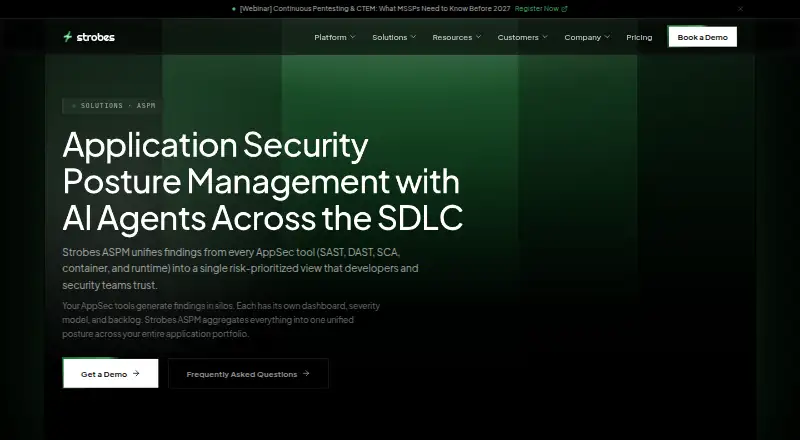
What Strobes ASPM is
Strobes ASPM brings findings from application security tools into a shared view for security teams and developers. It ingests results from SAST, DAST, software composition analysis, container scanners, penetration tests, and bug bounty programs. Its risk scoring weighs exploit likelihood, asset importance, and compensating controls, while displaying EPSS and KEV context. Strobes can apply security policies in CI/CD, block critical findings, warn about high findings, and return feedback in pull requests. AI agents can sort and deduplicate findings, create and route tickets, track SLAs, and check fixes by rescanning. The product lists more than 100 integrations, including security tools and cloud providers, and a GraphQL API for working with assets, findings, engagements, and assessments. Deployment choices include cloud SaaS and private deployment. The free plan costs nothing, with limits of 100 assets, 500 monthly tasks, and one connector. Starter costs $29,000 a year; Growth costs $45,000 a year. A 14-day trial includes guided onboarding.
Who it suits
Strobes describes its customers as security teams in mid-market companies and large organizations with complex, high-volume environments. It suits teams seeking to consolidate application-security findings and coordinate remediation.
What it does well
- Ingests findings from six listed AppSec sources.
- Risk scoring includes asset criticality and exploit likelihood.
- CI/CD policy enforcement includes blocking critical findings.
- AI agents route tickets and verify fixes by rescanning.
- Free plan includes ASPM and one connector.
What to know first
- Free plan is limited to 100 assets.
- Free plan allows 500 tasks per month.
- Free plan has one connector and community support.
- Starter costs $29,000 a year.
Limits
The free plan allows up to 100 assets, 500 tasks per month, and one connector, with community support. Starter costs $29,000 a year and covers up to 1,000 assets and 1,000 tasks per month; the 14-day trial provides full access to ASM, RBVM, PTaaS, ASPM, and AI Agents.
Plans
| Plan | Billed and limits | Price |
|---|---|---|
| Free | forever · up to 100 assets · 500 tasks/month · ASM, RBVM, ASPM · 1 connector · community support | Free |
| Starter | annually · up to 1,000 assets · 1,000 tasks/month · ASM, RBVM, ASPM · unlimited connectors · email support | $29,000 a year |
| Growth | annually · 1,001–25,000 assets · up to 25,000 tasks/month · ASM, RBVM, ASPM · unlimited connectors and users · dedicated CSM | $45,000 a year |
| Enterprise | 25,001+ assets · custom task limits · ASM, RBVM, ASPM · unlimited connectors and users · TAM, SLA and custom MSA | On request |
As strobes.co lists them, read 15 Oct 2026. The maker's own page has the final word.
Getting started
- Open the Strobes application security page.
- Choose the free plan or start the 14-day trial.
- Use the trial's guided onboarding with a dedicated security engineer.
- Connect security tools; the free plan includes one connector, while Starter includes unlimited connectors.
- Use the web app, API, or self-hosted platform option.
Strobes ASPM brings results from multiple application-security tools into a shared, risk-ranked workflow for developers and security teams. It is best suited to mid-market and larger organizations coordinating substantial security workloads. Its mix of prioritization, CI/CD controls, and remediation automation is broad, but the free tier is capped and paid plans start at $29,000 per year.
Overview
Strobes ingests findings from SAST, DAST, software composition analysis, container scanners, penetration tests, and bug bounty programs. It correlates results, maps ownership, supports remediation workflows, and manages SBOMs. That makes it a coordination layer for teams working across existing AppSec tools, rather than a reason to replace those scanners.
Risk scoring accounts for exploit likelihood, asset criticality, and compensating controls, with EPSS and KEV included in the risk context. This gives security teams more than raw severity when deciding what to address first, though the usefulness of any ranking depends on having relevant asset and finding data in the system.
Key features
Triage and remediation
AI agents can triage and deduplicate findings, create tickets, route work to teams, track SLAs, and verify fixes by rescanning. Connecting these steps can reduce handoffs for teams with high finding volumes; organizations seeking only a dashboard or a single scanner may find this workflow breadth unnecessary.
CI/CD controls and integrations
Strobes says it can block critical findings in CI/CD, warn on high findings, and provide feedback in pull requests. This gives teams a way to surface security issues during development, with different responses for different risk levels. The integrations catalog names more than 100 tools, including Nessus, Qualys, Burp Suite, Acunetix, Rapid7, Nuclei, Snyk, Checkmarx, SonarQube, AWS, Azure, Google Cloud, Prisma Cloud, and Wiz.
API and security
A GraphQL API supports querying and mutating assets, findings, engagements, and assessments, useful for teams that need programmatic access to platform data. Strobes states that it holds SOC 2 Type 2 and ISO 27001:2022 certifications, is CREST certified and CERT-In empanelled, and uses SOC 2 certified data centers, network segmentation, intrusion detection, 24/7 monitoring, and regular third-party penetration testing.
Pricing
The Free plan costs nothing, billed forever. It includes up to 100 assets, 500 tasks per month, ASM, RBVM, ASPM, one connector, and community support. That is a useful way to evaluate the platform or handle a small footprint, but the asset and task ceilings and single connector constrain broader tool coverage.
Starter costs $29,000 a year, billed annually. It raises the limits to 1,000 assets and 1,000 tasks per month, includes unlimited connectors and email support, and retains ASM, RBVM, and ASPM. It suits a smaller organization that needs more connections, but the task allowance is only twice the free tier's despite the substantial annual price.
Growth costs $45,000 a year, billed annually, and covers 1,001–25,000 assets and up to 25,000 tasks per month. It adds unlimited connectors and users plus a dedicated CSM, making it the clearer fit for larger teams and heavier workloads. Enterprise has custom pricing, starts at 25,001 assets with custom task limits, and includes unlimited connectors and users, a TAM, SLA, and custom MSA.
A 14-day trial provides full access to ASM, RBVM, PTaaS, ASPM, and AI Agents, with guided onboarding from a dedicated security engineer. It offers a broader evaluation than the permanently free tier, without changing the ongoing plan limits.
Platforms
Strobes is available through an API and web interface, with cloud SaaS or private deployment options. That flexibility is relevant to organizations with deployment requirements beyond a standard SaaS setup.
Who it's for
Strobes is aimed at security teams from mid-market companies to large organizations with complex, high-volume environments. It is a stronger fit when teams need to combine multiple scanner outputs with ownership, prioritization, policy enforcement, and remediation tracking. Smaller teams with few assets or tools may be adequately served by the free tier, while the paid entry price makes Starter a difficult step up unless its higher asset allowance and unlimited connectors are necessary.
Pros and cons
- Pros: Ingests findings across major AppSec categories and correlates them into a risk-prioritized view, reducing the need to assess each tool's output separately.
- Pros: AI triage, ticket routing, SLA tracking, and rescanning connect prioritization to remediation follow-through.
- Pros: More than 100 integrations, a GraphQL API, and cloud or private deployment support varied toolchains and operating needs.
- Cons: Free is limited to 100 assets, 500 monthly tasks, and one connector, which restricts its usefulness for broad deployments.
- Cons: Starter costs $29,000 a year for 1,000 assets and 1,000 monthly tasks, a substantial commitment for teams that have outgrown Free but do not need Growth-scale capacity.
Alternatives
ArcherySec is a better fit for teams that want a free, GPL-3.0-licensed, self-hosted option across API, web, and desktop platforms. OWASP DefectDojo suits teams seeking a free forever Community Edition, with support through OWASP Slack and GitHub; its Pay As You Go plan is 100.00 US.
Conviso Platform is worth considering for a small team that can work within its Free tier's five contributing developers, five assets, ten users, and two integrations. ScanDog may fit teams looking for a free plan capped at three products, ten workflows, two users, and 30 AI fixes per month.
Harness Security Testing Orchestration is an alternative for teams considering Harness's security testing orchestration plans. OX Security is another paid option, with listed OX Code capabilities spanning SAST, SCA, secrets and PII, SBOM, IaC, CI/CD, container scanning, IDE, and CLI.
Vulnetix Resolve and PointGuard AI are other paid alternatives to consider.
For broader discovery, browse Application Security Orchestration Platforms or Application Security Posture Management Software.
Verdict
Strobes ASPM is a strong choice for mid-market and larger security teams that need to turn findings from many tools into prioritized, owned, tracked remediation work. Its standout advantage is the connection between risk context, CI/CD controls, and automated follow-through. Look elsewhere if your needs are modest or budget-sensitive: the free plan is narrowly capped, and meaningful paid capacity begins at $29,000 per year.
Verdict
Strobes ASPM combines finding aggregation, risk prioritization, CI/CD controls, and remediation workflows. The free tier has defined asset, task, and connector limits; paid plans add higher limits and support options.
Questions
Is there a free plan?
Yes. The Free plan costs nothing, is billed forever, and includes up to 100 assets, 500 tasks per month, ASM, RBVM, ASPM, one connector, and community support.
How much do the paid plans cost?
Starter is $29,000 a year and Growth is $45,000 a year, both billed annually. Enterprise pricing is available by contacting sales.
What platforms and deployment options are available?
The listed platforms are API, self-hosted, and web. Strobes describes cloud SaaS and private deployment options.
What does the trial include?
The free trial lasts 14 days and provides full access to ASM, RBVM, PTaaS, ASPM, and AI Agents, with guided onboarding by a dedicated security engineer.
Which integrations are listed?
The integrations page lists more than 100 tools, including Nessus, Qualys, Burp Suite, Acunetix, Rapid7, Nuclei, Snyk, Checkmarx, SonarQube, AWS, Azure, Google Cloud, Prisma Cloud, and Wiz.
What security certifications does Strobes state it holds?
Strobes states it holds SOC 2 Type 2 and ISO 27001:2022 certifications, and is CREST certified and CERT-In empanelled.
Facts from Strobes ASPM's own pages
- AI automation
- AI agents triage and deduplicate findings, create tickets, route work to teams, track SLAs, and verify fixes by rescanning. · strobes.co, 30 Sept 2026
- API
- The developer platform exposes GraphQL at /api/graphql/ for querying and mutating assets, findings, engagements and assessments. · strobes.co, 15 Oct 2026
- CI/CD
- Strobes says it can enforce security policy in CI/CD, block critical findings, warn on high findings, and provide in-PR feedback. · strobes.co, 30 Sept 2026
- CI/CD gates
- Policies can block critical issues or warn on high-severity issues directly in CI/CD pipelines. · strobes.co, 15 Oct 2026
- Company facts
- BounceWatch lists Strobes as founded in 2019, headquartered in Plano, with 61 employees and seed-stage status. · bouncewatch.com, 15 Oct 2026
- Company legal name
- The company-data profile identifies the legal name as Strobes Security, Inc. · bouncewatch.com, 15 Oct 2026
- Coverage
- The ASPM page says the platform ingests findings from SAST, DAST, SCA, container scanners, pentests, and bug bounty programs. · strobes.co, 30 Sept 2026
- Data and AI controls
- Strobes says customer data is not used to train its AI models and that agents use bounded autonomy, approval checkpoints and explainable reasoning. · strobes.co, 15 Oct 2026
- Data protection
- The trust page says Strobes uses SOC 2 certified data centers, network segmentation, intrusion detection, 24/7 monitoring, and regular third-party penetration testing of its platform. · strobes.co, 30 Sept 2026
- Deduplication
- Strobes says it normalizes overlapping findings from multiple tools and removes 60–70% of finding noise. · strobes.co, 15 Oct 2026
- Deployment
- The platform page says Strobes is available as cloud SaaS or private deployment. · strobes.co, 30 Sept 2026
- Developer API
- Strobes documents GraphQL platform access for querying and mutating assets, findings, engagements, and assessments. · strobes.co, 30 Sept 2026
- Documentation
- The help center lists 45 exposure-management articles, 39 integration articles, 34 agentic-pentesting articles and sections for dashboards, workflows and administration. · help.strobes.co, 15 Oct 2026
- Funding
- BounceWatch records four rounds totaling $780,000, including a $400,000 seed round from Chitra Holdings Inc. on March 5, 2022. · bouncewatch.com, 15 Oct 2026
- Headquarters
- Plano, Texas, United States · strobes.co, 28 Sept 2026
- Integrations
- The integrations catalog advertises more than 100 connectors spanning scanners, cloud security, containers, ticketing and development tools. · strobes.co, 15 Oct 2026
- Intel API
- An Intel REST API at intel.strobes.co provides CVE lookup, EPSS, CISA KEV and threat-actor data; bulk and advanced endpoints require a license. · strobes.co, 15 Oct 2026
- Intended users
- Strobes describes its customers as security teams ranging from mid-market teams to large organizations with complex, high-volume environments. · strobes.co, 30 Sept 2026
- Limit: data visibility
- A G2 reviewer says some reported vulnerabilities occasionally fail to appear in the portal, complicating closure tracking. · g2.com, 15 Oct 2026
- Limit: learning curve
- Some G2 reviewers report that initial setup and workflow or integration customization take time to learn. · g2.com, 15 Oct 2026
- Limit: reporting
- A G2 reviewer criticizes reports as static and high-level, with insufficient filtering, trend analysis and export flexibility. · g2.com, 15 Oct 2026
- LinkedIn company size
- LinkedIn lists Strobes Security as privately held, headquartered in Plano, Texas, with 51–200 employees. · linkedin.com, 15 Oct 2026
- Native scanners
- Strobes lists built-in DAST, SAST, SCA, API-security, cloud-configuration, container and secret-scanning engines. · strobes.co, 15 Oct 2026
- Notable news
- Strobes’ press page records a 2022 SOC 2 Type 1 compliance achievement and a 2022 growth-capital announcement involving SucSEED Indovation Fund. · strobes.co, 15 Oct 2026