Freedom251 › Application Security Orchestration Platforms

Harness Security Testing Orchestration
Visit Harness Security Testing Orchestration Alternatives Pricing
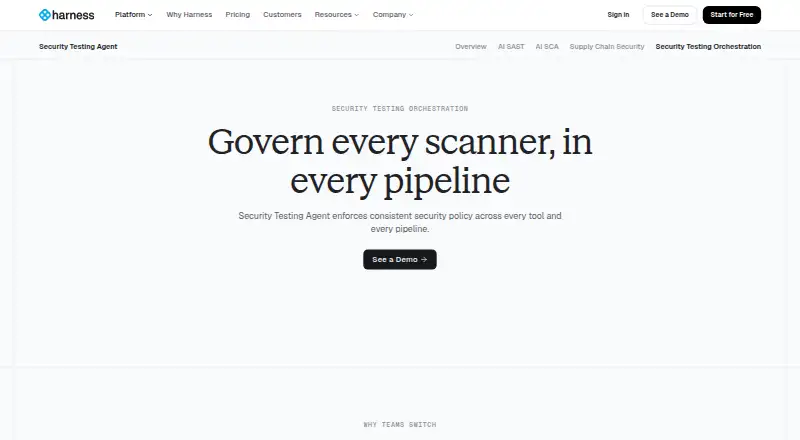
What Harness Security Testing Orchestration is
Harness Security Testing Orchestration is a cloud service for coordinating application security testing. It brings security findings into a workflow with finding deduplication, risk-based prioritization, remediation workflows, policy gates, and ticketing sync. It is available on the web. Harness lists Essentials for up to 500 users, one organization, and five custom dashboards; Enterprise lists unlimited users, organizations, and custom dashboards. Both plans are billed through Contact Sales, and pricing is on request. Although the pricing model is listed as paid and there is no free plan, a separate Free Plan is listed as free and includes Harness Open Source, Litmus Chaos, and community support. Harness was founded in 2017 and is headquartered in San Francisco, California, United States.
Who it suits
It suits teams coordinating security testing and managing findings through remediation and ticketing workflows. Organizations that need more than 500 users, one organization, or five custom dashboards can consider the listed Enterprise plan.
What it does well
- Deduplicates security findings.
- Prioritizes findings by risk.
- Includes remediation workflows and policy gates.
- Syncs with ticketing systems.
- Enterprise lists unlimited users and organizations.
What to know first
- Pricing is on request.
- No free plan is listed.
- Essentials is limited to 500 users and one organization.
- Essentials includes up to five custom dashboards.
Limits
Essentials covers up to 500 users, one organization and five custom dashboards. The Enterprise plan lists unlimited users, organizations and custom dashboards. A Free Plan is listed as free, though the free plan field says no.
Plans
| Plan | Billed and limits | Price |
|---|---|---|
| Free Plan | Harness Open Source included · Litmus Chaos included · Community support | Free |
| Essentials Plan | Contact Sales · Up to 500 users · Up to 1 organization · Up to 5 custom dashboards | On request |
| Enterprise Plan | Contact Sales · Unlimited users · Unlimited organizations · Unlimited custom dashboards | On request |
As harness.io lists them, read 22 Sept 2026. The maker's own page has the final word.
Getting started
- Visit the Harness Security Testing Orchestration website.
- Use the web service in its cloud deployment.
- Contact Sales about Essentials or Enterprise.
- Review the listed Free Plan, which includes Harness Open Source, Litmus Chaos and community support.
Harness Security Testing Orchestration is a cloud service for turning application-security findings into prioritized, governed work. It is best for organizations that need security checks connected to remediation and release controls, rather than a standalone findings inbox. The main decision is whether that workflow breadth justifies sales-led pricing and the capacity limits on Essentials.
Overview
Harness brings finding deduplication, risk-based prioritization, remediation workflows, ticketing synchronization, and policy gates into one web deployment. Deduplication helps prevent repeated scanner results from fragmenting attention. Risk-based ordering gives teams a practical way to focus on the most consequential issues first, while workflows and ticket sync connect those issues to ownership and follow-through. Policy gates add an enforcement point when a team wants security requirements applied to delivery processes.
This makes the product more than a repository for findings: it is intended to coordinate decisions, work items, and controls. That is a strong fit for established security and development operations. A small team that only needs basic issue collection may get little benefit from the extra workflow layer, particularly when there is no self-serve paid entry point.
Key features
Finding control and prioritization
Finding deduplication reduces duplicate records competing for triage time. Risk-based prioritization helps security staff allocate effort according to exposure rather than simply processing results in arrival order.
Remediation and governance
Remediation workflows provide structure after discovery, and ticketing sync supports handoff into the systems teams already use to manage work. Policy gates can place security checks at a decision point, making the product suitable for organizations that need rules enforced instead of merely documented.
The combined feature set favors coordinated programs with repeatable processes. The published capabilities do not make it a lightweight, low-commitment tool; its value depends on using the workflow and governance functions consistently.
Pricing
Harness uses a paid model with pricing on request and no free plan for the product. That sales-led approach can suit organizations that need a tailored commercial arrangement, but it prevents straightforward budget comparison before contacting sales.
Free Plan
The Free Plan costs nothing and includes Harness Open Source, Litmus Chaos, and community support. It is not presented as a free tier of the security-testing orchestration product, so teams should not treat it as a no-cost substitute for the paid plans.
Essentials Plan
Essentials has custom pricing, billed through Contact Sales. It supports up to 500 users, one organization, and five custom dashboards. Those limits may be adequate for a contained security program, but organizations with multiple business units or extensive reporting should check whether the single-organization and dashboard caps will constrain them.
Enterprise Plan
Enterprise is also custom priced and billed through Contact Sales. Unlimited users, organizations, and custom dashboards remove the principal capacity ceilings in Essentials. It is the logical fit for larger or decentralized programs, though the lack of a published price makes total cost impossible to assess from the plan description alone.
Platforms
Harness Security Testing Orchestration runs on the web and uses a cloud deployment. That avoids a self-hosted installation requirement, while teams needing local or self-managed deployment should look elsewhere.
Who it's for
Choose Harness when application-security findings must flow into prioritized remediation, tickets, and enforceable policy checks across development or release operations. Essentials is aimed at organizations that can work within one organization and five dashboards; Enterprise is better suited to multi-organization environments with broad user and reporting needs. It is a weaker match for individuals or small teams seeking transparent pricing, a free product tier, or self-hosting.
Pros and cons
- Pros: Deduplication keeps repeated findings from distorting triage; risk-based prioritization focuses attention on higher-risk work; remediation workflows and ticketing sync support accountable follow-through; policy gates add enforcement; Enterprise removes user, organization, and dashboard limits.
- Cons: Paid access requires a sales conversation; Essentials is capped at 500 users, one organization, and five custom dashboards; the service is cloud web-only; the Free Plan does not describe a free orchestration tier.
Alternatives
For a free, open-source, self-hosted option across API, desktop, server, and web environments, choose ArcherySec.
OWASP DefectDojo is preferable when a free-forever Community Edition, OWASP community support, and a free trial are priorities.
Choose Conviso Platform when a freemium service with explicit limits of five contributing developers, five assets, ten users, and two integrations is a better starting point.
ScanDog suits teams wanting a free tier with three products, ten workflows, two users, and 30 AI fixes per month.
Choose Strobes ASPM for a freemium ASPM offering with a free tier capped at 100 assets and 500 tasks per month.
OX Security is an alternative paid platform with API, extension, desktop, self-hosted, and web deployment options.
Vulnetix Resolve is another paid option with Linux, macOS, Windows, and web support.
PointGuard AI is a paid web-based alternative.
See the Application Security Orchestration Platforms list for more options.
Verdict
Harness Security Testing Orchestration is a strong choice for organizations that need findings, risk decisions, remediation ownership, ticketing, and policy enforcement tied together in a cloud workflow. Its main reason to look elsewhere is commercial and structural: custom pricing, no product free tier, Essentials capacity caps, and no self-hosted deployment make simpler or more transparent alternatives more suitable for small teams.
Verdict
Harness combines finding management with policy controls and remediation workflows in a cloud service. Plan limits and pricing are worth checking against an organization’s requirements.
Questions
Does Harness Security Testing Orchestration have a free plan?
The free plan field says no, while a plan named Free Plan is listed as free. That plan includes Harness Open Source, Litmus Chaos and community support.
How much do the paid plans cost?
Essentials and Enterprise have no listed prices and are billed through Contact Sales. The pricing note says pricing is on request.
What are the Essentials plan limits?
Essentials covers up to 500 users, up to one organization and up to five custom dashboards.
What does Enterprise include?
Enterprise lists unlimited users, organizations and custom dashboards.
What does the service do?
It supports finding deduplication, risk-based prioritization, remediation workflows, policy gates and ticketing sync.
What platform and deployment model does it use?
The platform is web, and the deployment model is cloud.
Facts from Harness Security Testing Orchestration's own pages
- Founded
- 2017 · harness.io, 23 Sept 2026
- Headquarters
- San Francisco, California, United States · harness.io, 23 Sept 2026