Freedom251 › Secrets Scanning Software
ByteHide Secrets
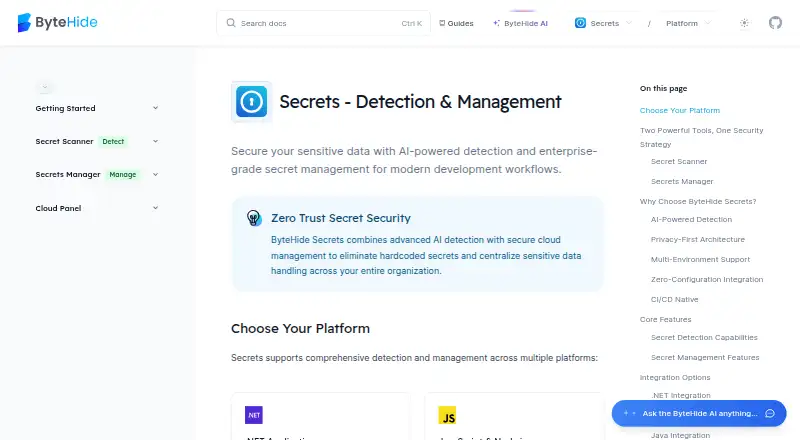
What ByteHide Secrets is
ByteHide Secrets combines secret detection with management for sensitive values. Its scanner searches source code, compiled binaries, repositories, and commit history, and works locally or in CI/CD pipelines. Listed targets include API keys, cloud and database credentials, certificates, SSH keys, Kubernetes secrets, and infrastructure-as-code secrets. The product says its machine-learning detection aims to find secrets while reducing false positives; its documentation says scanning stays local and source code does not leave the user's environment. For management, it supports separate development, staging, and production values, role-based access, audit logs, and SDK integration. ByteHide Vault provides encrypted, versioned storage, one-click rollback, and a local encrypted vault for isolated or air-gapped setups. It can sync secrets with AWS, Azure, GCP, Kubernetes, GitHub Actions, and Vercel, and supports scheduled credential rotation. Listed safeguards include encryption in transit and at rest, a zero-knowledge architecture, IP allowlisting, custom headers, two-factor authentication, and security-event webhooks. Integrations cover .NET, JavaScript and Node.js, Java, Go, PHP, and Python, alongside GitHub, GitHub Actions, Azure DevOps, AWS, Jenkins, GitLab CI, Webpack, and Vite. The free plan supports up to 2,000 secrets and requires no credit card.
Who it suits
It suits development and security teams that need code scanning alongside centralized secret management. The listed Vault uses also address multi-cloud, Kubernetes, regulated, or isolated environments.
What it does well
- Scans source, binaries, repositories, and commit history.
- Scanning can run locally or in CI/CD.
- Supports separate development, staging, and production values.
- Vault offers versioning and one-click rollback.
- Free plan allows up to 2,000 secrets.
What to know first
- The free plan is limited to 2,000 secrets.
- GitHub is the only supported VCS listed.
Limits
The Free plan includes up to 2,000 secrets. The pricing note also lists a 14-day trial.
Plans
| Plan | Billed and limits | Price |
|---|---|---|
| Free | Up to 2,000 secrets · no credit card | Free |
As docs.bytehide.com lists them, read 8 Oct 2026. The maker's own page has the final word.
Getting started
- Open the ByteHide Secrets documentation website.
- Choose the Free plan, which covers up to 2,000 secrets without a credit card, or use the 14-day trial.
- Use the API, web, Linux, macOS, or Windows platform, or select the self-hosted option.
- Run scanning locally or in a CI/CD pipeline; GitHub and GitHub Actions are among the listed integrations.
- Connect a listed SDK or integration to manage secrets and, if needed, configure Vault sync or scheduled rotation.
ByteHide Secrets combines secret scanning with a manager for storing and controlling sensitive values. It suits development and security teams that want scanning in local workflows and CI/CD alongside shared, environment-specific secrets. Its strongest case is the breadth of detection and vault options; teams should weigh the free plan’s 2,000-secret cap and GitHub-only VCS support.
Overview
The scanner checks source code, compiled binaries, repositories, and commit history, and can run locally or in CI/CD. It also scans pull requests. That scope helps teams catch exposed credentials in both current code and its history, while local scanning keeps source code in the user’s environment.
ByteHide says its machine-learning detection is designed to find secrets with fewer false positives. Detection targets include API keys, cloud and database credentials, certificates, SSH keys, Kubernetes secrets, and infrastructure-as-code secrets. The manager adds separate values for development, staging, and production, role-based access, audit logs, and SDK integration.
Key features
Secrets are encrypted in transit and at rest, and ByteHide describes the architecture as zero-knowledge. IP allowlisting, custom headers, two-factor authentication, and security-event webhooks add controls around access and monitoring. Integrations include GitHub, GitHub Actions, Azure DevOps, AWS, Jenkins, GitLab CI, Webpack, and Vite; supported language integrations cover .NET, JavaScript and Node.js, Java, Go, PHP, and Python.
ByteHide Vault stores secrets in an encrypted, versioned store, with one-click rollback and a local encrypted vault for isolated or air-gapped setups. It can sync values to AWS, Azure, GCP, Kubernetes, GitHub Actions, and Vercel, and schedule credential rotation. These options make the product more than a scanner, particularly for teams coordinating secrets across environments or cloud services.
Pricing
The Free plan costs nothing and allows up to 2,000 secrets without a credit card. That is a useful starting point for smaller projects, but the cap may constrain teams centralizing credentials across many services or environments. A 14-day trial is also offered. Paid-plan pricing is custom pricing.
GitHub is the supported VCS. CI/CD and pull-request scanning are supported, but teams whose repositories depend on another VCS should account for that constraint before choosing ByteHide Secrets.
Platforms
ByteHide Secrets supports API, Linux, macOS, self-hosted deployments, web, and Windows. The local encrypted vault and local scanning also give teams options for isolated environments where keeping source code and secrets close to their own systems matters.
Who it's for
Fast-moving development teams can use scanning and environment-specific secret management in one product. Multi-cloud and Kubernetes teams may benefit from Vault’s sync targets and scheduled rotation, while regulated teams can draw on access roles, audit logs, encryption, and local or air-gapped storage. Developers and security staff get scanning and access controls; leadership can use the same system to support oversight of sensitive values.
It is a weaker fit for teams that need VCS support beyond GitHub or that would exceed the free plan’s secret limit without a custom-priced plan.
Pros and cons
- Broad scanning coverage: checks code, binaries, repositories, and commit history, including local and CI/CD workflows and pull requests.
- Source stays local during scanning: the documented approach avoids sending source code out of the user’s environment.
- Vault options extend beyond storage: versioning, rollback, cloud sync, scheduled rotation, and an air-gapped local vault serve different deployment needs.
- Free use has a firm scope: the 2,000-secret limit is clear, but may be restrictive as a team’s environments and services grow.
- VCS coverage is narrow: GitHub is the supported VCS, which limits suitability for teams centered on another repository platform.
Alternatives
For other choices, compare secrets scanning software by the workflows and repository support your team needs.
- Vooda AI has a free self-hosted plan for production use, any company size, and no seat limits.
- Amazon Deequ is a free open-source library for teams that can use Apache Spark and match its release version.
- DeepSource offers an Open Source plan with unlimited public repositories and team members, plus 1,000 pull request reviews per month.
- detect-secrets is a free open-source Python module installable with pip or Homebrew.
- Endor Labs has a free Developer plan for individual developers, with local scans and no account requirement; it has no UI, policies, or scan history.
- ggshield offers a freemium option, and its CLI is open source.
- GitGuardian has a free Starter plan for up to 25 developers, with real-time scanning and up to 500 historical scan detections.
- Semgrep Code has a free edition covering code and supply chain for up to 10 repositories and 10 contributors.
Verdict
ByteHide Secrets is a strong choice for teams that want local and CI/CD scanning paired with a managed vault, especially when they need environment separation, cloud sync, rotation, or air-gapped storage. The combination is its main reason to choose it. Look elsewhere if GitHub is not your VCS or if the 2,000-secret free allowance does not cover your needs and custom pricing is unsuitable.
Verdict
ByteHide Secrets pairs scanning with access controls and secret storage options, including local vaults and cloud syncing. The free plan has a defined secret limit, and GitHub is the only listed VCS.
Questions
Is ByteHide Secrets free?
Yes. The Free plan costs nothing and includes up to 2,000 secrets, with no credit card required. Pricing also notes a 14-day trial.
Which platforms does it support?
Listed platforms are API, Linux, macOS, self-hosted, web, and Windows.
Which version control system is supported?
GitHub is the listed supported VCS. Pull-request scanning and CI/CD scanning are available.
Which languages and integrations are listed?
SDK integrations are listed for .NET, JavaScript and Node.js, Java, Go, PHP, and Python. Other listed integrations include GitHub, GitHub Actions, Azure DevOps, AWS, Jenkins, GitLab CI, Webpack, and Vite.
What does ByteHide Vault do?
It stores secrets in encrypted, versioned storage, supports one-click rollback and a local encrypted vault, syncs with AWS, Azure, GCP, Kubernetes, GitHub Actions, and Vercel, and can schedule credential rotation.
Facts from ByteHide Secrets's own pages
- Access safeguards
- Listed safeguards include IP allowlisting, custom headers, two-factor authentication, and webhook notifications for security events. · docs.bytehide.com, 8 Oct 2026
- AI detection
- The product says its machine-learning detection aims to identify secrets while reducing false positives. · docs.bytehide.com, 8 Oct 2026
- Cloud sync and rotation
- Vault says it syncs secrets to AWS, Azure, GCP, Kubernetes, GitHub Actions, and Vercel, and can rotate credentials on a schedule. · bytehide.com, 8 Oct 2026
- Detection scope
- The scanner lists API keys, cloud credentials, database credentials, certificates, SSH keys, Kubernetes secrets, and infrastructure-as-code secrets among its detection targets. · docs.bytehide.com, 8 Oct 2026
- Integrations
- Listed integrations include GitHub, GitHub Actions, Azure DevOps, AWS, Jenkins, GitLab CI, Webpack, and Vite. · docs.bytehide.com, 8 Oct 2026
- Intended users
- The Vault page describes use for fast-moving development teams, multi-cloud and Kubernetes teams, regulated teams, developers, security staff, and leadership. · bytehide.com, 8 Oct 2026
- Languages
- The documentation lists integrations for .NET, JavaScript and Node.js, Java, Go, PHP, and Python. · docs.bytehide.com, 8 Oct 2026
- Privacy
- The product documentation says scanning happens locally and source code does not leave the user's environment. · docs.bytehide.com, 8 Oct 2026
- Purpose
- ByteHide Secrets combines secret detection with secret management to find hardcoded credentials and centralize sensitive data. · docs.bytehide.com, 8 Oct 2026
- Scanner
- The scanner detects secrets in source code, compiled binaries, repositories, and commit history, and works locally and in CI/CD pipelines. · docs.bytehide.com, 8 Oct 2026
- Secret management
- The manager supports separate development, staging, and production values, role-based access, audit logs, and SDK integration. · docs.bytehide.com, 8 Oct 2026
- Security
- The product page states secrets are encrypted in transit and at rest and describes a zero-knowledge architecture. · docs.bytehide.com, 8 Oct 2026
- Vault storage
- ByteHide Vault says it stores secrets in an encrypted, versioned store and supports one-click rollback and a local encrypted vault for isolated or air-gapped setups. · bytehide.com, 8 Oct 2026
Where ByteHide Secrets stands on Freedom251
- Secrets Scanning Software#2 of 24