Freedom251 › Secrets Scanning Software

Vooda AI
What Vooda AI is
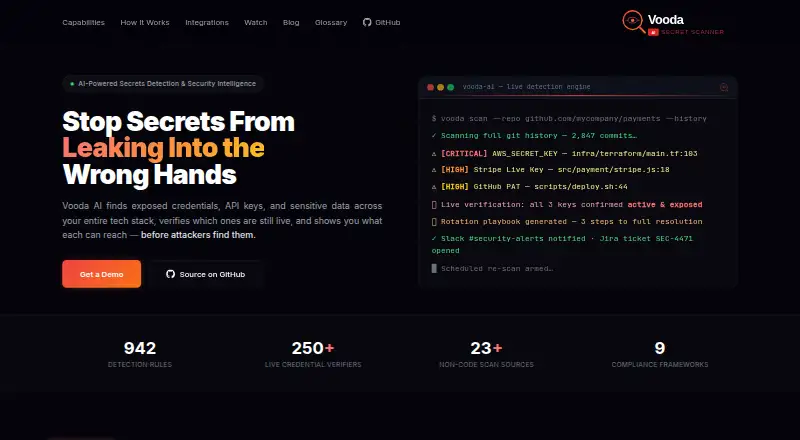
Vooda AI finds exposed credentials, API keys, and other sensitive data across a technology stack. It checks whether credentials are still active and what they can access, including repositories, storage buckets, databases, and IAM policies. Detection combines 942 provider-specific rules with entropy analysis, base64 decoding, structured-file parsing, and configuration checks. Vooda scans code and more than 23 non-code sources, including collaboration tools, cloud storage, containers, Postman, and CI/CD logs, and verifies credentials against more than 250 provider APIs. Its AI assigns confidence scores, learns from team accept or dismiss decisions, and suppresses known false positives. For remediation, it provides rotation playbooks and pre-filled pull requests. CI/CD options include GitHub and GitLab integrations, a container image, pre-commit scanning, and CI gating. The product offers a free self-hosted plan at no cost, with Docker required. It supports on-premise deployment, and air-gapped use with a local AI model and outbound verification disabled.
Who it suits
Vooda AI suits security teams looking for exposed secrets across code, collaboration tools, and other systems. Its self-hosted option may suit organizations that need to run the product on their own infrastructure.
What it does well
- Checks whether exposed credentials remain active.
- Scans code and 23+ non-code sources.
- Provides pre-commit scanning and CI gating.
- Offers a free self-hosted plan.
- Supports custom detectors and severity overrides.
What to know first
- Self-hosted plan requires Docker.
- Air-gapped use disables outbound credential verification.
Limits
The Self-hosted plan is listed as free and requires Docker. For air-gapped operation, the guide describes using a local AI model and disabling outbound credential verification.
Plans
| Plan | Billed and limits | Price |
|---|---|---|
| Self-hosted | Production use · any company size · no seat limits · requires Docker | Free |
As vooda.ai lists them, read 2 Oct 2026. The maker's own page has the final word.
Getting started
- Visit https://vooda.ai/.
- Choose the self-hosted plan, listed as free.
- Prepare Docker for the self-hosted deployment.
- Connect supported VCS platforms: GitHub, GitLab, or Bitbucket.
- Configure CI/CD scanning, pre-commit scanning, pull-request scanning, or push protection.
Vooda AI is a secrets-detection platform for teams that need to find exposed credentials across code and connected services. It is best suited to security teams that want to establish whether a secret still works and understand its potential reach. Its breadth and remediation tools are compelling, but air-gapped operation gives up live credential verification.
Overview
Vooda scans full Git history and more than 23 kinds of non-code sources, including collaboration tools, cloud storage, Docker images, Postman, and CI/CD logs. That reach matters when credentials can escape repositories into the services a team uses around them. Compliance mappings cover frameworks including SOC 2, PCI-DSS 4.0, ISO 27001:2022, NIST 800-53, HIPAA, and GDPR, giving teams a way to relate findings to familiar requirements.
Deployment supports on-premise use without installing agents. The self-hosted guide also supports air-gapped operation with a local AI model, but requires disabling outbound credential verification. That preserves isolation at the cost of knowing whether a discovered credential is still active.
Key features
Detection and triage
The detection engine combines 942 provider-specific rules with Shannon-entropy analysis, base64 decoding, structured-file parsing, and configuration-assignment detection. Custom detectors, severity overrides, allowlists, and suppressions give teams room to tune coverage to their environment. Vooda also checks credentials in real time against more than 250 provider APIs. AI confidence scores, learning from accept-or-dismiss decisions, and suppression of known false positives are intended to help teams prioritize findings rather than treat every match alike.
Impact and remediation
Vooda Radar checks active secrets, enumerates accessible repositories, buckets, databases, and IAM policies, then assigns an impact score from 0 to 100. That adds a useful view of potential reach beyond the initial detection. Provider-specific rotation playbooks and pre-filled pull requests to remove secrets from code give teams concrete remediation paths; the pull requests are specifically for code removal, not a claim that rotation itself is automated.
Workflow and integrations
GitHub Actions, a GitLab CI template, and a container image for Jenkins, CircleCI, or other runners support CI/CD use. Pre-commit scanning and CI gating can catch issues earlier in the development workflow, while push and pull-request scanning extend protection across common code changes. Listed integrations include GitHub, GitLab, Bitbucket, AWS S3, Slack, Jira, Jenkins, CircleCI, Microsoft Teams, ServiceNow, Notion, and Confluence.
Pricing
The Self-hosted plan costs nothing and is intended for production use at any company size, with no seat limits. It includes GitHub, GitLab, and Bitbucket support, CI/CD and pre-commit scanning, pull-request scanning, push protection, and custom detection rules. For organizations that can run Docker, the lack of seat limits makes it a notably open starting point. Docker is a real deployment requirement, and teams needing air-gapped use must accept disabled outbound credential checks.
Vooda is freemium, and the Self-hosted plan is the priced plan described here. No paid-plan price or terms are given.
Platforms
Vooda lists API, Linux, macOS, self-hosted, web, and Windows support. On-premise deployment and no-agent operation may suit teams reluctant to install scanning agents, while Docker is required for the free self-hosted plan.
Who it's for
Vooda is a strong fit for security teams that need broad source coverage, live credential validation, impact assessment, and actionable cleanup within development workflows. Its compliance mappings and enterprise access controls—SAML 2.0, Okta, Azure AD, Google Workspace SSO, role-based access control, and immutable audit logs—also suit organizations with formal security processes. The site advertises 24/7 support and a four-hour SLA. Teams that cannot use Docker or that require isolated operation without sacrificing live checks should look elsewhere.
Pros and cons
- Pros: Live checks against more than 250 provider APIs and Radar's access mapping help distinguish a working credential from a low-impact match.
- Pros: Coverage across code and 23+ non-code source types, plus CI/CD and pre-commit options, reaches beyond repository-only scanning.
- Pros: The free production plan has no seat limits and includes custom rules, push protection, and pull-request scanning.
- Cons: The free self-hosted plan requires Docker, which adds an operational prerequisite.
- Cons: Air-gapped use requires disabling outbound verification, removing the live-check advantage.
Alternatives
Endor Labs is worth considering for individual developers who want free local scans through its AURI MCP server without an account; its Developer plan has no UI or policies. Choose ggshield if an open-source CLI is the priority, noting its detection library is closed source. GitGuardian is another freemium option with a Starter plan that includes up to 25 developers and unlimited real-time scanning, with a historical scan detection cap.
HashiCorp Nomad is another freemium option. Semgrep Code may suit teams seeking code and supply-chain coverage in a free edition capped at 10 repositories and 10 contributors. For free alternatives, consider Betterleaks, Gitleaks, or Kingfisher.
Browse the Secrets Scanning Software directory for more options.
Verdict
Choose Vooda AI if your security team needs to scan beyond code, validate credentials live, and connect findings to impact and remediation without per-seat limits on the free production plan. Look elsewhere if Docker is impractical or air-gapped deployment must retain outbound credential verification.
Verdict
Vooda AI combines broad source scanning with live credential checks and remediation options. Its free self-hosted plan has a Docker requirement, and air-gapped operation means disabling outbound verification.
Questions
Is Vooda AI free?
Yes. The Self-hosted plan is listed as free for production use, any company size, and no seat limits. Docker is required.
Which platforms does Vooda AI support?
Its listed platforms are API, Linux, macOS, self-hosted, web, and Windows.
Which version control systems are supported?
The listed supported VCS platforms are GitHub, GitLab, and Bitbucket.
Can Vooda AI run on customer infrastructure?
Yes. Vooda states that it supports on-premise deployment, and its self-hosted guide describes air-gapped use with a local AI model and outbound credential verification disabled.
Who makes Vooda AI?
Vooda AI identifies itself as a Virantis product.
Facts from Vooda AI's own pages
- Access controls
- The platform lists SAML 2.0, Okta, Azure AD, and Google Workspace SSO, role-based access control, and immutable audit logs. · vooda.ai, 2 Oct 2026
- AI triage
- AI assigns confidence scores to findings, learns from team accept and dismiss decisions, and can suppress known false positives. · vooda.ai, 2 Oct 2026
- blast radius
- Vooda Radar verifies active secrets, enumerates accessible repositories, buckets, databases, and IAM policies, and generates a 0–100 impact score. · vooda.ai, 1 Oct 2026
- CI/CD
- Vooda offers a GitHub Action, GitLab CI template, and container image for Jenkins, CircleCI, or other runners, with pre-commit and CI gate options. · vooda.ai, 2 Oct 2026
- CI/CD protection
- The product provides a native GitHub Action, GitLab CI template, container image, pre-commit scanning, and CI gating. · vooda.ai, 1 Oct 2026
- Compliance
- The site says findings can be mapped to SOC 2, PCI-DSS 4.0, ISO 27001:2022, NIST 800-53, HIPAA, GDPR, OWASP Top 10, CWE Top 25, and CAPEC. · vooda.ai, 2 Oct 2026
- Connection security
- Vooda says connection credentials are encrypted at rest and remain within the customer's tenant; it also says no agents need to be installed. · vooda.ai, 2 Oct 2026
- customization
- Users can write custom detectors, override severity by rule and source, and manage allowlists and suppressions. · vooda.ai, 1 Oct 2026
- deployment
- Vooda states that it supports on-premise deployment and requires no agents to install. · vooda.ai, 1 Oct 2026
- Detection
- The platform describes 942 provider-specific detection rules alongside entropy analysis, base64 decoding, structured-file parsing, and custom detectors. · vooda.ai, 2 Oct 2026
- detection engine
- The detection engine uses 942 provider-specific rules, Shannon-entropy analysis, base64 decoding, structured-file parsing, and configuration-assignment detection. · vooda.ai, 1 Oct 2026
- Integrations
- Listed integrations include GitHub, GitLab, Bitbucket, AWS S3, Slack, Jira, Jenkins, CircleCI, Microsoft Teams, ServiceNow, Notion, and Confluence. · vooda.ai, 2 Oct 2026
- live verification
- Vooda verifies credentials in real time against more than 250 provider APIs. · vooda.ai, 1 Oct 2026
- Maker
- Vooda AI identifies itself as a Virantis product. · vooda.ai, 2 Oct 2026
- product category
- Vooda AI describes itself as an enterprise-grade secrets detection and security intelligence platform. · vooda.ai, 1 Oct 2026
- Purpose
- Vooda AI detects exposed credentials, API keys, and sensitive data across code and other connected sources, verifies whether credentials are live, and maps what they can access. · vooda.ai, 2 Oct 2026
- Remediation
- Vooda generates provider-specific credential rotation playbooks and pre-filled pull requests to remove secrets from code. · vooda.ai, 2 Oct 2026
- Scanning coverage
- The site lists scanning for full Git history and non-code sources including collaboration tools, cloud storage, containers, Postman, and CI/CD logs. · vooda.ai, 2 Oct 2026
- scan sources
- The platform scans 23+ non-code sources, including Slack, Teams, Confluence, Notion, Jira, cloud storage, Docker images, Postman, and CI/CD logs. · vooda.ai, 1 Oct 2026
- security
- The site states that connection credentials are encrypted at rest and never leave the customer tenant. · vooda.ai, 1 Oct 2026
- Self-hosting
- The self-hosted guide says the product can run on customer infrastructure and support air-gapped use by using a local AI model and disabling outbound credential verification. · vooda.ai, 2 Oct 2026
- Support
- The homepage lists 24/7 support and a 4-hour SLA. · vooda.ai, 2 Oct 2026
Where Vooda AI stands on Freedom251
- Secrets Scanning Software#17 of 24