Freedom251 › AI Security Testing Tools
Augustus
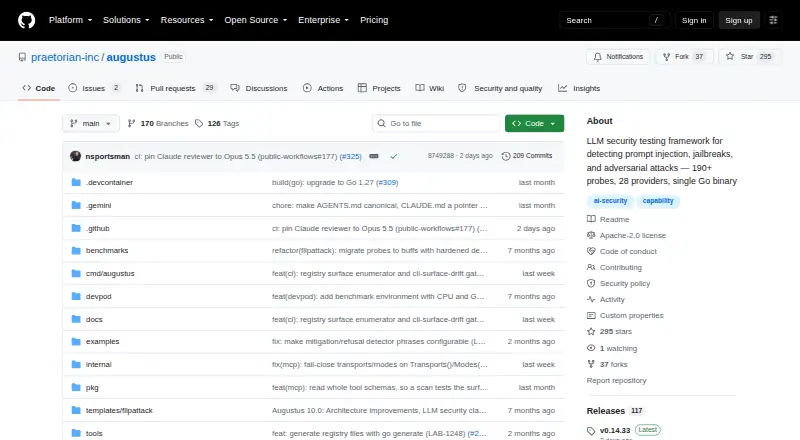
What Augustus is
Augustus is a free, Go-based scanner that security professionals can use to assess large language models with adversarial tests and produce vulnerability reports. It describes more than 210 probes across 47 attack categories, including jailbreaks, prompt injection, data extraction, safety benchmarks, and agent attacks. The project supports 28 provider categories and 43 generator variants, including hosted services, Ollama, and custom REST endpoints. More than 90 detectors and seven prompt transformations support analysis. Results can be output as tables, JSON, JSONL, or HTML reports. The project also lists concurrent scanning, rate limiting, retry logic, and timeout handling. Augustus is self-hosted, licensed under Apache 2.0, and compiles as a portable single binary; it can be installed with Go or built from source. The README requires Go 1.27.0 or later. The project is for authorized security testing only: users are instructed to assess systems they own or have explicit permission to test. API usage may require provider credentials.
Who it suits
Augustus is intended for security professionals assessing language models. It may suit teams seeking self-hosted adversarial scanning and report output, provided testing is authorized.
What it does well
- More than 210 probes across 47 categories
- Supports 28 provider categories and 43 variants
- More than 90 detectors
- Exports tables, JSON, JSONL, and HTML
- Free and Apache 2.0 licensed
What to know first
- Requires Go 1.27.0 or later
- API usage may require provider credentials
- Testing is limited to authorized systems
Limits
The free plan costs nothing. API usage may require provider credentials, and building from source requires Go 1.27.0 or later.
Plans
| Plan | Billed and limits | Price |
|---|---|---|
| Augustus | Apache 2.0 licensed open-source software · API usage may require provider credentials | Free |
As github.com lists them, read 4 Oct 2026. The maker's own page has the final word.
Getting started
- Open the Augustus GitHub repository.
- Install using Go or build the project from source; the README requires Go 1.27.0 or later.
- Compile it as a portable single binary.
- Use it only to test systems you own or have explicit permission to assess.
Augustus is a self-hosted Go scanner for adversarial testing of large language models and AI applications. It is aimed at security professionals and engineering teams running authorized assessments across multiple providers. The combination of broad probe coverage, automation, and a zero-cost Apache 2.0 license makes it a strong fit for technical teams prepared to manage their own tooling.
Overview
Augustus concentrates on model security rather than general-purpose evaluation. It exercises jailbreak, prompt-injection, data-extraction, unsafe-output, and agent-attack scenarios, then produces vulnerability reports. A portable single binary can be installed with Go or built from source, but Go 1.27.0 or later is required. That setup suits teams already comfortable with developer toolchains, CI systems, or internal security services; it is less suitable for buyers seeking a hosted scanner with no local build step.
The project is explicitly for systems you own or have permission to test. Self-hosting keeps scan execution under your control, while the Apache 2.0 license allows use and modification under its terms. Provider credentials may still incur charges from the underlying AI services.
Key features
More than 210 probes cover 47 attack categories, including jailbreaks, prompt injection, data extraction, safety benchmarks, and agent attacks. That breadth supports a wider assessment than a single-purpose jailbreak checker, particularly when teams need to compare several models or applications. Coverage numbers indicate scope, not guaranteed detection quality for every target, so security staff still need to interpret findings.
Augustus connects to 28 provider categories through 43 generator variants. Integrations include OpenAI, Anthropic, Azure OpenAI, AWS Bedrock, Vertex AI, Ollama, and custom REST endpoints. This variety is valuable in mixed-provider environments and for private endpoints, although each connection still depends on correctly configured credentials and access.
More than 90 detectors combine pattern matching, LLM-as-a-judge, HarmJudge, Perspective API, and unsafe-content detection. Seven prompt transformations—such as encoding, paraphrase, poetry, low-resource-language translation, and case changes—vary inputs to expose failures that a fixed prompt set could miss. Custom test cases and custom detection rules make the scanner more adaptable to an organization’s threat model.
Results can be emitted as tables, JSON, JSONL, or HTML, so teams can read scans interactively or feed structured output into reporting and automation. Concurrent scanning, rate limiting, retry logic, and timeout handling are practical production features for repeatable pipelines. CI/CD and pull-request scanning support earlier checks during development, while GitHub and GitLab compatibility fits common repository workflows.
Pricing
Augustus — $0.00 per free. The plan is free open-source software under Apache 2.0, with no subscription charge. It includes the scanner itself and its listed probes, providers, detectors, transformations, reporting formats, and automation features. API usage may require provider credentials, and those providers can charge separately. This plan is best for security teams, researchers, and developers able to operate self-hosted tooling. There is no paid tier described, so organizations needing hosted support or managed capacity should consider alternatives.
Platforms
Augustus runs on Linux, macOS, and Windows, with self-hosted deployment. Its portable binary is convenient once built, but the Go 1.27.0-or-later prerequisite makes installation more involved than browser-first services. It supports GitHub and GitLab workflows, including CI/CD and pull-request scanning.
Who it's for
Security professionals conducting authorized production assessments are the core audience. Engineering and platform teams can use it to put repeatable model checks into repositories and pipelines, especially when applications span several commercial and local providers. It is a poor fit for unapproved probing, casual users wanting a guided hosted experience, or organizations unwilling to maintain a Go-based self-hosted tool.
Pros and cons
Pros
- Broad attack coverage: 210-plus probes across 47 categories address more than one vulnerability class.
- Provider flexibility: 28 categories, 43 generator variants, and custom REST endpoints support heterogeneous environments.
- Useful automation: concurrency, rate limits, retries, timeouts, CI/CD, and pull-request scanning suit recurring assessments.
- Open distribution: the free Apache 2.0 license and single-binary format avoid subscription costs and simplify controlled deployment.
- Adaptable analysis: custom cases, custom rules, seven transformations, and four report formats help teams fit existing processes.
Cons
- Self-hosting overhead: installation requires Go 1.27.0 or a source build rather than a ready-made hosted workspace.
- Provider costs remain: API credentials and usage can add charges outside Augustus.
- Specialist scope: authorized security testing is its purpose, not a general consumer model-testing service.
Alternatives
AIRTA Red Team is another free, open-source option across API, desktop, web, and Windows environments, useful when broader deployment choices and a bring-your-own-key model matter more than Augustus’s stated probe and detector breadth.
OpenSecureAI Scanner suits teams wanting a freemium service with a $49.00-per-month Pro plan, 50,000 API requests, hosted remediation, gateway completions, and priority email.
Project Moonshot is a free choice spanning self-hosted and web deployments.
Promptfoo offers a free Community plan with 10,000 red-team probes per month and broad evaluation integrations, making it relevant when a published quota and hosted-or-local flexibility are priorities.
PromptGuard provides a free tier capped at 20,000 scans per month, one key, one project, and 24-hour log retention, with a $19.00-per-month Team plan for teams that prefer those defined service limits.
PyRIT is a free open-source framework for users prepared to manage a Python environment and configured AI endpoints.
Basilisk is a free AGPL-3.0 tool distributed through CLI, desktop, Docker, or source formats.
AgentScan offers a web/API service whose free plan allows five scans per month and 185 attack vectors, with paid tiers for higher usage.
For adjacent collections, see AI Security Testing Tools and Secrets Scanning Software.
Verdict
Choose Augustus if you are a security professional or engineering team that wants extensive, customizable LLM attack testing in a self-hosted, free package. Its main advantage is the combination of probe breadth, provider reach, detectors, and pipeline-ready operation. Look elsewhere if you need a managed service, minimal installation, or predictable hosted quotas rather than a Go-based tool you operate yourself.
Verdict
Augustus provides a broad set of model vulnerability probes, detectors, and report formats in a self-hosted package. It requires Go 1.27.0 or later, and should only be used on systems you own or are authorized to test.
Questions
How much does Augustus cost?
The Augustus plan is free. It is Apache 2.0 licensed open-source software.
Which model providers does it support?
It supports 28 provider categories and 43 generator variants, including OpenAI, Anthropic, Azure OpenAI, AWS Bedrock, Vertex AI, Ollama, and custom REST endpoints.
What kinds of vulnerabilities can it test?
Its probes cover jailbreaks, prompt injection, data extraction, safety benchmarks, and agent attacks, among other categories.
What formats can reports use?
Scan results can be output as tables, JSON, JSONL, or HTML reports.
How can I install it?
Augustus can be installed with Go or built from source as a portable single binary. The README requires Go 1.27.0 or later.
Who should use Augustus?
The project identifies security professionals as its intended users and says it is for authorized testing of systems the user owns or has permission to assess.
Facts from Augustus's own pages
- Attack coverage
- The README describes 210+ vulnerability probes across 47 attack categories, including jailbreaks, prompt injection, data extraction, safety benchmarks, and agent attacks. · github.com, 4 Oct 2026
- Authorized use
- The project says Augustus is designed for authorized security testing and instructs users to test only systems they own or have explicit permission to test. · github.com, 4 Oct 2026
- Detectors
- It includes 90+ detectors such as pattern matching, LLM-as-a-judge, HarmJudge, Perspective API, and unsafe content detection. · github.com, 4 Oct 2026
- Distribution
- Augustus compiles as a portable single binary and can be installed with Go or built from source; the README requires Go 1.27.0 or later. · github.com, 4 Oct 2026
- Founded
- 2010 · github.com, 28 Sept 2026
- Headquarters
- Austin, Texas, United States · github.com, 28 Sept 2026
- Intended audience
- The README describes Augustus as built for production security testing and identifies security professionals as its users. · github.com, 4 Oct 2026
- License
- The repository identifies Augustus as licensed under Apache 2.0. · github.com, 4 Oct 2026
- Production features
- The project lists concurrent scanning, rate limiting, retry logic, and timeout handling as built-in production features. · github.com, 4 Oct 2026
- Prompt transformations
- Seven prompt transformations include encoding, paraphrase, poetry, low-resource language translation, and case transforms. · github.com, 4 Oct 2026
- Providers
- It supports 28 LLM provider categories with 43 generator variants, including OpenAI, Anthropic, Azure OpenAI, AWS Bedrock, Vertex AI, Ollama, and custom REST endpoints. · github.com, 4 Oct 2026
- Purpose
- Augustus is a Go-based LLM vulnerability scanner for security professionals that tests models against adversarial attacks and produces vulnerability reports. · github.com, 4 Oct 2026
- Reports
- Scan results can be output as tables, JSON, JSONL, or HTML reports. · github.com, 4 Oct 2026
- Security reporting
- The security policy asks researchers to report vulnerabilities privately by email and says receipt will be acknowledged within 48 hours and severity assessed within 7 days. · github.com, 4 Oct 2026
- Support
- The README directs users to open GitHub issues for bugs or feature requests and invites contributions of probes, detectors, and provider integrations. · github.com, 4 Oct 2026
Where Augustus stands on Freedom251
- AI Security Testing Tools#6 of 29