Freedom251 › AI Red Teaming Tools
OpenSecureAI Scanner
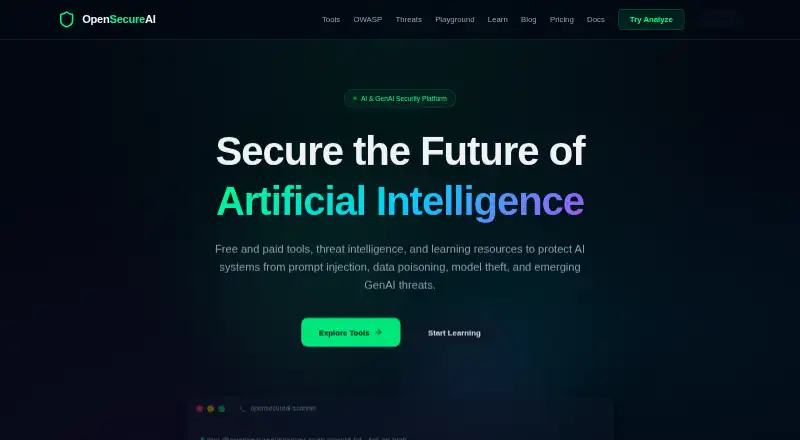
What OpenSecureAI Scanner is
OpenSecureAI Scanner checks untrusted text for patterns associated with prompt injection, jailbreaks, system-prompt leaks, and data exfiltration. Its scanPrompt library API returns a score from 0 to 100, a risk level, and findings for individual rules. Developers can use it as an npm package, CLI, GitHub Action, or REST API; the package targets Node 18+ and has no runtime dependencies. Authenticated hosted scans add detections for obfuscation and encoding evasions, indirect injection, tool abuse, multilingual overrides, and de-obfuscation. The LLM Gateway can forward prompts to a selected OpenAI, Anthropic, xAI, or Groq provider and scan the response. Documentation says authenticated scans save a dashboard summary without retaining raw prompt text, and gateway provider keys are not stored or logged. Free access includes in-browser tools and npm packages; the Free plan lists 2,000 API requests per month, while Pro costs $49 a month. The maker says paid checkout is not self-serve, so customers need to contact sales for setup. The platform is intended for AI application teams, agent and MCP developers, security reviewers, learners, and red-teamers.
Who it suits
It suits developers and security teams checking text supplied to AI systems, as well as agent and MCP developers, learners, and red-teamers. Teams wanting hosted advanced scans or the LLM Gateway should note the listed plan limits and sales setup requirement.
What it does well
- Available as an npm package, CLI, GitHub Action, and REST API.
- Returns a score, risk level, and rule findings.
- Authenticated scans add advanced detection categories.
- Documentation says raw prompt text is not stored.
- Free plan lists 2,000 API requests monthly.
What to know first
- Free plan is limited to 2,000 API requests monthly.
- Anonymous API uses the basic engine with IP rate limiting.
- Paid checkout is not self-serve.
- Pro costs $49 a month.
Limits
The Free plan allows 2,000 API requests per month at 30 requests per minute per key. Pro costs $49 a month and allows 50,000 requests per month at 120 requests per minute per key; hosted AI remediation and LLM Gateway completions are included.
Plans
| Plan | Billed and limits | Price |
|---|---|---|
| Free | $0/month · 2,000 API requests/month · 30 requests/minute per key · browser tools and npm packages · hosted advanced engine · scan history · LLM Gateway BYOK · BYOK AI remediation | Free |
| Pro | $49/month · 50,000 API requests/month · 120 requests/minute per key · hosted AI remediation · hosted LLM Gateway completions · priority email support | $49 a month |
| Team | Custom · 250,000 API requests/month · 300 requests/minute per key · team seats and SSO planned · custom rules and SLA planned | On request |
As opensecureai.com lists them, read 15 Oct 2026. The maker's own page has the final word.
Getting started
- Visit the OpenSecureAI website.
- Use the in-browser tools or install the npm package for free access.
- Choose the CLI, GitHub Action, or REST API for a developer workflow.
- For authenticated hosted scans, use the hosted API with an API key.
- Contact sales to arrange a paid plan.
Overview
OpenSecureAI Scanner checks untrusted text for prompt-injection and related risks, with options ranging from in-browser tools and a local npm package to an authenticated hosted API. It best suits developers and AI security teams who want to add text screening to a workflow; its free entry points are broad, but API quotas and the contact-sales setup for paid plans shape its appeal.
The scanPrompt library returns a 0–100 score, a risk level and findings for individual rules. The scanner targets prompt injection, jailbreaks, system-prompt leaks and data-exfiltration patterns. That makes it useful as one screening layer, rather than a complete security program: the published scope centers on untrusted text and does not establish coverage for every threat to an AI system.
Key features
Developers can use the scanner through an npm package, CLI, GitHub Action or REST API. The package targets Node 18 and later and has no runtime dependencies, a practical fit for teams integrating checks into Node-based applications or build workflows. In-browser tools and npm packages are free and open; anonymous API use is rate-limited by IP and runs the basic engine.
Authenticated hosted calls add detections for obfuscation and encoding evasions, indirect injection, tool abuse, multilingual overrides and de-obfuscation. This is the clearest reason to use the hosted engine when the basic checks are not enough, although accessing it through the free API tier requires an API key and remains subject to a monthly request cap.
The LLM Gateway can forward prompts to a selected OpenAI, Anthropic, xAI or Groq provider and model, then scan the response. Documentation says authenticated scans save a summary to the dashboard but do not store raw prompt text; provider keys used with the gateway are not stored or logged. The company says it responds to vulnerability reports within 48 hours.
Pricing
OpenSecureAI is freemium. The Free plan is $0/month and includes 2,000 API requests per month, 30 requests per minute per key, in-browser tools and npm packages, plus the hosted advanced engine with an API key. It suits evaluation or modest-volume use, but the request cap and rate limit may constrain sustained production traffic.
Pro costs $49 a month, billed $49/month. It raises the allowance to 50,000 API requests per month and 120 requests per minute per key, and adds hosted AI remediation, LLM Gateway completions and priority email support. This is the published paid option for teams that need materially more capacity or gateway access. Paid checkout is not self-serve: customers must contact sales to be set up.
Team has custom pricing and is billed Custom. It provides 250,000 API requests per month and 300 requests per minute per key. Team seats and SSO, along with custom rules and an SLA, are planned rather than current inclusions, so buyers needing those capabilities should not treat them as available features.
Platforms
OpenSecureAI Scanner supports API, Linux, macOS, web and Windows. Its npm package and CLI suit developer workflows, while web tools offer a browser-based route. Both deployment modes are supported.
Who it's for
The platform is aimed at AI application teams, agent and MCP developers, security and compliance reviewers, learners and red-teamers. Developers looking to screen text through an API or build pipeline have the most directly defined use case. Teams seeking broader AI security work should weigh whether this scanner’s stated text-pattern focus matches their needs.
Pros and cons
- Pros: Free browser and package access make it possible to start without a paid plan; multiple integration formats suit different developer workflows.
- Pros: Authenticated hosted scans extend detection to evasions, indirect injection and tool abuse, while the documented handling avoids retaining raw prompt text.
- Cons: The free API allowance is 2,000 requests monthly, with a 30-per-minute limit per key.
- Cons: Paid access requires contacting sales, and Team’s seats, SSO, custom rules and SLA are planned, not included as current capabilities.
Alternatives
For a free option from the AI Verify Foundation, Project Moonshot is available across API, desktop, web and self-hosted platforms.
Promptfoo is worth considering for local or self-hosted LLM evaluation: its free Community plan includes 10k red-team probes per month and all LLM evaluation features, model providers and integrations.
PromptGuard offers 20,000 scans a month on its free plan, with one API key, one project and 24-hour log retention; its Team plan is $19 a month.
PyRIT is a free open-source framework for users comfortable with a Python environment and configured AI endpoints. Augustus is another free, Apache 2.0-licensed open-source option, with provider credentials potentially needed for API use. Basilisk is free AGPL-3.0 software distributed as a CLI, desktop app, Docker image or source, for authorized use only.
AgentScan may suit readers who want a web-based agent scanner: its free plan allows five scans per month and covers 185 attack vectors across five categories. Giskard offers a free open-source library for local deployment, including a basic LLM vulnerability scan and basic RAG evaluation report.
Browse more options in AI Security Testing Tools or AI Red Teaming Tools.
Verdict
OpenSecureAI Scanner is a sensible choice for developers and AI teams who want accessible text screening, several integration routes and stronger hosted detections behind an API key. Its free tools lower the barrier to trying it, but the free API cap is modest and paid setup requires sales contact. Look elsewhere if your priority is a larger free scan allowance, or if you need Team’s planned seats, SSO or custom rules now.
Verdict
OpenSecureAI Scanner offers several ways to check untrusted text, with additional hosted detections for authenticated scans. Review the request limits and contact-sales setup for paid access before choosing it.
Questions
Is OpenSecureAI Scanner free?
Yes. The Free plan is billed at $0/month and includes 2,000 API requests per month, in-browser tools, and npm packages.
How much does Pro cost?
Pro costs $49 a month, billed $49/month.
Which platforms does it support?
Its listed platforms are API, Linux, macOS, web, and Windows.
What developer interfaces are available?
The scanner is available as an npm package, CLI, GitHub Action, and REST API.
Which AI providers can the LLM Gateway use?
It can forward prompts to a selected OpenAI, Anthropic, xAI, or Groq provider and model, then scan the response.
How are authenticated scans and provider keys handled?
Documentation says authenticated scans save a summary to the dashboard without storing raw prompt text. Gateway provider keys are never stored or logged.
Facts from OpenSecureAI Scanner's own pages
- Agent Guard
- Agent Guard audits OpenAI, Anthropic and MCP tool definitions for excessive agency, code-execution and SSRF sinks, secret access and cross-tool exfiltration. · opensecureai.com, 15 Oct 2026
- API
- The public REST API exposes scan, unified analysis, agent-guard, gateway, events and threat-feed endpoints. · opensecureai.com, 15 Oct 2026
- CLI and CI
- The scanner and firewall packages include command-line interfaces, and the scanner provides a GitHub Action for pull-request gating. · opensecureai.com, 15 Oct 2026
- Company founding
- OpenSecureAI states that it was founded in 2026 and launched its prompt-injection scanner and platform during 2026. · opensecureai.com, 15 Oct 2026
- Company history
- The About page says OpenSecureAI was founded in 2026 and is global and remote-first. · opensecureai.com, 2 Oct 2026
- Developer use
- The scanner is available as an npm package, CLI, GitHub Action, and REST API, and its package targets Node 18+ with zero runtime dependencies. · opensecureai.com, 2 Oct 2026
- Documentation depth
- Documentation includes installation, library API, CLI flags and exit codes, GitHub Action configuration, REST examples, observability fields, system-prompt auditing and threat-feed queries. · opensecureai.com, 15 Oct 2026
- Founded
- 2026 · opensecureai.com, 28 Sept 2026
- Free access
- The maker says its in-browser tools and npm packages are free and open, and the anonymous API uses the basic engine with IP rate limiting. · opensecureai.com, 2 Oct 2026
- Gateway integrations
- The gateway names OpenAI, Anthropic, xAI and Groq as supported providers and accepts customer-supplied keys. · opensecureai.com, 15 Oct 2026
- Headquarters
- The company describes itself as global and remote-first rather than listing a physical headquarters. · opensecureai.com, 15 Oct 2026
- Hosted engine
- Authenticated hosted API calls add private detections for obfuscation and encoding evasions, indirect injection, tool abuse, multilingual overrides, and de-obfuscation. · opensecureai.com, 2 Oct 2026
- Independent domain assessment
- ScamAdviser describes opensecureai.com as very likely safe, citing valid SSL and DNSFilter safety signals. · scamadviser.com, 15 Oct 2026
- Independent package publisher
- The npm profile aistar lists three OpenSecureAI packages: scanner 0.2.0, firewall 0.2.0 and agent-guard 0.1.0. · npmjs.com, 15 Oct 2026
- Independent reputation score
- Gridinsoft reports a 72/100 trust score for opensecureai.com and says no major malware or phishing detections were found. · fr.gridinsoft.com, 15 Oct 2026
- Integrations
- The LLM Gateway can forward prompts to a selected OpenAI, Anthropic, xAI, or Groq provider/model and scan the response. · opensecureai.com, 2 Oct 2026
- Intended users
- The maker identifies AI application teams, agent and MCP developers, security and compliance reviewers, learners, and red-teamers as audiences for its platform. · opensecureai.com, 2 Oct 2026
- Key handling
- The docs state that LLM Gateway provider keys are never stored or logged. · opensecureai.com, 2 Oct 2026
- License status
- OpenSecureAI says its core engine and npm packages are open source, while the hosted advanced engine contains private detections; the pages do not name a specific open-source license. · opensecureai.com, 15 Oct 2026
- Limit: account and enterprise controls
- Team seats, SSO, custom rules and SLA support are marked planned, and paid checkout currently requires contacting sales. · opensecureai.com, 15 Oct 2026
- Limit: domain transparency
- ScamAdviser flags free registration email addresses and low Tranco traffic rank as negative signals. · scamadviser.com, 15 Oct 2026
- Limit: independent verification
- Gridinsoft characterizes the domain as reliable but still requiring verification rather than fully validated. · fr.gridinsoft.com, 15 Oct 2026
- LLM Gateway
- The gateway scans an input, forwards it to a selected model provider, scans the response and can mask leaked secrets or PII or block risky traffic. · opensecureai.com, 15 Oct 2026
- Observability
- LLM Observability aggregates injection attempts, blocks and anomalies from API events while instructing users to send labels and metadata instead of raw prompts or responses. · opensecureai.com, 15 Oct 2026
Where OpenSecureAI Scanner stands on Freedom251
- AI Red Teaming Tools#3 of 27
- AI Security Testing Tools#4 of 29