Freedom251 › AI Security Testing Tools
PyRIT
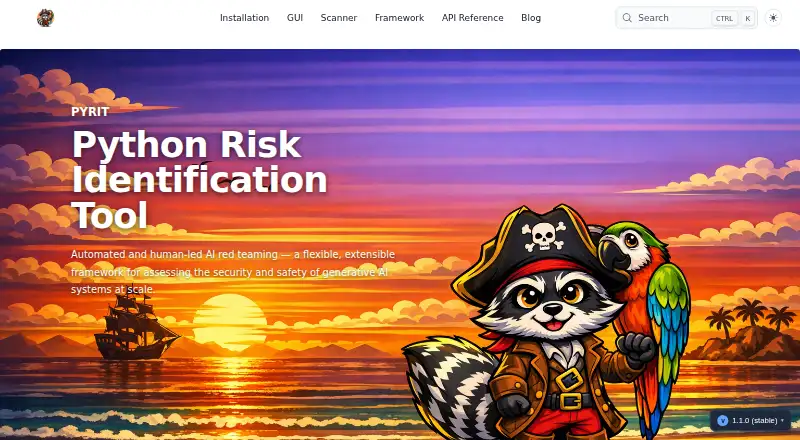
What PyRIT is
PyRIT is a free, open-source framework for automated and human-led red teaming of generative AI systems, focused on security and safety assessments. Teams can run checks with its command-line scanner, interactive shell, or CoPyRIT graphical interface, or build workflows using the framework. It supports single- and multi-turn strategies such as Crescendo, TAP, and Skeleton Key. Scenarios combine strategies and datasets for repeatable assessments of content harms, psychosocial risks, data leakage, and other objectives. Documented targets include OpenAI, Azure, Anthropic, Google, Hugging Face, custom HTTP endpoints and WebSockets, and web apps tested with Playwright. Components include targets, converters, scorers, memory, datasets, attacks, and scenarios. Converters can alter text prompts or transform among text, images, audio, video, and files; scorers return Boolean or normalized 0.0–1.0 results. Built-in memory can track conversations, scores, and attack results using SQLite or Azure SQL. PyRIT is self-hosted and requires a Python environment and configured AI endpoints.
Who it suits
PyRIT suits teams assessing the security and safety of generative AI systems that can provide a Python environment and configure AI endpoints. Its interfaces and framework workflows accommodate both direct assessment runs and custom workflows.
What it does well
- Supports automated and human-led red teaming.
- Includes single- and multi-turn attack strategies.
- Offers command-line, shell, and graphical interfaces.
- Scorers can use LLMs, Azure AI Content Safety, or custom logic.
- Built-in memory supports SQLite or Azure SQL.
What to know first
- Requires a Python environment and configured AI endpoints.
- Local installation prerequisites list Python 3.10 through 3.14.
- Frontend contributor setup requires Node.js 22 or higher.
- Shared or deployed configuration should use Azure Key Vault; plaintext .env files are less secure.
Limits
The free plan is an open-source framework that requires a Python environment and configured AI endpoints. Local installation prerequisites list Python 3.10 through 3.14; frontend contributor setup requires Node.js 22 or higher.
Plans
| Plan | Billed and limits | Price |
|---|---|---|
| PyRIT | Open-source framework · requires a Python environment and configured AI endpoints | Free |
As azure.github.io lists them, read 30 Sept 2026. The maker's own page has the final word.
Getting started
- Open the PyRIT documentation website.
- Choose the documented local installation with pip or uv, or a Docker installation option.
- For local installation, use Python 3.10 through 3.14.
- Configure the AI endpoints you intend to assess.
- Choose the command-line scanner, interactive shell, CoPyRIT graphical interface, or a framework workflow.
PyRIT is an open-source toolkit for probing the security and safety of generative AI. It suits security engineers, developers, and evaluators who can operate Python-based infrastructure and supply their own model endpoints. Its breadth and composability are compelling for bespoke red-team programs, while teams wanting a hosted, turnkey service should choose another approach.
Overview
PyRIT combines automated and human-guided red teaming in a framework you assemble around your assessment goals. You can work from its command-line scanner or interactive shell, use the CoPyRIT graphical interface, or construct workflows directly in the framework. This gives experienced teams several ways to move from exploratory testing to repeatable runs, but it also means configuration and operational ownership stay with you.
Targets documented by the project cover OpenAI, Azure, Anthropic, Google, and Hugging Face, plus custom HTTP endpoints, WebSockets, and web applications exercised through Playwright. That range makes it suitable for comparing providers or testing an application’s own interface rather than only a single API. Prompt-injection, jailbreak, data-leakage, unsafe-output, and custom test cases are all within its stated scope.
Key features
Strategies and repeatable scenarios
Single-turn and multi-turn attack strategies include Crescendo, TAP, and Skeleton Key. Scenarios combine strategies with datasets so teams can rerun assessments against defined objectives such as content harms, psychosocial risks, and data leakage. The result is a better basis for consistent evaluations than a collection of ad-hoc prompts, while the framework still leaves you to select suitable datasets and attack paths.
Prompt conversion
Converters can encode, obfuscate, translate, or semantically alter prompts. They also support transformations between text, images, audio, video, and files. This is useful when a test needs to vary how an instruction reaches a model or cross modality boundaries, although designing meaningful conversions remains part of the evaluator’s work.
Scoring and memory
Scorers can produce Boolean results or normalized scores from 0.0 to 1.0. They may rely on another LLM, Azure AI Content Safety, or custom logic, allowing teams to balance automated judging with domain-specific rules. Built-in memory records conversations, scores, and attack results in SQLite or Azure SQL, giving repeated campaigns a place to retain results and context.
Interfaces and modular architecture
The framework separates targets, converters, scorers, memory, datasets, attacks, and scenarios. That modularity supports replacing one part without rebuilding the whole assessment. The command line and shell favor scripted or interactive work, while CoPyRIT offers a graphical route for users who prefer not to begin in a terminal.
Setup and credential handling
Local installation is documented with pip or uv, and Docker installation is also available. Local prerequisites cover Python 3.10 through 3.14; contributors working on the frontend need Node.js 22 or newer. For shared or deployed configurations, PyRIT recommends Azure Key Vault and warns that plaintext .env files are less secure. In CoPyRIT, an API key entered while creating a target is held in memory and is not written to disk, which reduces persistence risk during that session.
Pricing
| Plan | Price | What it includes |
|---|---|---|
| PyRIT | free | Open-source framework; requires a Python environment and configured AI endpoints |
There is no license fee or subscription charge for the framework. The trade-off is that hosting, environment maintenance, endpoint access, and any provider usage costs remain your responsibility. This is a strong fit for organizations with existing engineering and security infrastructure, not for buyers seeking bundled hosted capacity or a managed testing allowance.
Platforms
PyRIT supports API, Linux, macOS, self-hosted, web, and Windows deployments. Its self-hosted model works across those environments, with installation available through Python tooling or Docker. The platform breadth helps distributed teams standardize on the same framework, but compatibility still depends on meeting the stated Python and, for frontend contributors, Node.js requirements.
Who it's for
Choose PyRIT if you need automated and human-led testing across several model providers or custom application endpoints, and you want to define your own attacks, conversions, scoring rules, datasets, and scenarios. It is particularly appropriate for security teams and developers building an internal evaluation process that must be rerun and retained.
Look elsewhere if you need a hosted workflow, a fixed quota, or minimal infrastructure work. PyRIT supplies the framework rather than a managed service, so teams without Python operations experience or endpoint credentials will face a steeper start.
Pros and cons
Pros
- Broad target coverage: Provider integrations, custom HTTP and WebSocket endpoints, and Playwright-tested web apps support varied assessment programs.
- Repeatable, extensible testing: Scenarios, datasets, modular attacks, converters, and custom test cases let teams standardize and adapt campaigns.
- Flexible evaluation: Boolean or 0.0–1.0 scoring can use LLMs, Azure AI Content Safety, or bespoke logic.
- Multiple working styles: CLI, interactive shell, CoPyRIT, and framework APIs accommodate scripted, graphical, and programmatic use.
Cons
- Operational burden: Users must provide the Python environment, configure endpoints, and manage deployment themselves.
- Provider credentials remain your responsibility: The free framework does not include model access or usage allowances.
- Security requires deliberate setup: Shared deployments should use Azure Key Vault rather than less-secure plaintext environment files.
- Frontend contribution requirements are current and specific: Node.js 22 or newer is required for contributor setup.
Alternatives
AIRTA Red Team is another free, open-source option across API, desktop, web, and Windows environments; choose it when you want no license fee and are comfortable bringing your own LLM API key.
OpenSecureAI Scanner suits teams that want a freemium hosted tier, with a Pro plan at $49 a month, 50,000 API requests per month, and hosted remediation and gateway completions.
Project Moonshot is a free choice for teams seeking a similarly broad, self-hosted platform footprint.
Promptfoo is the better fit when a freemium community plan with 10,000 red-team probes per month and broad provider integrations matches your workflow.
PromptGuard favors teams wanting a managed free allowance of 20,000 scans per month, one API key, one project, and 24-hour log retention.
Augustus is a free Apache 2.0 open-source alternative for Linux, macOS, Windows, and self-hosted use.
Basilisk is a free AGPL-3.0 tool distributed through CLI, desktop, Docker, or source packages.
AgentScan is a freemium API and web service with a free tier of five scans per month and 185 attack vectors.
Verdict
PyRIT is a strong choice for technically capable teams that want an open, modular foundation for repeatable generative-AI red teaming across providers and custom interfaces. Choose it for control over attack design, scoring, memory, and deployment. Choose an alternative when you need hosted execution, included quotas, or a simpler path from signup to results.
Verdict
PyRIT provides a modular way to assess generative AI systems with repeatable scenarios and a range of targets. It is a fit for teams prepared to self-host and configure the required environment and endpoints.
Questions
Is PyRIT free?
Yes. The PyRIT plan is free, and the framework is open source.
How is PyRIT deployed?
It is self-hosted. The documentation provides local installation with pip or uv and separate Docker installation options.
Which Python versions are listed for local installation?
The local installation prerequisites list Python 3.10 through 3.14.
What interfaces can I use to run assessments?
You can use the command-line scanner, interactive shell, CoPyRIT graphical interface, or build workflows with the framework.
Which AI targets are documented?
Targets include OpenAI, Azure, Anthropic, Google, Hugging Face, custom HTTP endpoints and WebSockets, and web apps tested with Playwright.
How does CoPyRIT handle an API key entered for a target?
The key is kept in memory and is not persisted to disk.
Facts from PyRIT's own pages
- Attack strategies
- It supports single-turn and multi-turn strategies including Crescendo, TAP, and Skeleton Key. · microsoft.github.io, 30 Sept 2026
- Compatibility limit
- The local installation page lists Python 3.10 through 3.14 as prerequisites, and the contributor setup page requires Node.js 22 or higher for the frontend. · microsoft.github.io, 30 Sept 2026
- Components
- The modular framework includes targets, converters, scorers, memory, datasets, attacks, and scenarios. · microsoft.github.io, 30 Sept 2026
- Credential handling
- In CoPyRIT, an API key entered when creating a target is stored in memory only and is not persisted to disk. · microsoft.github.io, 30 Sept 2026
- Installation
- The documentation provides local installation with pip or uv and separate Docker installation options. · microsoft.github.io, 30 Sept 2026
- Interfaces
- Users can run assessments with the command-line scanner and interactive shell, use the CoPyRIT graphical interface, or build workflows with the framework. · microsoft.github.io, 30 Sept 2026
- Memory
- Built-in memory can track conversations, scores, and attack results using SQLite or Azure SQL. · microsoft.github.io, 30 Sept 2026
- Prompt conversion
- Converters transform prompts through text operations such as encoding, obfuscation, translation, and semantic changes, as well as conversions among text, images, audio, video, and files. · microsoft.github.io, 30 Sept 2026
- Purpose
- PyRIT is an open-source framework for automated and human-led red teaming to assess the security and safety of generative AI systems. · microsoft.github.io, 30 Sept 2026
- Scenarios
- Its scenarios package attack strategies and datasets for repeatable assessments of content harms, psychosocial risks, data leakage, and other objectives. · microsoft.github.io, 30 Sept 2026
- Scoring
- Scorers can return true/false or normalized 0.0–1.0 scores and can use LLMs, Azure AI Content Safety, or custom logic. · microsoft.github.io, 30 Sept 2026
- Security
- PyRIT recommends Azure Key Vault for shared or deployed configuration and warns that plaintext .env files are less secure. · microsoft.github.io, 30 Sept 2026
- Targets
- Documented targets include OpenAI, Azure, Anthropic, Google, Hugging Face, custom HTTP endpoints and WebSockets, and web apps tested with Playwright. · microsoft.github.io, 30 Sept 2026
Where PyRIT stands on Freedom251
- AI Security Testing Tools#16 of 29