Freedom251 › Translation Software

Argos Translate
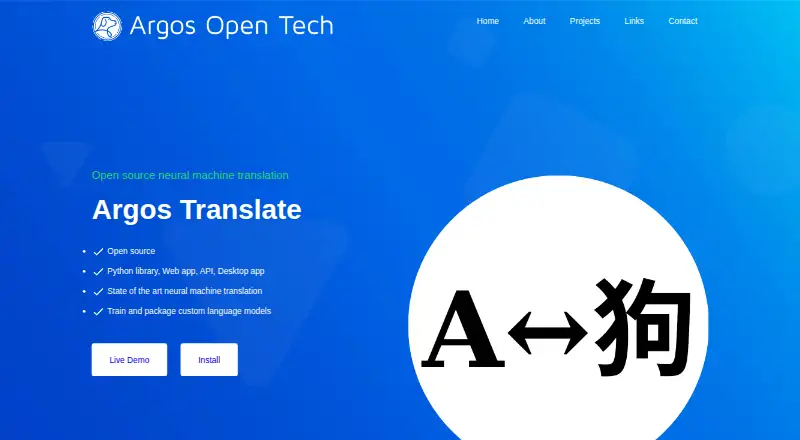
What Argos Translate is
Argos Translate is a free, open-source Python library for offline machine translation. It uses OpenNMT and can be used as a Python library, a command-line tool, or a GUI application. Language models come as installable .argosmodel archives, and you need to install the requested language pair before translating. The project lists languages including Arabic, Chinese, English, French, Hindi, Japanese, and Spanish, among others. For a pair without a direct installed translation, Argos can route text through an installed intermediate language, though this may reduce translation quality. The maker describes LibreTranslate as an API and web app built on Argos Translate. It also links to a separate file-translation tool for .txt, .odt, .odp, .docx, .pptx, .epub, and .html files. The project is dual licensed under MIT or Creative Commons CC0. The maker links to a community forum and lists machine-translation support or consulting among its contract services.
Who it suits
Argos Translate suits users looking for an offline translation library they can use through Python, the command line, or a GUI. It may also fit developers who want to work with installable language models or build on the project.
What it does well
- Works offline and is free to use.
- Available as a Python library, CLI, or GUI.
- Users can train and package custom language models.
- Dual licensed under MIT or Creative Commons CC0.
What to know first
- The requested language pair must be installed first.
- Indirect translation through another language may reduce quality.
Limits
The free plan is the open-source offline translation library. Translation requires an installed model for the requested language pair; using an intermediate language for an indirect pair can reduce translation quality.
Plans
| Plan | Billed and limits | Price |
|---|---|---|
| Open source | Offline translation library · Python, command-line, and GUI use | Free |
As argosopentech.com lists them, read 9 Oct 2026. The maker's own page has the final word.
Getting started
- Visit the Argos Translate website.
- Choose Python library, command-line, or GUI use.
- Install the .argosmodel package for the language pair you need.
- Use the installed pair for translation, or route through an installed intermediate language if needed.
Argos Translate is an open-source translation library that runs offline and can be used through Python, a command-line interface, or a graphical application. It is best suited to developers, privacy-conscious users, and organizations that want to operate translation on their own systems. The main compromise is that every required language pair depends on an installed model, and indirect translation can reduce quality.
Overview
Argos Translate uses OpenNMT as its translation engine and packages language models as installable .argosmodel archives. That arrangement gives users control over which models are present and supports offline work without sending text to a hosted service. It also puts installation and model management in the user’s hands.
The project can serve as a Python library, command-line tool, or GUI application. Developers can embed it in software, technically inclined users can automate jobs from a shell, and non-developers can use the desktop-style interface. LibreTranslate is an API and web application built on top of Argos Translate, while a separate tool handles translation of .txt, .odt, .odp, .docx, .pptx, .epub, and .html files.
Key features
Offline models and language coverage
The project README names languages including Arabic, Chinese, English, French, Hindi, Japanese, Spanish, and others. Coverage is therefore broad enough for many common combinations, but a language appearing in the project’s coverage does not by itself make every pair usable. The requested pair must be installed before translation can begin.
Direct and indirect translation
When no direct model is installed for a combination, Argos can pivot through an installed intermediate language. This expands the combinations that can be attempted, but the extra translation step can lower quality. It is a practical fallback for informal or lower-stakes text, not a substitute for a direct model when wording accuracy matters.
Custom models and integration
The maker says users can train and package custom language models. That is valuable for teams with specialized terminology or a need to control deployment, although it assumes the technical capacity to create and maintain those models. API access, Python integration, and command-line use make Argos more adaptable than a single-purpose translation app.
Licensing and support
The project README describes dual licensing under MIT or Creative Commons CC0. A community forum provides a place for user support, and the maker lists machine-translation support or consulting among its contract services.
Pricing
| Plan | Price | Includes |
|---|---|---|
| Open source | free | Offline translation library; Python, command-line, and GUI use |
Argos Translate is free, with no paid tier or usage quota stated for the open-source plan. The value is strongest for users who can run and maintain software themselves; those seeking a managed service, polished hosted workflow, or guaranteed pair availability may need a different product.
Platforms
Argos Translate is available through an API, on Linux, and in self-hosted deployments. Its listed availability is categorized as web and desktop, but the core offering is the software you operate rather than a conventional hosted consumer app.
Who it's for
Choose Argos Translate if offline operation, open licensing, API access, or custom models is central to your project. It fits developers building translation into Python applications, teams that want self-hosted processing, and users translating supported files without relying on an online connection.
Look elsewhere if you need a broad consumer-device footprint, a ready-made cloud service, or dependable direct translation for a pair that is not supplied as an installed model. Indirect pairs are available, but with a possible quality penalty.
Pros and cons
- Pros: Free software with offline capability, self-hosting, API access, Python and command-line integration, a GUI, and support for custom trained models.
- Pros: Model packages and file-translation tooling cover several deployment and document workflows.
- Cons: Users must install the requested language pair before translating, so listed language coverage does not ensure every combination is ready.
- Cons: Pivoting through an intermediate language can reduce translation quality.
- Cons: Running models, managing packages, and training custom models require more technical involvement than a hosted translation app.
Alternatives
For a mobile and browser-oriented freemium service, consider iTranslate, which offers text translation free and adds a paid PRO plan with keyboard extension and custom phrase support. Papago is a better fit when you want consumer apps plus API access and stated monthly allowances for images, documents, and voice translation. Lara Translate suits users who prefer a hosted service with a free 60,000-character monthly allowance, one user, and document-size limits.
Yandex Translate is a free option for personal, noncommercial text and web-page translation. Google Translate is another free choice, including document translation up to 10 MB and PDFs up to 300 pages. DeepL Translator fits users wanting a hosted freemium workflow with 50,000 characters per user each month, one file translation monthly, and glossary features.
For API-centric workloads, Google Cloud Translation offers a 500,000-character monthly free allowance before its paid neural-machine-translation tier. Baidu Translate is an alternative with broad platform coverage, including self-hosting, and team plans.
Verdict
Argos Translate is a strong choice for developers and organizations that need free, offline, self-hosted translation with API access and the option to build custom models. Choose another service when you prioritize managed consumer apps, published usage allowances, or a guaranteed direct language pair without installing and maintaining models yourself.
Verdict
Argos Translate offers several ways to run offline translation and supports custom language models. Check that the required pair is available, especially if direct translation quality matters.
Questions
Is Argos Translate free?
Yes. Its Open source plan is free.
Can Argos Translate work offline?
Yes. The project describes it as offline capable.
Which platforms can I use?
The listed platforms include web and desktop, with Linux and self-hosted options. It can be used as a Python library, command-line tool, or GUI application.
Is Argos Translate open source?
Yes. The README says it is dual licensed under MIT or Creative Commons CC0.
Do I need to install language models?
Yes. The .argosmodel package for the requested language pair must be installed before translation.
Does it provide an API?
API access is available. The maker describes LibreTranslate as an API and web app built on Argos Translate.
Facts from Argos Translate's own pages
- API access
- Yes · argosopentech.com, 23 Sept 2026
- API and web app
- The maker describes LibreTranslate as an API and web app built on top of Argos Translate. · argosopentech.com, 9 Oct 2026
- Custom models
- The maker says users can train and package custom language models. · argosopentech.com, 9 Oct 2026
- File translation
- The maker links to a tool for translating .txt, .odt, .odp, .docx, .pptx, .epub, and .html files using Argos Translate. · argosopentech.com, 9 Oct 2026
- Free plan
- Yes · argosopentech.com, 23 Sept 2026
- Headquarters
- Ithaca, New York, United States · argosopentech.com, 28 Sept 2026
- Indirect language pairs
- It can pivot through installed intermediate languages for pairs without a direct installed translation, with some loss of translation quality. · github.com, 9 Oct 2026
- Language coverage
- The project README lists languages including Arabic, Chinese, English, French, Hindi, Japanese, Spanish, and others. · github.com, 9 Oct 2026
- Language models
- It installs language model packages distributed as .argosmodel archives. · argosopentech.com, 9 Oct 2026
- Licensing
- The project README says Argos Translate is dual licensed under MIT or Creative Commons CC0. · github.com, 9 Oct 2026
- Notable requirement
- A requested language pair must be installed before using it for translation. · github.com, 9 Oct 2026
- Offline use
- The project describes itself as offline capable, and the maker describes Argos Translate as an offline translation library. · argosopentech.com, 9 Oct 2026
- Purpose
- Argos Translate is an open-source offline translation library written in Python. · argosopentech.com, 9 Oct 2026
- Support
- The maker links to a community forum and lists machine translation support or consulting among its contract services. · argosopentech.com, 9 Oct 2026
- Translation engine
- It uses OpenNMT for translations. · argosopentech.com, 9 Oct 2026
- Ways to use it
- It can be used as a Python library, command-line tool, or GUI application. · argosopentech.com, 9 Oct 2026
Where Argos Translate stands on Freedom251
- Translation Software#6 of 156
- Language Translation Software#3 of 30
- AI Translation Tools#3 of 24
- Translation apps#60 of 158