Freedom251 › Device Farm Software

Appetize
What Appetize is
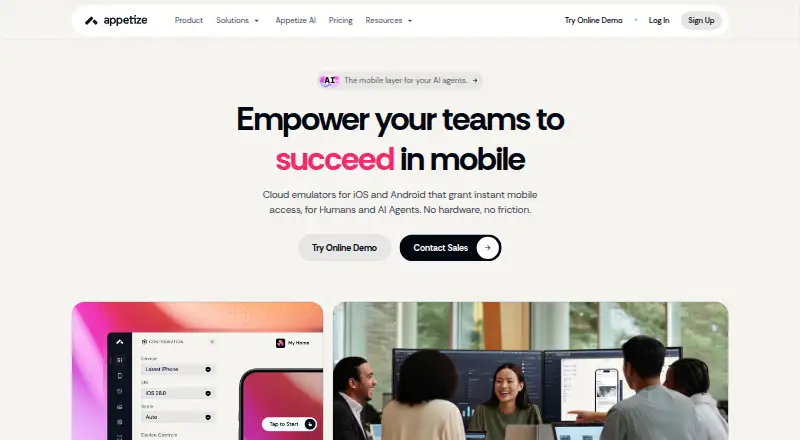
Appetize runs native iOS and Android apps on virtual mobile devices that users access through a web browser. Teams can preview, share, or embed uploaded apps and use the service for demos, onboarding, training, mobile testing, and screenshot automation. Debugging features include network traffic monitoring, debug logs, UI automation, proxy configuration, device and OS selection, language and locale settings, mock location, and deep links. AppRecorder automation for Playwright supports end-to-end test building, running, and debugging; JavaScript SDK and REST API options are also listed. Appetize names GitHub Actions, GitLab, Bitrise, and Jenkins as CI/CD integrations, and lists Claude Code, Codex, and Cursor support through its CLI and REST API. The service does not provide real devices. Customers upload their app files, and iOS uploads must be Simulator builds; IPA files are not supported. The Free plan provides 30 minutes refilled monthly and limits sessions to three minutes. Paid plans include Starter at $59 a month and Premium at $319 a month.
Who it suits
Appetize suits developers and teams that need browser-accessible virtual iOS and Android sessions for previews, testing, demos, or training. Its automation and CI/CD options may also suit teams incorporating app checks into development workflows.
What it does well
- Runs native iOS and Android apps in a browser.
- Includes debugging tools such as logs and network monitoring.
- Supports Playwright and AppRecorder automation.
- Offers a free plan with monthly minutes.
- Lists a 99.9% uptime Service Level Agreement.
What to know first
- Does not provide real devices.
- Free sessions are limited to three minutes.
- iOS uploads must be Simulator builds; IPA files are unsupported.
- Paid plans charge $0.06 per minute after included minutes.
Limits
The Free plan includes one user, up to two active devices, 30 minutes refilled monthly, and a three-minute session limit. Starter costs $59 a month and Premium costs $319 a month; each includes 500 minutes, with additional usage at $0.06 per minute. Starter allows up to three active devices and Premium up to 16.
Plans
| Plan | Billed and limits | Price |
|---|---|---|
| Free | Single user · 2 active devices maximum · 30 minutes refilled monthly | Free |
| Starter | $708/year · 3 active devices maximum · 500 minutes included, then $0.06/min | $59 a month |
| Premium | $3828/year · 16 active devices maximum · 500 minutes included, then $0.06/min | $319 a month |
| Enterprise | Per User or Metered billing · Custom Built Solutions · Private Clouds or Self-Hosting · 24/7 support | On request |
As appetize.io lists them, read 7 Oct 2026. The maker's own page has the final word.
Getting started
- Open https://appetize.io/.
- Choose the Free plan or review Starter, Premium, and Enterprise options.
- Upload your app files; iOS uploads must be iOS Simulator builds.
- Open a browser-accessible session to run, share, or embed the app.
- Use the available debugging or automation tools as needed.
Appetize is a browser-based service for running native iOS and Android apps on virtual devices. It is best suited to developers and teams who need shareable previews or automated mobile testing; it is less suitable when physical-device coverage or unrestricted iOS app uploads are essential.
Overview
Upload an app to create a session that can be run in a browser, embedded, or shared. That makes Appetize useful beyond development: teams can use it for demos, training, onboarding, and app previews without asking viewers to install the app. The trade-off is that teams must supply their own app files, and iOS uploads must be Simulator builds; IPA files are not supported.
Appetize centers on virtual devices, not physical hardware. Its 99.9% uptime Service Level Agreement, ISO 27001 security program, SOC 2 Type 2 compliance, and CSA CAIQ with over 260 controls across 17 domains may suit organizations assessing a hosted workflow. Appetize also says its policies address GDPR and CCPA, and that it operates a dedicated EU Cloud and uses approved contractual or other lawful transfer mechanisms.
Key features
Testing and debugging
AppRecorder supports building, running, and debugging Playwright end-to-end tests on Appetize devices. A JavaScript SDK and REST API provide additional ways to work with the service. Debugging tools include network traffic monitoring, logs, UI automation, proxy configuration, device and OS selection, language and locale settings, mock location, and deep links. This breadth supports reproducing varied app conditions, though it remains virtual-device testing rather than validation on physical phones.
Automation and integrations
Appetize names GitHub Actions, GitLab, Bitrise, and Jenkins as CI/CD integrations. Its CLI and REST API also support Claude Code, Codex, and Cursor. These connections give teams routes to include Appetize in existing build and coding workflows without limiting automation to a browser session.
Sharing and service
Browser-accessible sessions can be shared or embedded, making Appetize practical for product demonstrations and distributed review. The pricing page directs users to submit support tickets and specifies 24/7 support for Enterprise. Enterprise customers can also contact Appetize about private clouds or self-hosting.
Pricing
The Free plan costs nothing and is limited to one user, two active devices, 30 minutes refilled monthly, and three-minute sessions. It is a low-commitment way to try browser sessions, but the short session cap and small monthly allowance constrain regular testing.
Starter costs $59 a month, billed $708/year. It allows three active devices and includes 500 minutes, then charges $0.06/min. Premium costs $319 a month, billed $3828/year, and raises the active-device maximum to 16 while keeping the same 500 included minutes and $0.06/min overage. Both list unlimited sessions, which removes the Free plan's three-minute session limit, but does not remove the minute quota. Starter suits smaller teams; Premium is for teams needing more concurrent devices, not more included runtime.
Enterprise uses per-user or metered billing with custom pricing, and adds 24/7 support plus private-cloud or self-hosting options. The published plans make the ongoing cost of minutes important for teams with heavy testing workloads. The Free plan has no paid commitment, while the two fixed-price plans are billed annually at the stated totals.
Platforms
Appetize supports iOS, Android, web access, APIs, and self-hosted deployment options for Enterprise customers. It supports browser testing and parallel sessions; the plan device caps determine how many active devices are available, with Free capped at two, Starter at three, and Premium at 16. Because real devices are not offered, it cannot replace a physical-device farm when hardware-specific behavior is the requirement.
Who it's for
Appetize is a strong fit for app developers who want virtual iOS and Android sessions, teams automating end-to-end tests with Playwright, and organizations sharing demos or training experiences through a browser. It is a weaker fit for teams that need real-device coverage, rely on IPA uploads, or expect a small monthly minute allowance to support sustained testing.
Pros and cons
- Pros: Browser-based sharing and embedding make previews, demos, and onboarding accessible without local app installation.
- Pros: Playwright automation, SDK and API access, and named CI/CD integrations support integration into development workflows.
- Pros: Debugging controls include network monitoring, logs, locale settings, mock location, and deep links for varied test scenarios.
- Cons: iOS uploads must be Simulator builds; IPA files are not supported.
- Cons: There are no real devices, limiting its value for hardware-specific validation.
- Cons: Free is capped at 30 minutes per month and three minutes per session, while paid plans charge $0.06/min after 500 included minutes.
Alternatives
Choose Maestro if local, open-source test automation on your own devices is a better fit: its Local plan is free and includes Maestro MCP, Viewer, Studio, CLI, and local agents.
SureAsset is a free alternative for asset lifecycle management, hardware and software license tracking, and API access and automation, rather than virtual app sessions.
Samsung Remote Test Lab offers free sign-up with limited daily credits and device-dependent reservation times.
Consider TestMu AI Real Device Cloud when real-device testing is the priority; its free plan allows one parallel test and five live sessions per month, up to two minutes per session.
Firebase Cloud Messaging is a no-cost option for cloud messaging rather than app testing.
TestingBot is another testing option, with a Live plan priced at €20 a year, billed annually, or €30 month-to-month, and support for real iOS and Android devices.
BrowserStack Live is an alternative for live desktop and mobile testing; its Freelancer plan is $12.50 a month billed annually, with a 100-minute allowance and one user/account.
DeviceFarmer is another free option for teams comparing device-farm software.
Browse Device Farm Software or Android emulators for more options.
Verdict
Appetize is a good choice for developers and product teams that want shareable virtual iOS and Android sessions alongside browser-based debugging and Playwright automation. Its strongest advantage is bringing previews, testing, and integrations into one workflow. Choose another service if physical-device validation is central, and budget carefully if testing will regularly exceed the paid plans' 500 included minutes.
Verdict
Appetize offers browser-based virtual device sessions, debugging features, and test automation for iOS and Android apps. The free tier is limited, and uploaded iOS apps must meet its Simulator-build requirement.
Questions
Is Appetize free?
Yes. Its Free plan costs nothing and includes one user, two active devices maximum, and 30 minutes refilled monthly. Sessions are limited to three minutes.
How much do the paid plans cost?
Starter costs $59 a month, billed $708/year. Premium costs $319 a month, billed $3828/year. Both include 500 minutes, then charge $0.06 per minute.
Which platforms and operating systems does it support?
The listed platforms are Android, API, iOS, self-hosted, and web. Appetize runs native iOS and Android apps on virtual mobile devices through a browser.
Does Appetize use real devices?
No. Its device sessions run on virtual mobile devices.
Which integrations and automation options are listed?
AppRecorder supports Playwright, and the platform also lists a JavaScript SDK and REST API. Named CI/CD integrations are GitHub Actions, GitLab, Bitrise, and Jenkins; Claude Code, Codex, and Cursor are supported through the CLI and REST API.
Can Enterprise customers self-host?
Enterprise customers can contact Appetize about private clouds or self-hosting. Enterprise pricing is per-user or metered, and the plan lists 24/7 support.
Facts from Appetize's own pages
- Automation
- Appetize provides AppRecorder automation for Playwright to build, run, and debug end-to-end tests on Appetize devices. · docs.appetize.io, 7 Oct 2026
- Debugging
- Features include monitoring network traffic, debug logs, UI automation, proxy configuration, device and OS selection, language and locale settings, mock location, and deep links. · docs.appetize.io, 7 Oct 2026
- Free plan
- Yes · appetize.io, 21 Sept 2026
- Hosting
- Enterprise customers can contact Appetize about private clouds or self-hosting. · appetize.io, 7 Oct 2026
- Integrations
- Its Appetize AI page names GitHub Actions, GitLab, Bitrise, and Jenkins as CI/CD integrations and also lists Claude Code, Codex, and Cursor support through the CLI and REST API. · appetize.io, 7 Oct 2026
- Plan limit
- The Free plan has a three-minute session limit, while Starter and Premium list unlimited sessions in the plan comparison. · appetize.io, 7 Oct 2026
- Privacy
- Appetize says its policies address GDPR and CCPA and that it operates a dedicated EU Cloud and uses approved contractual or other lawful transfer mechanisms. · accounts.appetize.io, 7 Oct 2026
- Security
- Appetize states that it maintains an ISO 27001 security program, is SOC 2 Type 2 compliant, and has a CSA CAIQ with over 260 controls across 17 domains. · accounts.appetize.io, 7 Oct 2026
- Service level
- The pricing page says Appetize backs its availability promise with a 99.9% uptime Service Level Agreement. · appetize.io, 7 Oct 2026
- Sharing and embedding
- Appetize supports running, embedding, and sharing uploaded apps through browser-accessible sessions. · docs.appetize.io, 7 Oct 2026
- Support
- The pricing page directs users to submit a support ticket and lists 24/7 support for Enterprise. · appetize.io, 7 Oct 2026
- Upload requirement
- Customers upload app files themselves; iOS uploads must be iOS Simulator builds, and IPA files are not supported. · support.appetize.io, 7 Oct 2026
- Use cases
- The platform lists live and embedded previews, mobile app support, training and onboarding, demos, mobile testing, and screenshot automation as use cases. · docs.appetize.io, 7 Oct 2026
- What it does
- Appetize is a cloud-based platform for running and testing native iOS and Android apps on virtual mobile devices from a web browser. · docs.appetize.io, 7 Oct 2026
Where Appetize stands on Freedom251
- Device Farm Software#1 of 26
- Mobile Device Testing Software#1 of 18
- Android emulators#6 of 19