Freedom251 › Key-Value Databases
Apache Accumulo
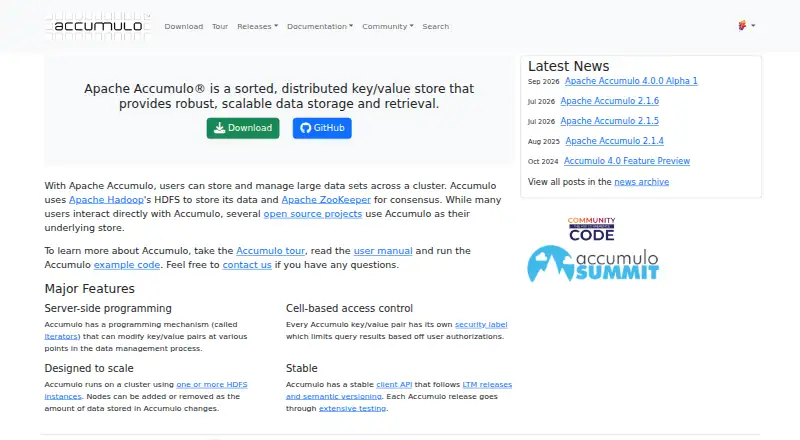
What Apache Accumulo is
Apache Accumulo is a free, open-source sorted, distributed key/value store for storing and retrieving large datasets across a cluster. It uses Apache Hadoop HDFS for storage and Apache ZooKeeper for consensus. Nodes can be added or removed as data needs change, and each key/value pair can carry a security label that limits which results a user can query. Accumulo Iterators can modify key/value pairs during data management. The software is self-hosted and supports a Java API and Thrift. The project says its client API follows Long Term Maintenance releases and semantic versioning. Its downloads page lists source and binary archives for versions 4.0.0-alpha-1, 3.0.0, and 2.1.6; the 4.0.0-alpha-1 release is marked alpha, and alpha or beta releases are not production ready. The project offers user and developer mailing lists, plus an interactive Java API tour designed for Accumulo 2.1.x or later. It is licensed under Apache License, Version 2.0.
Who it suits
Accumulo suits teams that need self-hosted, clustered storage for large datasets, with per-key query access controls. Its Java API tour and mailing lists may also help developers learning or contributing to the project.
What it does well
- Stores and manages large datasets across a cluster
- Per-key security labels restrict query results
- Nodes can be added or removed as data changes
- Offers Java API and Thrift access
- Free and licensed under Apache License 2.0
What to know first
- Requires a self-hosted cluster using HDFS
- The 4.0.0-alpha-1 release is not production ready
- The interactive tour is designed for 2.1.x or greater
Plans
| Plan | Billed and limits | Price |
|---|---|---|
| Apache Accumulo | Open-source sorted, distributed key/value store · Apache License 2.0 | Free |
As accumulo.apache.org lists them, read 4 Oct 2026. The maker's own page has the final word.
Getting started
- Visit the Apache Accumulo website.
- Choose a source or binary archive for a listed release.
- Deploy Accumulo in a self-hosted environment using HDFS and ZooKeeper.
- Connect through the Java API or Thrift protocol.
- Use the interactive tour for Java API exercises designed for Accumulo 2.1.x or later.
Apache Accumulo is a distributed database for teams building data systems around Java clients and Hadoop infrastructure. Its strongest fit is a self-hosting team that needs to scale sorted key/value data while applying access rules to individual entries; it is a poor choice for buyers seeking a managed service.
Overview
Accumulo stores sorted key/value pairs across a cluster, using Hadoop HDFS for data storage and ZooKeeper for consensus. Nodes can be added or removed as stored data changes, making it a practical foundation for large datasets that need to grow across cluster resources. That flexibility comes with an operational commitment: teams must run the software and its supporting infrastructure themselves.
The project is maintained by the Apache Software Foundation and released under Apache License 2.0. Its client API follows Long Term Maintenance releases and semantic versioning, and the project says each release undergoes extensive testing. Downloads include versions 2.1.6, 3.0.0, and 4.0.0-alpha-1; the latter is explicitly not production ready, so production adopters should choose a stable release line.
Key features
Security labels at the key/value level
Each pair can carry its own security label, and a query returns only results allowed by the user's authorizations. This is a strong fit when different entries in one store require different visibility rules; teams that only need broad access controls may not benefit enough to justify Accumulo's infrastructure demands.
Iterator-based processing
Accumulo Iterators can modify key/value pairs at different stages of data management. That gives developers a way to add server-side processing to the storage workflow, though it also makes the Java API and its learning curve central to implementation.
Cluster scaling and protocols
Accumulo supports clustering and multi-region deployment, with Java API and Thrift protocols. Its combination of distributed storage and adjustable cluster membership suits systems whose data footprint changes over time, provided the team can operate HDFS and ZooKeeper.
Pricing
Apache Accumulo is free and open source: its Apache Accumulo plan costs nothing under Apache License 2.0. There is no paid tier or free trial to compare; the tradeoff is that teams self-host and manage the supporting stack rather than buying a hosted deployment.
Platforms
Accumulo is available for Linux and self-hosted deployments, with an API interface. Its supported protocols are Java API and Thrift. It uses Hadoop HDFS for storage and ZooKeeper for consensus, so Linux availability should not be mistaken for a standalone install with no infrastructure dependencies.
Who it's for
Choose Accumulo if you need distributed sorted key/value storage, entry-level query controls, and the ability to grow a cluster, and have operators able to manage its Hadoop-based foundation. It is less suitable for small teams looking for a ready-to-use database, or for organizations that want a vendor-managed service rather than self-hosting.
The project's user mailing list covers general questions and help, while the dev list is for contributor discussions. Its interactive tour teaches the Java API through independent exercises and targets Accumulo 2.1.x or later, making it a useful starting point for developers evaluating the client workflow.
Pros and cons
- Pro: Security labels apply to individual key/value pairs, allowing query results to reflect user authorizations at a fine-grained level.
- Pro: Cluster nodes can be added or removed as data changes, supporting deployments that need to adjust capacity over time.
- Pro: The free Apache-licensed software avoids a product subscription charge.
- Con: HDFS and ZooKeeper are part of the architecture, adding infrastructure that operators must run and coordinate.
- Con: The 4.0.0-alpha-1 release is not production ready, so adopters must select a stable release line for production use.
- Con: The Java API and Iterator model make it a developer-oriented system, not a turnkey database for teams without engineering and operations capacity.
Alternatives
Wide-Column Databases and Key-Value Databases are useful starting points for comparing products by database category.
- Apache Cassandra is another free, self-managed open-source distributed database; consider it if you want a NoSQL alternative with Linux, macOS, Windows, and web platform support.
- Amazon Keyspaces is a paid service with on-demand and provisioned capacity options; consider it if you prefer capacity that can adjust to traffic or be provisioned, rather than operating Accumulo yourself.
- Azure Cosmos DB for NoSQL offers a free tier with 1,000 RU/s, 25 GB of storage, and one free-tier account per Azure subscription; consider it if those limits suit your needs and you want its API-oriented offering.
- Google Cloud Bigtable is a paid alternative with Enterprise and Enterprise Plus plans priced at $0.65 a month and $0.85 a month respectively; consider it if you want a cloud Bigtable edition rather than self-hosted Accumulo.
- Apache HBase is free, open-source, and distributed, with operators configuring and managing deployments; consider it as another self-managed database option.
- SWC-DB is a free option for Linux and self-hosted deployments; consider it if its GPLv3 licensing terms fit your use.
- Tencent Cloud API Gateway is another option.
- Azure Application Insights is another option.
Verdict
Apache Accumulo is a strong choice for engineering teams that need scalable key/value storage with query controls attached to individual entries and can operate HDFS-backed clusters. Choose a stable release line for production; look elsewhere if managed infrastructure or a simpler deployment matters more than fine-grained access control and cluster-level control.
Verdict
Apache Accumulo combines distributed key/value storage with per-key query controls and cluster scaling. Check the release maturity and HDFS requirements before choosing a version for deployment.
Questions
How much does Apache Accumulo cost?
The listed plan is free. The software is open source under Apache License, Version 2.0.
Which platforms and protocols does it support?
The listed platforms are API, Linux, and self-hosted. Supported protocols are Java API and Thrift.
Is Apache Accumulo open source?
Yes. The project identifies Apache License, Version 2.0 as its license.
Which releases are available?
The downloads page lists source and binary archives for 4.0.0-alpha-1, 3.0.0, and 2.1.6. The project labels 4.0.0-alpha-1 as alpha and says alpha or beta releases are not production ready.
Where can users get help?
The project provides a user mailing list for general questions and help. A separate dev list is for contributor discussions.
Facts from Apache Accumulo's own pages
- Access control
- Each key/value pair has its own security label, which limits query results based on user authorizations. · accumulo.apache.org, 4 Oct 2026
- API stability
- The project says its client API follows Long Term Maintenance releases and semantic versioning, and each release undergoes extensive testing. · accumulo.apache.org, 4 Oct 2026
- Community support
- The project provides a user mailing list for general questions and help, and a dev list for contributor discussions. · accumulo.apache.org, 4 Oct 2026
- Hands-on learning
- The interactive tour introduces the Accumulo Java API through independent steps and exercises and is designed for Accumulo 2.1.x or greater. · accumulo.apache.org, 4 Oct 2026
- Large datasets
- Users can store and manage large data sets across a cluster. · accumulo.apache.org, 4 Oct 2026
- License
- The Apache Accumulo site identifies the software as licensed under Apache License, Version 2.0. · accumulo.apache.org, 4 Oct 2026
- Maintainer
- Apache Accumulo is an Apache Software Foundation project; the foundation describes itself as a U.S. 501(c)(3) nonprofit founded in 1999. · apache.org, 4 Oct 2026
- Purpose
- Apache Accumulo is a sorted, distributed key/value store for robust, scalable data storage and retrieval. · accumulo.apache.org, 4 Oct 2026
- Release maturity
- The site labels 4.0.0-alpha-1 an alpha release and says alpha or beta releases are not production ready. · accumulo.apache.org, 4 Oct 2026
- Release options
- The downloads page lists source and binary archives for Accumulo 4.0.0-alpha-1, 3.0.0, and 2.1.6. · accumulo.apache.org, 4 Oct 2026
- Scalability
- Accumulo runs on a cluster using one or more HDFS instances, and nodes can be added or removed as stored data changes. · accumulo.apache.org, 4 Oct 2026
- Security reporting
- The project asks that potential security issues be reported privately by email and says it follows the ASF vulnerability handling process. · accumulo.apache.org, 4 Oct 2026
- Server-side programming
- Accumulo Iterators can modify key/value pairs at various points in the data management process. · accumulo.apache.org, 4 Oct 2026
- Storage and coordination
- Accumulo uses Apache Hadoop HDFS to store its data and Apache ZooKeeper for consensus. · accumulo.apache.org, 4 Oct 2026
Where Apache Accumulo stands on Freedom251
- Key-Value Databases#4 of 31
- Wide-Column Databases#3 of 22