Freedom251 › Wide-Column Databases
SWC-DB
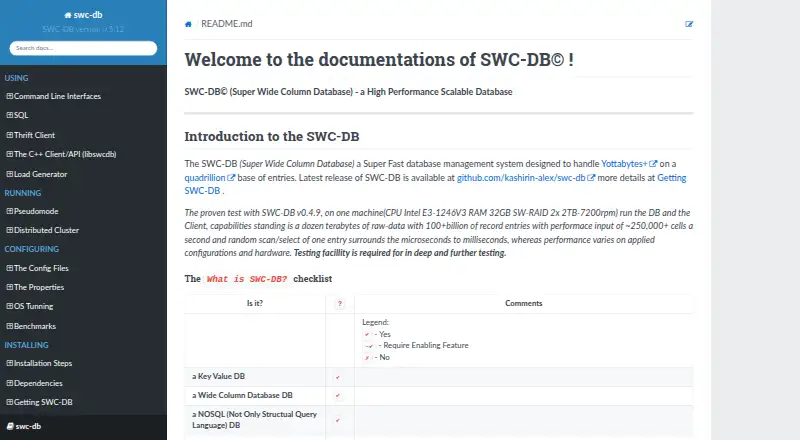
What SWC-DB is
SWC-DB is a free, self-hosted database that its maker describes as a high-performance, scalable Super Wide Column Database. Its documentation classifies it as key-value, wide-column, NoSQL and time-series software, and the maker says it is designed for yottabytes of data and a quadrillion base of entries. SQL is supported, but joins are not. The data model uses cell keys made from lists of fractions with timestamps and numerous columns rather than tables or namespaces. Data can use automatic or user-defined versions, in ascending or descending order, with a configurable maximum to retain. The maker describes ACID concepts for an individual data entry, but writes across multiple entries are not atomic as a group. Communications can use SSL; transaction security also depends on the configured filesystem and clients supporting a secure layer. User-concept access controls are marked unsupported. Deployment materials include a cluster utility and tar.xz, Debian and Arch Linux AUR packages. SWC-DB is licensed under GPLv3.
Who it suits
SWC-DB suits teams seeking a self-hosted wide-column database with SQL and horizontal scaling. Its GPLv3 licensing and unsupported user-concept access controls are important considerations.
What it does well
- Free and self-hosted under GPLv3.
- Supports SQL and horizontal scaling.
- Cluster utility deploys and controls distributed clusters.
- Client libraries include C++, Java, Python and Ruby.
What to know first
- SQL does not include joins.
- Multi-entry writes are not atomic as a group.
- User-concept access controls are unsupported.
- Transaction security depends partly on filesystem and clients.
Limits
The free plan is released under GPLv3, and the maker invites commercial-purpose licensing inquiries for uses limited by that license. SQL has no joins, writes across multiple entries are not atomic as a group, and user-concept access controls are unsupported.
Plans
| Plan | Billed and limits | Price |
|---|---|---|
| SWC-DB | GPLv3; commercial-purpose licensing inquiries for uses limited by GPLv3 | Free |
As swcdb.org lists them, read 4 Oct 2026. The maker's own page has the final word.
Getting started
- Visit the SWC-DB website
- Choose a tar.xz or Debian package, or use the Arch Linux AUR packages
- Configure a supported filesystem option
- Use the cluster utility to deploy and start a distributed cluster
- Consult the Google Group for discussion or GitHub issues for bugs and feature requests
SWC-DB is a self-hosted database for very large key-value, wide-column, NoSQL and time-series workloads. It best suits engineers operating Linux-based distributed infrastructure who need configurable versions and storage backends. The absence of joins, limited multi-entry transaction guarantees and unsupported user-level access controls make schema and security planning essential.
Overview
Founded in 2019, SWC-DB is designed for horizontal growth rather than hosted convenience. Its maker targets yottabytes of data and a quadrillion-base of entries, positioning it for systems where scale and distributed storage take priority over conventional relational design. You deploy and manage the software yourself, using its cluster utility to deploy, start and stop distributed clusters.
The data model combines key-value, wide-column, NoSQL and time-series approaches. Cell keys are lists of fractions with timestamps, while columns are numerous and not organized into tables or namespaces. That structure can fit sparse, versioned datasets, but teams must be comfortable modeling without familiar table boundaries.
Key features
Queries, versions and transactions
SWC-DB offers multiple query interfaces, including SQL. SQL can ease adoption for query-oriented teams, but it has no joins, so it is not a substitute for a relational system built around cross-table queries. Automatic or user-defined versions may be ordered ascending or descending, and you can set the maximum number retained. This provides explicit control over historical data and storage growth.
Transactions follow an important boundary: ACID concepts apply to a single data entry, while writes involving multiple entries are not atomic as a group. Applications that require all-or-nothing updates across several entries must account for that behavior in their design.
Storage, clustering and security
Built-in filesystem choices include local storage, broker, Hadoop JVM, Hadoop and Ceph. That range lets operators align deployment with existing infrastructure, but it also places backend selection and administration on the customer. Communications can use SSL. Transaction security additionally depends on the configured filesystem and on clients supporting a secure layer, so secure operation requires coordination across the stack.
User-concept access controls are unsupported. SWC-DB therefore suits environments that can enforce authorization outside the database rather than teams expecting built-in per-user permissions.
Clients and operations
Thrift libraries cover C++, Java, Python, Ruby and C-Glib, with generated clients for .NET Standard and Rust. Downloads include tar.xz and Debian packages, and Arch Linux packages are described through the AUR. Support is provided through a Google Group, GitHub issues and commercial-support contacts. The software is released under GPLv3; organizations whose commercial use is constrained by that license can inquire about commercial-purpose licensing.
Pricing
The SWC-DB plan costs nothing. It is the GPLv3 release, with commercial-purpose licensing inquiries for uses limited by GPLv3. There are no paid tiers, seat charges or hosted-service terms in this offering, but self-hosting leaves infrastructure and operations costs with you. Choose it when license cost and deployment control matter more than managed-service convenience; look elsewhere if you want a provider to run the database.
Platforms
SWC-DB supports API access, Linux and self-hosted deployment. The package formats and cluster tooling reinforce a Linux-oriented operating model. Client-library coverage is broad, spanning native, JVM, scripting and generated .NET Standard and Rust clients.
Who it's for
SWC-DB is a strong fit for infrastructure teams building horizontally scaled key-value, wide-column or time-series systems, especially when version retention and selectable local, Hadoop or Ceph storage are useful. It is less suitable for relational applications needing joins, workflows requiring atomic multi-entry writes, or organizations that require database-native user access controls. Teams without Linux cluster-operating capability should prefer a managed alternative.
Pros and cons
- Pros: Free GPLv3 software removes license fees for compatible use.
- Pros: A scale target reaching yottabytes and a quadrillion-base of entries supports exceptionally large designs.
- Pros: Configurable version ordering and retention help balance history against storage growth.
- Pros: Local, broker, Hadoop JVM, Hadoop and Ceph filesystem options accommodate varied infrastructure.
- Cons: SQL has no joins, limiting relational query patterns.
- Cons: Multi-entry writes are not atomic as a group, complicating cross-entry consistency.
- Cons: User-concept access controls are unsupported, so authorization must be handled elsewhere.
- Cons: Self-hosting and cluster administration require operational expertise and infrastructure ownership.
Alternatives
Choose Apache Cassandra instead for a free, self-managed distributed NoSQL database with Linux, macOS, Windows and web platform coverage. Amazon Keyspaces is the better choice when you want a hosted API with on-demand or provisioned capacity rather than operating clusters yourself.
Azure Cosmos DB for NoSQL fits teams seeking a freemium service with a free tier offering 1,000 RU/s and 25 GB storage. Pick Google Cloud Bigtable for a paid hosted Bigtable service with Enterprise, Enterprise Plus and Data Boost options.
Apache Accumulo and Apache HBase are free, self-managed distributed stores for teams preferring those open-source projects. Tencent Cloud API Gateway and Azure Application Insights address API gateway and application-monitoring needs rather than serving as direct database substitutes. Browse more options in Wide-Column Databases.
Verdict
Choose SWC-DB when you need a free, self-hosted wide-column system built for extreme scale, configurable version history and selectable storage backends, and you have the team to operate it. Look elsewhere when joins, atomic multi-entry transactions, built-in user authorization or managed hosting are core requirements.
Verdict
SWC-DB combines a wide-column data model, SQL and distributed cluster tools, with versioning and configurable filesystem options. Its SQL lacks joins, and its transaction guarantees differ between individual entries and multi-entry writes.
Questions
Is SWC-DB free?
Yes. The listed plan is free, and SWC-DB is published under GPLv3.
Can SWC-DB be used commercially?
The maker invites inquiries about commercial-purpose licensing when a use is limited by GPLv3.
Does SWC-DB support SQL?
Yes, but the maker says SQL does not include joins.
What client languages are listed?
The Thrift documentation lists C++, Java, Python, Ruby, and C-Glib libraries, plus generated clients for .NET Standard and Rust.
How can SWC-DB be deployed?
It is self-hosted. Downloads include tar.xz and Debian packages, with Arch Linux AUR packages also described; a cluster utility can deploy, start, and stop a distributed cluster.
Where can users get support?
The maker directs users to a Google Group for discussion and help, GitHub issues for bugs or feature requests, and commercial support contact options.
Facts from SWC-DB's own pages
- Access control
- The maker's feature checklist marks user-concept access controls as unsupported. · swcdb.org, 4 Oct 2026
- Client languages
- The Thrift client documentation lists C++, Java, Python, Ruby and C-Glib libraries, plus generated clients for .NET Standard and Rust. · swcdb.org, 4 Oct 2026
- Data model
- The documentation identifies SWC-DB as a key-value, wide-column, NoSQL and time-series database. · swcdb.org, 4 Oct 2026
- Deployment
- The maker documents a cluster utility with commands to deploy, start and stop a distributed SWC-DB cluster. · swcdb.org, 4 Oct 2026
- Downloads
- The download page offers tar.xz and Debian packages and describes Arch Linux AUR packages. · swcdb.org, 4 Oct 2026
- Filesystem options
- Build options list local, broker, Hadoop JVM, Hadoop and Ceph as built-in filesystem choices. · swcdb.org, 4 Oct 2026
- Founded
- 2019 · swcdb.org, 28 Sept 2026
- Keys and columns
- Its cell keys are lists of fractions with timestamps, and it has numerous columns without tables or namespaces. · swcdb.org, 4 Oct 2026
- License
- The maker publishes SWC-DB under GPLv3 and invites inquiries about commercial-purpose licensing when activities are limited by GPLv3. · swcdb.org, 4 Oct 2026
- Product
- SWC-DB describes itself as a high-performance, scalable Super Wide Column Database. · swcdb.org, 4 Oct 2026
- Scale
- The maker says the system is designed for yottabytes of data and a quadrillion base of entries. · swcdb.org, 4 Oct 2026
- Security
- The documentation says communications can use SSL, while transaction security also depends on the configured filesystem and clients supporting a secure layer. · swcdb.org, 4 Oct 2026
- SQL
- SWC-DB supports SQL, but the maker notes that it has no joins. · swcdb.org, 4 Oct 2026
- Support
- The maker directs users to a Google Group for discussions and help, GitHub issues for bugs or feature requests, and lists commercial support contact options. · swcdb.org, 4 Oct 2026
- Transactions
- The maker describes ACID concepts for a single data entry, while multi-entry writes are not atomic as a group. · swcdb.org, 4 Oct 2026
- Versions
- The maker says data can use automatic or user-defined versions, with ascending or descending order and a configurable maximum to keep. · swcdb.org, 4 Oct 2026
Where SWC-DB stands on Freedom251
- Wide-Column Databases#8 of 22