Freedom251 › Wide-Column Databases

Amazon Keyspaces
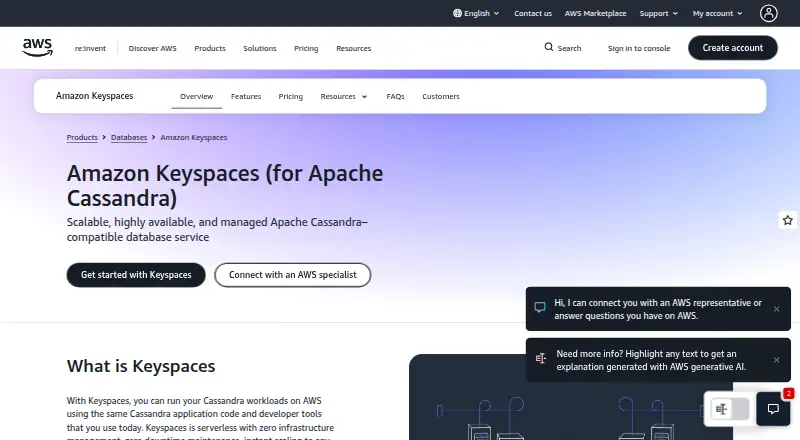
What Amazon Keyspaces is
Amazon Keyspaces is a managed Apache Cassandra-compatible database service for applications that need scalable storage without managing database infrastructure. It scales with application demand and supports the Cassandra Query Language API, existing application code, drivers, and developer tools. Tables can use on-demand or provisioned read and write capacity; provisioned capacity can be configured to scale automatically. AWS lists single-digit-millisecond read and write performance, with no limit on table size or row count. Multi-Region deployments offer up to 99.999% availability, and data is replicated three times across multiple Availability Zones. The service integrates with CloudWatch metrics and can stream changes to Amazon OpenSearch Service. Keyspaces Streams provides change data capture, and point-in-time recovery can restore table data to any second within the preceding 35 days. Data is encrypted at rest by default, with AWS-owned or customer-managed keys. The free tier is available for the first three months after the first resource is created and is limited to one per payer account.
Who it suits
It suits teams running Cassandra-compatible applications, including low-latency, IoT, game-profile, and time-series workloads. It may also suit teams migrating Cassandra workloads or needing multi-region deployments.
What it does well
- Supports Cassandra APIs, code, drivers, and tools
- Offers on-demand and provisioned capacity modes
- Point-in-time recovery covers the preceding 35 days
- Encrypts stored data by default
What to know first
- Free tier lasts only three months
- Free tier is limited to one per payer account
- Maximum row size is 1 MB
Limits
The free tier lasts for the first three months after the first Keyspaces resource is created and is limited to one per payer account. It includes 30 million write request units, 30 million read request units, and 1 GB of storage; usage beyond these allowances is billed according to the selected capacity mode and applicable usage.
Plans
| Plan | Billed and limits | Price |
|---|---|---|
| On-demand capacity | Pay for reads and writes actually performed · Capacity adjusts to application traffic | On request |
| Provisioned capacity | Specify read and write capacity in advance · Automatic scaling is available | On request |
| AWS Free Tier | Available for the first three months; one free tier per payer account · 30 million write request units · 30 million read request units · 1 GB storage | Free |
| Database Savings Plans | Usage commitment over a 1-year term · Up to 18% savings stated by AWS | On request |
| Amazon Keyspaces — on-demand capacity | Pay for reads and writes performed, plus storage and other applicable usage; no per-month price stated. · 30 million on-demand write request units/month · 30 million on-demand read request units/month · 1 GB storage free for first 3 months | On request |
| Amazon Keyspaces — provisioned capacity | Specify expected reads and writes per second; charged for provisioned capacity, storage, and other applicable usage. · Capacity can be adjusted with auto scaling · AWS Free Tier: 30 million on-demand write request units/month, 30 million on-demand read request units/month, and 1 GB storage for first 3 months | On request |
As aws.amazon.com lists them, read 20 Sept 2026. The maker's own page has the final word.
Getting started
- Open the Amazon Keyspaces website.
- Choose API or web access.
- Create the first Keyspaces resource to begin the free tier.
- Select on-demand or provisioned capacity for a table.
- Connect using the Cassandra Query Language API, drivers, or developer tools.
Overview
Amazon Keyspaces is a managed database service for applications that use Apache Cassandra’s query interface. It is a strong fit for teams moving Cassandra workloads or building low-latency applications who want AWS to handle infrastructure and scaling. Choose it for that compatibility and operational model; look elsewhere if your rows may exceed 1 MB or you need a free tier beyond its first three months.
Key features
Keyspaces supports the Cassandra Query Language API, existing application code, Cassandra drivers and developer tools. That gives migration projects a path to retain familiar interfaces instead of adapting applications to a different query model. Its tunable consistency controls and transaction support add options for application behavior.
Tables offer two capacity modes. On-demand capacity adjusts to application traffic and charges for reads and writes performed, which avoids setting throughput in advance. Provisioned capacity lets teams specify expected read and write capacity; auto scaling can adjust it, but charges apply to provisioned capacity, storage and other usage. The former favors workloads with changing demand, while the latter gives teams more explicit capacity control.
AWS describes single-digit-millisecond read and write performance, with no limit on table size or row count. The 1 MB maximum row size remains a meaningful constraint for records that bundle large amounts of data. Multi-Region deployments offer up to 99.999% availability, and table data is replicated three times across multiple Availability Zones. The higher stated availability is tied to Multi-Region deployments, not a blanket guarantee for every setup.
Operational features include CloudWatch performance metrics, change capture through Keyspaces Streams using its Streams API or the Kinesis Client Library, and streaming changes to Amazon OpenSearch Service. Point-in-time recovery keeps continuous backups and can restore table data to any second in the previous 35 days. Managed Time to Live expires rows and attributes without requiring teams to manage tombstones or compaction.
Data is encrypted at rest by default, with AWS-owned or customer-managed keys through AWS Key Management Service. IAM integration, TLS and AWS PrivateLink connectivity to Amazon VPC provide access and network controls suited to AWS-based deployments.
Pricing
Keyspaces is paid, with no free trial. On-demand capacity has custom pricing: customers pay for reads and writes performed, plus storage and applicable usage. Provisioned capacity also has custom pricing and charges for specified capacity, storage and other applicable usage. Neither mode has a published monthly price, so expected workload and capacity are central to estimating cost.
The AWS Free Tier costs nothing for the first three months after creating the first Keyspaces resource, and is limited to one free tier per payer account. It includes 30 million write request units, 30 million read request units and 1 GB of storage. That allowance can help evaluate a modest workload, but it is temporary and finite rather than an ongoing free plan.
Database Savings Plans have custom pricing and require a one-year usage commitment; AWS states savings of up to 18%. That may suit teams able to commit usage, but the commitment is less flexible than paying for actual on-demand reads and writes.
Platforms
Keyspaces is available through API and web interfaces. It is a managed service with a CQL query interface, multi-region support and horizontal scaling.
Who it's for
Keyspaces suits teams migrating Cassandra applications, and developers building IoT data, game player profiles, time-series data or other low-latency applications. It is particularly compelling when Cassandra compatibility and reduced infrastructure management matter together. Consider another database if workload records can exceed 1 MB, or if predictable long-term free usage is essential.
Pros and cons
- Pro: Cassandra API and tooling compatibility can reduce migration changes for existing applications.
- Pro: On-demand and provisioned modes, including provisioned auto scaling, offer different ways to match capacity to traffic.
- Pro: Multi-Region availability, three-way replication across Availability Zones, and point-in-time recovery provide resilience and recovery options.
- Pro: Managed TTL removes the need to operate tombstone and compaction handling for expiring data.
- Con: The 1 MB maximum row size rules it out for workloads that need larger individual rows.
- Con: The free tier ends after three months and is capped by request units and storage, so it cannot stand in for a lasting free plan.
- Con: Capacity and savings-plan prices are custom, making cost comparison dependent on usage and commitment terms.
Alternatives
Apache Cassandra is the better fit for teams seeking a free, self-managed open-source database and willing to operate it themselves. Apache HBase is another free, open-source distributed database for operators prepared to configure and manage deployments.
Google Cloud Bigtable is worth comparing for teams considering a different cloud database with a free trial and Enterprise and Enterprise Plus editions. SWC-DB is a free, self-hosted option for teams comfortable with Linux and its GPLv3 licensing terms.
Apache Accumulo offers a free, self-hosted sorted distributed key/value store under Apache License 2.0. HPE Ezmeral Data Fabric is an alternative to assess when a paid data fabric with reseller-based pricing is under consideration. Baidu Tera is another free, self-hosted option. Cloudera Data Lake Service is relevant for teams prepared to contact sales for custom pricing.
Browse more options in Wide-Column Databases or Database Software.
Verdict
Choose Amazon Keyspaces if your application already speaks Cassandra and you want managed scaling, AWS integrations and recovery features without running database infrastructure. The strongest reason to pick it is that combination of compatibility and managed operations; the clearest reasons to look elsewhere are the 1 MB row ceiling and usage-dependent pricing after a short, capped free-tier period.
Verdict
Amazon Keyspaces combines Cassandra compatibility with managed, serverless capacity options and recovery features. Check the free-tier window and 1 MB maximum row size against your workload.
Questions
How much does Amazon Keyspaces cost?
No fixed price is listed here. On-demand usage is charged for reads and writes performed, storage, and other applicable usage; provisioned capacity is charged based on capacity, storage, and other applicable usage.
Does Keyspaces have a free plan?
Its AWS Free Tier is available for the first three months after creating the first Keyspaces resource. It includes 30 million write request units, 30 million read request units, and 1 GB storage, and is limited to one per payer account.
Can Cassandra applications use Keyspaces?
Keyspaces supports the Cassandra Query Language API, existing application code, Cassandra drivers, and developer tools.
What capacity options are available?
Tables can use on-demand read and write capacity or provisioned capacity. Provisioned capacity can use auto scaling.
Does Keyspaces support multiple Regions?
Yes. Multi-Region deployments offer up to 99.999% availability, and table data is replicated three times across multiple Availability Zones.
What integrations does Keyspaces offer?
It integrates with Amazon CloudWatch for performance metrics and supports streaming changes to Amazon OpenSearch Service. Change data capture is available through Keyspaces Streams and its Streams API or the Kinesis Client Library.
Facts from Amazon Keyspaces's own pages
- Availability
- Multi-Region deployments offer up to 99.999% availability, and table data is replicated three times across multiple Availability Zones. · aws.amazon.com, 30 Sept 2026
- Backups
- Point-in-time recovery provides continuous backups and can restore table data to any second in the preceding 35 days. · aws.amazon.com, 30 Sept 2026
- Capacity modes
- Tables can use on-demand or provisioned read and write capacity, and provisioned capacity can use auto scaling. · aws.amazon.com, 30 Sept 2026
- Cassandra compatibility
- It supports the Cassandra Query Language API, existing application code, Cassandra drivers, and developer tools. · aws.amazon.com, 30 Sept 2026
- Change data capture
- Keyspaces Streams provides change data capture through its Streams API or the Kinesis Client Library. · aws.amazon.com, 30 Sept 2026
- Free plan
- No · aws.amazon.com, 20 Sept 2026
- Free tier limit
- The free tier lasts for the first three months after creating the first Keyspaces resource and is limited to one free tier per payer account. · aws.amazon.com, 30 Sept 2026
- Integrations
- The service integrates with Amazon CloudWatch for performance metrics and supports streaming changes to Amazon OpenSearch Service. · aws.amazon.com, 30 Sept 2026
- Latency and scale
- Amazon Keyspaces provides single-digit-millisecond read and write performance and tables have no limit on size or row count. · aws.amazon.com, 30 Sept 2026
- Network and access controls
- Amazon Keyspaces integrates with AWS Identity and Access Management and supports TLS and AWS PrivateLink connectivity to Amazon VPC. · aws.amazon.com, 30 Sept 2026
- Product
- Amazon Keyspaces is a scalable, highly available, managed Apache Cassandra-compatible database service. · aws.amazon.com, 30 Sept 2026
- Security
- Customer data is encrypted at rest by default, with AWS-owned or customer-managed keys available through AWS Key Management Service. · aws.amazon.com, 30 Sept 2026
- Serverless
- The service is serverless, requires no infrastructure management, and scales automatically with application demand. · aws.amazon.com, 30 Sept 2026
- TTL
- Managed Time to Live settings expire rows and attributes and delete expired records without requiring users to manage tombstones or compaction. · aws.amazon.com, 30 Sept 2026
- Use cases
- AWS describes use cases including low-latency applications, Cassandra workload migration, IoT device data, game player profiles, and time-series data. · aws.amazon.com, 30 Sept 2026
Where Amazon Keyspaces stands on Freedom251
- Wide-Column Databases#4 of 22
- NoSQL Databases#9 of 30
- Database Software#56 of 74