Freedom251 › Wide-Column Databases
Baidu Tera
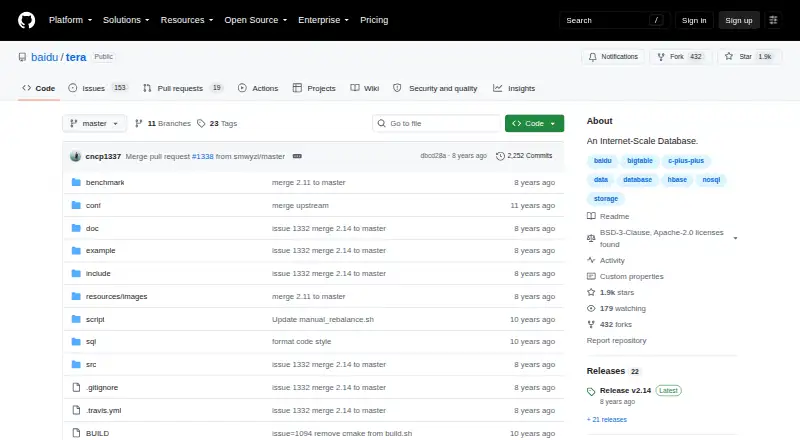
What Baidu Tera is
Baidu Tera is a free, self-hosted distributed NoSQL database designed for real-time applications. It stores sparse, multidimensional tables indexed by row key, column key, and timestamp, and the project describes scaling to petabytes across thousands of commodity servers. Listed features include strict consistency, MVCC, automatic failover, online schema changes, and snapshots. Tera supports automatic sharding with ranged or hashed strategies, as well as linear and modular scalability. Storage options include RAMDISK, SSD, and disk tables, with tiered and block caches and Bloom Filters for real-time queries. Applications can use C++, Java, Python, and REST APIs. Its architecture comprises an SDK, a master, and tablet servers that handle reads, writes, and scans using an enhanced LevelDB storage engine. Tera can run on raw machines or in Docker; a pseudo-distributed mode can run on a single host using the local filesystem. The README describes use in Baidu products including web indexing, WebPage DB, and LinkBase DB, across throughput-oriented and latency-sensitive workloads. The repository lists BSD-3-Clause and Apache-2.0 licenses.
Who it suits
Tera may suit teams building self-hosted, real-time applications that need distributed tables and strict consistency. Its listed deployment options include raw machines, Docker, and a single-host pseudo-distributed mode.
What it does well
- Free and self-hosted
- Supports strict consistency and MVCC
- Offers ranged or hashed sharding
- Clients include C++, Java, Python, and REST
What to know first
- Listed platforms are Linux and self-hosted
- The README does not state security certifications or compliance claims
Getting started
- Open the Baidu Tera project website.
- Review the English manuals for pseudo-distributed mode, the API, or teracli.
- Choose a deployment on raw machines or in Docker.
- For a single-host setup, use the pseudo-distributed mode with the local filesystem.
- Connect an application using C++, Java, Python, or REST APIs.
Verdict
Tera combines distributed storage, consistency controls, and multiple client interfaces. Review its deployment requirements and documentation to determine whether it fits your environment.
Questions
How much does Baidu Tera cost?
Tera is free, and the listed pricing model includes a free plan.
Is there a free trial?
No. The listed free trial availability is no.
Which platforms and client interfaces are listed?
Platforms include API, Linux, and self-hosted. Client interfaces include C++, Java, Python, and REST APIs.
Can Tera be deployed in Docker?
Yes. The project describes deployment on raw machines or in Docker, as well as a pseudo-distributed mode on one host.
What licenses does the repository list?
The repository lists BSD-3-Clause and Apache-2.0 licenses.
What infrastructure integrations are listed?
The README lists HDFS and other filesystems, ZooKeeper and Nexus lock services, and Sofa-pbrpc as infrastructure dependencies.
Facts from Baidu Tera's own pages
- Architecture
- Tera consists of an SDK, a master, and tablet servers; tablet servers use an enhanced LevelDB storage engine and handle read, write, and scan requests. · github.com, 4 Oct 2026
- Client APIs
- The README lists C++, Java, Python, and RESTful APIs for accessing Tera. · github.com, 4 Oct 2026
- Client interfaces
- The project lists C++, Java, Python, and REST APIs. · github.com, 4 Oct 2026
- Consistency and availability
- Listed features include strict consistency, automatic failover, online schema changes, and snapshots. · github.com, 4 Oct 2026
- Data and consistency
- Tera supports MVCC, column-oriented storage with locality groups, and strict consistency. · github.com, 4 Oct 2026
- Data model
- Tera stores sparse, distributed, multidimensional tables indexed by row key, column key, and timestamp. · github.com, 4 Oct 2026
- Deployment
- The README says Tera can run on raw machines or in Docker, and describes a pseudo-distributed mode on a single host using the local filesystem. · github.com, 4 Oct 2026
- Documentation
- The English documentation index links to user manuals for pseudo-distributed mode, the API, and teracli, plus a performance benchmark page. · github.com, 4 Oct 2026
- Integrations
- Tera's README lists HDFS and other filesystems, ZooKeeper and Nexus lock services, and Sofa-pbrpc as infrastructure dependencies. · github.com, 4 Oct 2026
- Intended use
- The README describes use in throughput-oriented and latency-sensitive Baidu products, including web indexing, WebPage DB, and LinkBase DB. · github.com, 4 Oct 2026
- License
- The repository lists BSD-3-Clause and Apache-2.0 licenses. · github.com, 4 Oct 2026
- Operations
- Listed capabilities include automatic failover, online schema changes, and snapshots. · github.com, 4 Oct 2026
- Product
- Tera is a high-performance distributed NoSQL database designed for real-time applications. · github.com, 4 Oct 2026
- Scale
- The project says Tera can scale to petabytes of data across thousands of commodity servers. · github.com, 4 Oct 2026
- Security and compliance
- The repository lists BSD-3-Clause and Apache-2.0 licenses; the README does not state security certifications or compliance claims. · github.com, 4 Oct 2026
- Sharding
- Features include linear and modular scalability, automatic configurable sharding, and ranged or hashed sharding strategies. · github.com, 4 Oct 2026
- Storage and queries
- Tera supports RAMDISK, SSD, and disk tables, tiered cache, block cache, and Bloom Filters for real-time queries. · github.com, 4 Oct 2026
- Support and contribution
- The README welcomes contributions and provides [email protected] for joining the project. · github.com, 4 Oct 2026
- Use cases
- Baidu says it uses Tera in products including web indexing, WebPage DB, and LinkBase DB, for workloads ranging from throughput-oriented applications to latency-sensitive services. · github.com, 4 Oct 2026
Where Baidu Tera stands on Freedom251
- Wide-Column Databases#7 of 22