Freedom251 › Wide-Column Databases
Google Cloud Bigtable
What Google Cloud Bigtable is
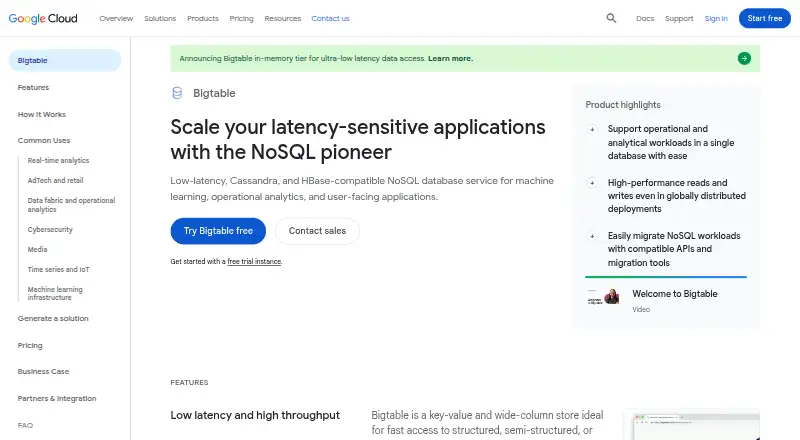
Google Cloud Bigtable is a managed NoSQL database for low-latency machine learning, operational analytics, and user-facing applications. It stores structured, semi-structured, and unstructured data as key-value and wide-column records. SQL queries are supported, including an API with more than 200 functions for aggregations, windowing, geospatial and JSON processing, and vector search. Compute scales horizontally, while an instance can span as many as eight regions with automatic replication between clusters. Google says multi-region instances provide 99.999% availability and protection against a regional failure. Listed integrations include Apache Spark, Hadoop, GKE, Dataflow, Dataproc, Vertex AI Vector Search, BigQuery, and LangChain. Bigtable provides APIs and migration tools for systems including HBase, Cassandra, DynamoDB, and Aerospike. Security controls include IAM, customer-managed encryption keys, audit logging, and access controls at table, column, or row level. The service is cloud-deployed and has a 10-day trial subject to eligibility requirements. Google says its capacity-based low-latency compute may suit larger workloads better than small applications.
Who it suits
Bigtable suits teams building low-latency applications or handling machine learning and operational analytics workloads. Google's stated workload guidance points toward larger workloads rather than small applications.
What it does well
- Supports SQL queries with more than 200 functions.
- Instances can span up to eight regions.
- Includes automatic replication between clusters.
- Security controls include table-, column-, or row-level access.
What to know first
- No free plan is listed.
- Trial eligibility excludes some prior Google service users.
- Google says it may be less suited to small applications.
Plans
| Plan | Billed and limits | Price |
|---|---|---|
| Enterprise | Standard Bigtable edition | $0.65 a month |
| Enterprise Plus | Premium Bigtable edition | $0.85 a month |
| Data Boost | per serverless processing unit per hour · On-demand isolated compute for batch processing | Free |
| Standard backup storage | per GB per month · Incremental backups · Billed by physical backup size | $0.03 a month |
| HDD storage | per GB per month · Infrequent Access uses HDD at the same rate · Each replica billed separately | $0.03 a month |
| Hot backup storage | per GB per month · Optimized for reduced restore time · Billed by physical backup size | $0.12 a month |
| SSD storage | per GB per month · Each replica billed separately | $0.17 a month |
| In-memory tier | per 40,000 rows per second capacity · Enterprise Plus only · Up to 120,000 rows per second per node | $0.20 a month |
The first 8 of 10 plans, as cloud.google.com lists them, read 20 Sept 2026. The maker's own page has the final word. Every plan
Getting started
- Open the Google Cloud Bigtable website.
- Check whether you meet the stated eligibility requirements for the 10-day trial.
- Choose the Standard or Premium edition and relevant compute or storage options.
- Connect through the web or API using a supported protocol.
Google Cloud Bigtable is a managed database for low-latency applications, analytics, and machine learning. It suits teams with substantial workloads that need horizontal scaling and multi-region deployment. Its breadth is compelling, but capacity-based compute makes it a weaker fit for small applications.
Overview
Bigtable stores structured, semi-structured, and unstructured data in a key-value and wide-column model. That gives teams flexibility across data types, but it is not a general-purpose relational database. The cloud service supports clustering, TTL, both persistence modes, and values up to 100 MB.
Connections are supported through gRPC, REST/HTTP, GoogleSQL, and the Apache HBase and Apache Cassandra APIs. Migration tools cover HBase, Cassandra, DynamoDB, and Aerospike, which may help teams move from those systems, though migration still requires planning. Bigtable supports multi-region instances spanning up to eight regions, with automatic replication between clusters. Google says those instances offer 99.999% availability and protection against a regional failure.
Key features
Bigtable's SQL query API includes more than 200 functions, with aggregations, windowing, geospatial and JSON processing, and vector search. That range makes it useful for teams that need analytics or AI-oriented queries alongside a key-value and wide-column foundation, rather than access only through application code.
Horizontal compute scaling and integrations with Apache Spark, Hadoop, GKE, Dataflow, Dataproc, Vertex AI Vector Search, BigQuery, and LangChain give teams several paths to connect Bigtable with data processing and machine-learning workflows. Its security controls include customer-managed encryption keys with Cloud External Key Manager support, IAM, VPC Service Controls, Access Transparency and Access Approval, audit logging, and table-, column-, or row-level access control. These controls offer fine-grained options for organizations with demanding access and audit requirements.
Pricing
Bigtable is paid, with no free plan. Its trial lasts 10 days, but eligibility is restricted: users must never have been paying customers of Google Cloud, Google Maps Platform, or Firebase, and must not have previously signed up for the Free Trial. That makes the trial unavailable to many existing Google Cloud customers.
The named editions are Enterprise at $0.65 a month for Standard Bigtable edition and Enterprise Plus at $0.85 a month for Premium Bigtable edition. Compute capacity is billed per node per hour: Enterprise compute capacity is $0.65 a month, while Enterprise Plus compute capacity is $0.85 a month and includes Enterprise edition capabilities. These capacity-based charges make it important to match provisioned compute to workload needs; Google describes this model as more favorable for larger workloads and less ideal for small applications.
Other charges cover the storage and processing choices teams use. SSD storage is $0.17 a month per GB, with each replica billed separately. HDD storage is $0.03 a month per GB; Infrequent Access uses HDD at the same rate, and each replica is billed separately. Standard backup storage is $0.03 a month per GB and uses incremental backups billed by physical backup size. Hot backup storage is $0.12 a month per GB, billed by physical backup size and optimized for reduced restore time.
Data Boost is free, billed per serverless processing unit per hour for isolated batch-processing compute. The in-memory tier is $0.20 a month per 40,000 rows-per-second capacity, is limited to Enterprise Plus, and supports up to 120,000 rows per second per node. These charges are listed with monthly prices but also have separate usage or capacity billing bases, so they should not be read as a complete workload cost.
Platforms
Bigtable is a cloud deployment with web and API platforms. The protocol options span gRPC, REST/HTTP, GoogleSQL, and the HBase and Cassandra APIs, making it accessible to teams using those interfaces without requiring a self-managed deployment.
Who it's for
Bigtable is strongest for organizations running larger, latency-sensitive applications, operational analytics, or machine-learning workloads that can benefit from horizontal scaling, broad query support, and multi-region resilience. Its integrations and compatibility APIs can also suit teams building around Google's data and AI services or planning a migration from a supported database.
It is less compelling for a small application or a buyer seeking a free tier: the service has no free plan, trial eligibility is narrow, and capacity-based compute is not positioned as a good fit for small workloads. Teams wanting to operate an open-source database themselves may prefer a self-managed alternative.
Pros and cons
- Pros: SQL querying includes advanced processing functions and vector search, extending Bigtable beyond direct key-value access.
- Pros: Horizontal scaling and instances spanning up to eight regions support large workloads and regional resilience.
- Pros: Multiple APIs, migration tools, and data-platform integrations give teams options for connecting existing systems and workflows.
- Pros: Fine-grained access controls and customer-managed encryption keys support stricter security needs.
- Cons: There is no free plan, and the 10-day trial excludes prior paying users of Google Cloud, Google Maps Platform, and Firebase as well as previous trial sign-ups.
- Cons: Capacity-based compute is a poor match for small applications, and per-replica storage charges add to the cost of multi-replica deployments.
- Cons: The wide-column and key-value model is not a general-purpose relational database, despite SQL query support.
Alternatives
Apache Cassandra is a better fit for teams seeking a free, open-source NoSQL database they can self-manage across Linux, macOS, Windows, or a web platform. It gives up Bigtable's managed cloud deployment.
Amazon Keyspaces is worth considering for readers who prefer capacity that can adjust to application traffic or payment for reads and writes actually performed; its on-demand and provisioned options have custom pricing.
Apache HBase suits teams seeking a free, open-source distributed database and willing to configure and manage deployments themselves.
SWC-DB is a free, self-hosted option for teams comfortable with Linux and API-based access; commercial-purpose licensing inquiries apply to uses limited by GPLv3.
Apache Accumulo is a free, open-source sorted distributed key/value store for teams that want Apache License 2.0 software and can manage it themselves.
Azure Cosmos DB for NoSQL may suit readers who want a free tier with 1,000 RU/s, 25 GB of storage, and one free-tier account per Azure subscription.
Tencent Cloud API Gateway is another paid service with a free allowance of its first 1 million API calls per month during the first year.
Azure Application Insights is an alternative for readers looking for usage-based data ingestion with the first 5 GB per month per billing account free.
Browse Wide-Column Databases, Key-Value Databases, or Database Software for more options.
Verdict
Choose Google Cloud Bigtable for larger, latency-sensitive workloads that need managed horizontal scaling, rich SQL querying, and multi-region resilience. Look elsewhere if you need a free entry point, run only a small application, or want a general-purpose relational database.
Verdict
Bigtable combines a wide-column and key-value model with SQL querying, horizontal scaling, and multi-region deployment. Its trial has eligibility limits, and Google describes its capacity-based compute as a better fit for larger workloads.
Questions
Is Google Cloud Bigtable free?
There is no free plan. A 10-day trial is available to eligible users.
How much does Bigtable cost?
Listed prices include $0.65 a month for Enterprise and $0.85 a month for Enterprise Plus. Compute, storage, and other listed options have separate rates and billing units.
Which platforms and protocols does it support?
The listed platforms are web and API. Supported protocols include gRPC, REST/HTTP, Apache HBase API, Apache Cassandra API, and GoogleSQL.
Can Bigtable work with other data tools?
Listed integrations include Apache Spark, Hadoop, GKE, Dataflow, Dataproc, Vertex AI Vector Search, BigQuery, and LangChain.
Who can use the trial?
Google says trial eligibility requires never having been a paying user of Google Cloud, Google Maps Platform, or Firebase, and not having previously signed up for the Free Trial.
Facts from Google Cloud Bigtable's own pages
- Availability
- Google says multi-region instances offer 99.999% availability and protection against a regional failure. · cloud.google.com, 29 Sept 2026
- Data model
- It is a key-value and wide-column store for structured, semi-structured, and unstructured data. · cloud.google.com, 29 Sept 2026
- Free plan
- No · cloud.google.com, 20 Sept 2026
- Free trial
- New Google Cloud users can receive $300 in Welcome credit for 90 days to spend on covered products and services, including Bigtable when covered by the trial program. · docs.cloud.google.com, 29 Sept 2026
- Integrations
- The product page lists integrations with Apache Spark, Hadoop, GKE, Dataflow, Dataproc, Vertex AI Vector Search, BigQuery, and LangChain. · cloud.google.com, 29 Sept 2026
- Migration
- Bigtable provides Apache Cassandra and HBase APIs and migration tools for HBase, Cassandra, DynamoDB, and Aerospike. · cloud.google.com, 29 Sept 2026
- Pricing model
- Pricing is based on compute capacity, database storage, backup storage, and network usage; the page says ingress, same-region egress, and same-region replication are free. · cloud.google.com, 29 Sept 2026
- Product
- Bigtable is a fully managed, low-latency NoSQL database service for machine learning, operational analytics, and user-facing applications. · cloud.google.com, 29 Sept 2026
- Scaling and deployment
- Bigtable scales compute horizontally and supports instances spanning as many as eight regions, with automatic replication between clusters. · cloud.google.com, 29 Sept 2026
- Security
- Security controls include customer-managed encryption keys with Cloud External Key Manager support, IAM, VPC Service Controls, Access Transparency, Access Approval, audit logging, and table-, column-, or row-level access control. · cloud.google.com, 29 Sept 2026
- SQL
- Bigtable supports SQL queries, including a SQL query API with more than 200 functions and support for aggregations, windowing, geospatial and JSON processing, and vector search. · cloud.google.com, 29 Sept 2026
- Trial eligibility
- Google says trial eligibility requires never having been a paying user of Google Cloud, Google Maps Platform, or Firebase and not having previously signed up for the Free Trial. · docs.cloud.google.com, 29 Sept 2026
- Workload fit
- Google says capacity-based low-latency compute can make Bigtable more favorable for larger workloads and less ideal for small applications. · cloud.google.com, 29 Sept 2026
Where Google Cloud Bigtable stands on Freedom251
- Wide-Column Databases#10 of 22
- Key-Value Databases#21 of 31
- NoSQL Databases#26 of 30
- Database Software#67 of 74