
Cloudera Data Lake Service
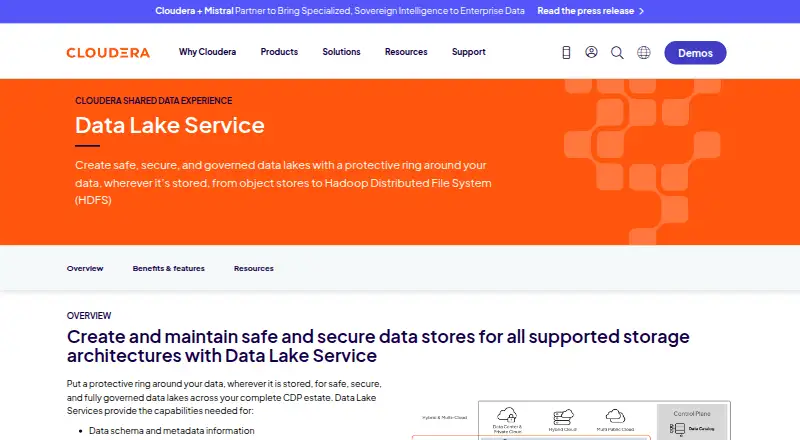
What Cloudera Data Lake Service is
Cloudera Data Lake Service provides data schema and metadata management, governance, access controls and auditing for data lake workloads. It captures schema and metadata definitions that platform workloads discover or create. Teams can search metadata, trace lineage and chain of custody, classify and profile data, and maintain a business glossary.
Security features include granular policies based on roles and attributes, auditing of unauthorized access, and encryption at rest and in motion with key management. Apache Ranger policies can govern access at database, table, column and file levels, including dynamic conditions such as time or geolocation. Apache Knox provides a protected single sign-on gateway to Data Lake and Cloudera Data Platform interfaces. Each Data Lake cluster includes Hive Metastore, Apache Ranger, Apache Atlas and Apache Knox. Cloudera offers light-duty and enterprise Data Lakes for AWS, Azure and GCP. The service supports hybrid deployment, SQL analytics, streaming ingestion, data sharing and open table formats. Data Lake API endpoints are available in the Endpoints tab of the Cloudera Management Console. The listed pricing note is From $0.20; the Data Lake Service plan is also described as Contact Sales for pricing. Cloud prices exclude infrastructure and networking costs.
Who it suits
The service suits organizations that need metadata governance, detailed access policies and auditing for data lake workloads. It also fits teams working with SQL analytics, streaming ingestion, data sharing or open table formats across AWS, Azure or GCP.
What it does well
- Captures schema and metadata definitions from platform workloads.
- Supports metadata search, lineage, classification, profiling and a business glossary.
- Ranger policies reach database, table, column and file levels.
- Knox provides a protected single sign-on gateway.
- Available for light-duty and enterprise Data Lakes on AWS, Azure and GCP.
What to know first
- There is no free plan.
- The Data Lake Service plan is listed as Contact Sales for pricing.
- Cloud prices exclude infrastructure and networking costs.
Plans
| Plan | Billed and limits | Price |
|---|---|---|
| Cloudera Data Lake Service | Contact Sales for pricing · Pricing not listed on the Data Lake Service page | On request |
As cloudera.com lists them, read 30 Sept 2026. The maker's own page has the final word.
Getting started
- Visit the Cloudera Data Lake Service page.
- Contact Cloudera about pricing or book a demo.
- Choose a light-duty or enterprise Data Lake for AWS, Azure or GCP.
- Use the Cloudera Management Console to find Data Lake API endpoints in the Endpoints tab.
- Use the included Hive Metastore, Apache Ranger, Apache Atlas and Apache Knox services.
Cloudera Data Lake Service is a governed data-lake environment for teams that need schema and metadata management, fine-grained authorization, and auditable access across cloud and hybrid deployments. It suits enterprises running SQL, streaming, and machine-learning workloads where lineage and policy enforcement matter more than a simple object store. The trade-off is a sales-led commercial model and cloud budgeting that must account for infrastructure and networking separately.
Overview
The service combines metadata, security, and lake operations in a Data Lake cluster. Each cluster includes Hive Metastore, Apache Ranger, Apache Atlas, and Apache Knox, giving teams a coordinated foundation for cataloging data, enforcing policy, and exposing protected user interfaces. Cloudera supports light-duty and enterprise Data Lakes on AWS, Azure, and GCP, with hybrid deployment and both cloud and on-premises options.
It is more than storage: SQL analytics, ACID transactions, open table formats, streaming ingestion, data sharing, workflow automation, hosted notebooks, and model deployment are supported. API endpoints are exposed through the Endpoints tab in Cloudera Management Console, while Knox provides single sign-on through a protected gateway.
Key features
Metadata and governance
Workloads automatically capture schema and metadata definitions, reducing manual catalog upkeep as data changes. Search, lineage, chain-of-custody auditing, classification, profiling, and a business glossary support both technical operators and governance teams. Column-level, pipeline, report, and model lineage enable impact analysis before a change reaches downstream assets.
Security and access
Ranger policies can govern databases, tables, columns, and files, with dynamic conditions such as time or geolocation. Role- and attribute-based rules provide more precision than broad dataset permissions, and the service audits unauthorized access. Encryption covers data at rest and in motion with key management, making the platform a strong fit for regulated workloads.
Analytics and machine learning
Open table formats, SQL and other query interfaces, ACID transactions, and both batch and streaming ingestion support mixed lake workloads. Python, R, Scala, and Spark are supported, alongside version control, model versioning, artifact storage, deployment tracking, and model lineage. These capabilities favor teams operating repeatable data and ML pipelines rather than isolated analysis projects.
Pricing
Cloudera Data Lake Service is paid, with pricing shown from $0.20. The Data Lake Service plan uses custom pricing through Contact Sales, and no free plan is provided. On-premises Cloudera Data Services are also sold through Contact Sales. Cloud prices exclude infrastructure and networking costs, so the service price is not a complete estimate of running a production lake. This model fits organizations that can negotiate an enterprise deployment; smaller teams seeking a self-serve or no-cost start should look elsewhere.
Platforms
Access is available through web and API interfaces. Deployment spans cloud and hybrid environments, with support for AWS, Azure, and GCP. Hosted notebooks and workflow automation suit managed development, while self-managed and on-premises choices address placement or compliance requirements.
Who it's for
Choose it for enterprise data platforms that need centralized governance, dynamic authorization, auditable access, and lineage across analytics and machine-learning estates. It is especially appropriate when multiple clouds, regulated data, or both batch and streaming pipelines make separate point tools difficult to coordinate. It is a weaker fit for a small project that only needs inexpensive storage and basic querying, because pricing is sales-led and additional cloud infrastructure costs apply.
Pros and cons
- Pros: Automatic schema and metadata capture limits catalog maintenance as workloads evolve.
- Pros: Ranger policies reach database, table, column, and file levels and can react to time or location.
- Pros: Atlas lineage, profiling, classification, glossary, and chain-of-custody auditing support compliance and impact analysis.
- Pros: Knox single sign-on, encryption in transit and at rest, and unauthorized-access auditing strengthen controlled access.
- Cons: Contact-Sales pricing and separate infrastructure and networking charges make total cost harder to forecast.
- Cons: The broad enterprise feature set is excessive for teams needing only a basic lake or open-source deployment.
Alternatives
For a broader category comparison, see Data Lake Software, Data Fabric Software, and Data Lakehouse Platforms. A warehouse-oriented shortlist is at Data Warehouse Software; specialist directories include Wide-Column Databases and Model Registry Software.
HPCC Systems is a free, Apache 2.0-licensed self-hosted option when avoiding a paid Cloudera deployment matters. Parseable offers a free OSS plan with SQL queries, dashboards, threshold alerts, OIDC SSO, unlimited users, and customizable retention and object storage. Apache Hadoop HDFS and Apache Ozone are free open-source choices for teams prepared to run infrastructure themselves.
AWS Lake Formation is worth choosing when AWS-native permissions are the priority; creating permissions through integrated services is free, while standard integrated-service usage rates apply. Tencent Cloud Application Performance Management is a freemium alternative with free-trial packages. HPE Ezmeral Data Fabric suits buyers seeking reseller-based data-fabric licensing. lakeFS fits teams wanting managed or self-managed lake versioning, including on-premises, own-cloud, or air-gapped deployments.
Verdict
Cloudera Data Lake Service is a strong choice for organizations that need governed, auditable lake operations with granular policies, integrated catalogs, and lineage spanning data and models. Its main reason to choose is the depth of governance and security integrated with analytics and ML workflows. Look elsewhere if you need transparent self-service pricing, a free tier, or a lightweight open-source lake without separate cloud infrastructure charges.
Verdict
Choose Cloudera Data Lake Service if your workloads need metadata governance, granular access policies and auditing within a data lake environment. Check the pricing terms with Cloudera before planning cloud costs, since the plan is listed as Contact Sales for pricing and cloud prices exclude infrastructure and networking.
Questions
Is Cloudera Data Lake Service free?
No. The listed pricing model is paid, and there is no free plan.
What is the price?
The pricing note says From $0.20. The plan is also described as Contact Sales for pricing; cloud prices exclude infrastructure and networking costs.
Which cloud providers are supported?
Cloudera supports light-duty and enterprise Data Lakes for AWS, Azure and GCP.
What services come with a Data Lake cluster?
A cluster includes Hive Metastore, Apache Ranger, Apache Atlas and Apache Knox.
Does the service support single sign-on?
Yes. Apache Knox provides a protected single sign-on gateway to Data Lake and Cloudera Data Platform user interfaces.
Who makes Cloudera Data Lake Service?
Cloudera is the maker. The listed company facts give a founding year of 2008 and headquarters in Silicon Valley, California.
Facts from Cloudera Data Lake Service's own pages
- Access controls
- Apache Ranger policies can control access at database, table, column, and file levels and can apply dynamic conditions such as time or geolocation. · docs.cloudera.com, 30 Sept 2026
- API access
- Data Lake API endpoints are available from the Endpoints tab in the Cloudera Management Console. · docs.cloudera.com, 30 Sept 2026
- Cloud availability
- Cloudera supports light-duty and enterprise Data Lakes for AWS, Azure, and GCP. · docs.cloudera.com, 30 Sept 2026
- Founded
- 2008 · cloudera.com, 28 Sept 2026
- Governance
- Supports metadata search, lineage and chain-of-custody auditing, classification, profiling, and a business glossary. · cloudera.com, 30 Sept 2026
- Headquarters
- San Jose, California, United States · cloudera.com, 28 Sept 2026
- Integrated services
- A Data Lake cluster includes Hive Metastore, Apache Ranger, Apache Atlas, and Apache Knox services. · docs.cloudera.com, 30 Sept 2026
- Pricing detail
- The pricing page lists on-premises Cloudera Data Services as Contact Sales for pricing and says cloud prices exclude infrastructure and networking costs. · cloudera.com, 30 Sept 2026
- Purpose
- Provides capabilities for data schema and metadata, metadata governance and management, data access authorization and authentication, and compliance-ready access auditing. · cloudera.com, 30 Sept 2026
- Schema and metadata
- Automatically captures and stores schema and metadata definitions discovered or created by platform workloads. · cloudera.com, 30 Sept 2026
- Security
- Supports granular, dynamic, role- and attribute-based security policies, auditing of unauthorized access, and encryption at rest and in motion with key management. · cloudera.com, 30 Sept 2026
- Single sign-on
- Apache Knox provides a protected gateway for single sign-on to Data Lake and Cloudera Data Platform user interfaces. · cloudera.com, 30 Sept 2026
- Support
- Cloudera’s product page points users to product support, community, documentation, and downloads, and invites them to book a demo. · cloudera.com, 30 Sept 2026
Where Cloudera Data Lake Service stands on Freedom251
- Model registries#26 of 38
- Data Lake Software#13 of 19