Freedom251 › Model Registry Software

Snowflake Feature Store
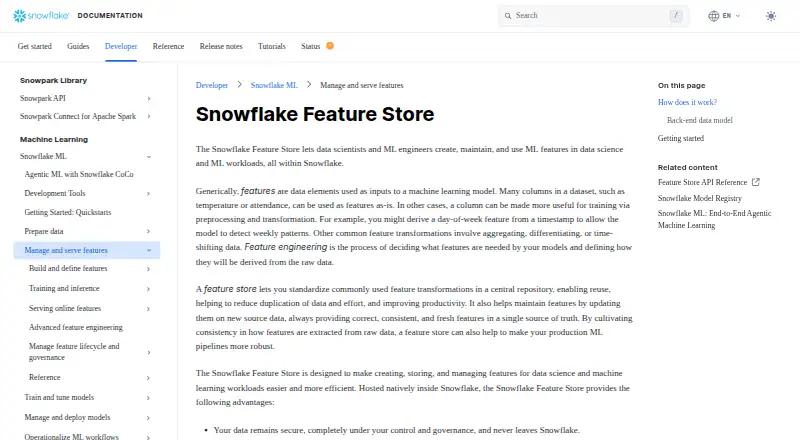
What Snowflake Feature Store is
Snowflake Feature Store helps data scientists and machine-learning engineers create, manage, and use machine-learning features within Snowflake. It works with batch and streaming data, and can update features as new data arrives. Teams can write feature transformations in Python or SQL, then use backfill and ASOF JOIN for point-in-time-correct features. Snowflake-managed feature views refresh incrementally on a schedule using dynamic tables. External feature views are maintained by another process, such as dbt, and use views with no additional storage cost. The service integrates with Snowflake Model Registry and supports user-managed dbt pipelines. Its ML Lineage capability traces data from its source through features and datasets to a trained model, with lineage created automatically when the Feature Store is used. In Snowsight, users can search for and discover features. The Python API, included in the snowflake-ml-python package, works in a local Python IDE or a Snowsight worksheet or notebook. Data remains under Snowflake governance, with access controlled through fine-grained roles. Snowflake offers consumption-based plans, with no plan prices listed. Feature view versions can be up to 128 characters; for Postgres-backed online serving, the combined feature-view name and version limit is 46 characters.
Who it suits
Snowflake Feature Store suits data scientists and ML engineers who need to create, update, and use features within Snowflake. It also fits teams that want Python or SQL transformations, point-in-time joins, and feature lineage, or that maintain pipelines with dbt.
What it does well
- Supports both batch and streaming data with automatic updates.
- Feature transformations can be written in Python or SQL.
- Supports backfill and point-in-time-correct features using ASOF JOIN.
- Integrates with Snowflake Model Registry and dbt pipelines.
- Automatically creates lineage from source data through trained models.
- Data stays under Snowflake governance with role-based access control.
What to know first
- Feature view versions are limited to 128 characters.
- Postgres-backed online serving has a 46-character combined name and version limit.
- Snowflake-managed feature views use dynamic tables.
Limits
Feature view versions have a maximum length of 128 characters. Postgres-backed online serving limits the combined feature-view name and version to 46 characters. Snowflake-managed feature views use dynamic tables; external feature views use views and incur no additional storage cost.
Plans
| Plan | Billed and limits | Price |
|---|---|---|
| Standard | consumption-based · core platform functionality · Snowpark · data sharing · optimized storage and Time Travel | On request |
| Enterprise | consumption-based · all Standard features · multi-cluster compute · granular governance and privacy controls · extended Time Travel | On request |
| Business Critical | consumption-based · all Enterprise features · Tri-Secret Secure · private connectivity · failover and failback | On request |
| Virtual Private Snowflake | consumption-based · all Business Critical features · completely separate isolated Snowflake environment | On request |
As docs.snowflake.com lists them, read 1 Oct 2026. The maker's own page has the final word.
Getting started
- Open the Snowflake Feature Store documentation.
- Use the Python API from the snowflake-ml-python package in a local Python IDE or Snowsight worksheet or notebook.
- Author feature transformations in Python or SQL.
- Choose Snowflake-managed feature views for scheduled incremental refreshes, or maintain external views with a separate process such as dbt.
- Use Snowsight to search for and discover features.
Verdict
Choose Snowflake Feature Store if your team builds ML features within Snowflake and needs batch or streaming updates, point-in-time joins, or automatic lineage. Consider how its feature-view name limits fit your setup, and note that Snowflake-managed views use dynamic tables while external views incur no additional storage cost.
Questions
What does Snowflake Feature Store do?
It lets data scientists and ML engineers create, maintain, and use machine-learning features within Snowflake.
How is it priced?
Snowflake lists consumption-based plans, but no plan prices are given.
Can it handle streaming data?
Yes. It supports batch and streaming data, with automatic updates as new data arrives.
Can I write transformations in Python?
Yes. Feature transformations can be authored in Python or SQL. The Python API is part of the snowflake-ml-python package.
Does it support point-in-time features?
Yes. It supports backfill and point-in-time-correct features using ASOF JOIN.
Where can I use the Feature Store API?
The Python API can be used in a local Python IDE or in a Snowsight worksheet or notebook.
Facts from Snowflake Feature Store's own pages
- API platforms
- The Snowflake Feature Store Python API is part of the snowflake-ml-python package and can be used in a local Python IDE or in a Snowsight worksheet or notebook. · docs.snowflake.com, 1 Oct 2026
- Compliance
- Snowflake lists global certifications and attestations including ISO 27001, ISO 27017, ISO 27018, SOC 1 Type II, and SOC 2 Type II. · docs.snowflake.com, 1 Oct 2026
- Cost model
- Snowflake-managed feature views use dynamic tables, while external feature views use views and incur no additional storage cost. · docs.snowflake.com, 1 Oct 2026
- Data support
- It supports batch and streaming data with automatic updates as new data arrives. · docs.snowflake.com, 1 Oct 2026
- Examples and support
- Snowflake quickstarts are examples only and are not guaranteed for accuracy or covered by a Snowflake Service Level Agreement. · docs.snowflake.com, 1 Oct 2026
- Feature views
- Snowflake-managed feature views refresh incrementally on a schedule, while external feature views are maintained by another process such as dbt. · docs.snowflake.com, 1 Oct 2026
- Founded
- 2012 · docs.snowflake.com, 28 Sept 2026
- Headquarters
- Menlo Park, California, United States · docs.snowflake.com, 28 Sept 2026
- Integrations
- The Feature Store integrates with Snowflake Model Registry and supports user-managed pipelines with dbt. · docs.snowflake.com, 1 Oct 2026
- Limits
- Feature view versions have a maximum length of 128 characters, and Postgres-backed online serving limits combined feature-view name and version length to 46 characters. · docs.snowflake.com, 1 Oct 2026
- Lineage
- ML Lineage can trace data flow from source to feature to dataset to trained model and is automatically created when the Feature Store is used. · docs.snowflake.com, 1 Oct 2026
- Point-in-time features
- It supports backfill and point-in-time-correct features using ASOF JOIN. · docs.snowflake.com, 1 Oct 2026
- Purpose
- Snowflake Feature Store lets data scientists and ML engineers create, maintain, and use machine-learning features within Snowflake. · docs.snowflake.com, 1 Oct 2026
- Security
- Data remains under Snowflake governance and does not leave Snowflake, with access managed through fine-grained role-based access control. · docs.snowflake.com, 1 Oct 2026
- Transformations
- Feature transformations can be authored in Python or SQL. · docs.snowflake.com, 1 Oct 2026
- User interface
- Snowsight provides a Feature Store UI for searching and discovering features. · docs.snowflake.com, 1 Oct 2026
Where Snowflake Feature Store stands on Freedom251
- Model Registry Software#24 of 36
- Model registries#27 of 38
- Experiment Tracking#18 of 22
- Feature Store Software#17 of 20