Freedom251 › Key-Value Databases

etcd
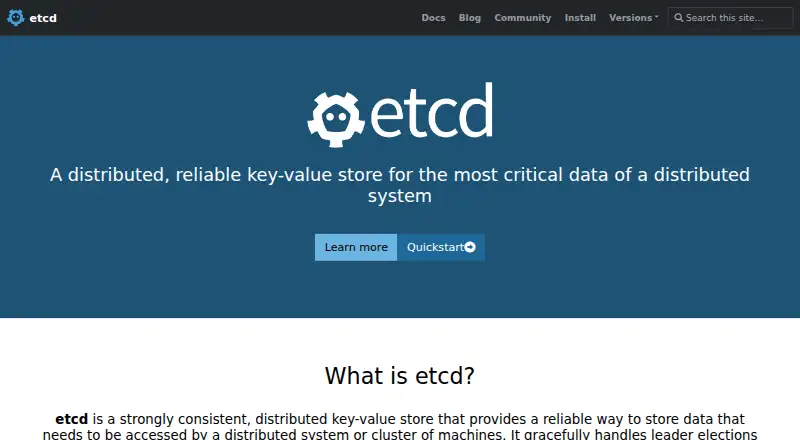
What etcd is
etcd is a self-hosted, strongly consistent key-value store for information used by distributed systems and clusters of machines. It arranges data in hierarchical directories, lets clients watch keys or directories for changes, and allows values to be read or written using HTTP tools such as curl. Distribution uses the Raft protocol. The project says etcd can handle leader elections during network partitions and tolerate machine failures, including loss of the leader. Keys can be assigned a time-to-live expiration. etcd is a core Kubernetes component and Kubernetes' primary datastore. The project provides pre-built binaries, source builds and container images. Its platform table lists Linux on AMD64 and ARM64 as tier 1; Darwin and Windows on those architectures are tier 3, while unlisted platforms are unsupported. TLS and client-certificate authentication are supported for client and peer communications, but are not enabled by default. The source repository identifies Apache 2.0 as its license. The integrations listing includes Kubernetes, CoreDNS and client libraries for several languages, with a warning that third-party entries are not tested or maintained by the etcd team.
Who it suits
etcd suits teams building distributed systems or clusters that need shared key-value storage and change notifications. It is also relevant to Kubernetes operators, where it serves as the primary datastore.
What it does well
- Strong consistency and Raft-based distribution.
- Supports key watches and optional expiration.
- Can tolerate leader-node failure.
- Provides pre-built binaries, source builds and container images.
- Apache 2.0 licensed and free.
What to know first
- TLS and client-certificate authentication are off by default.
- Linux is tier 1; Darwin and Windows are tier 3.
- Third-party listed integrations are not maintained by the project.
Limits
Linux on AMD64 and ARM64 is tier 1, while Darwin and Windows on AMD64 or ARM64 are tier 3; unlisted platforms are unsupported. TLS and client-certificate authentication are supported but disabled by default.
Plans
| Plan | Billed and limits | Price |
|---|---|---|
| Open-source etcd | Apache 2.0 licensed · self-hosted software | Free |
As etcd.io lists them, read 4 Oct 2026. The maker's own page has the final word.
Getting started
- Visit the etcd website and choose pre-built binaries, a source build, or a container image.
- Select a supported host platform and architecture.
- Deploy etcd as self-hosted software.
- Configure TLS and client-certificate authentication if needed; these features are off by default.
- Connect clients using the available interfaces and read or write key-value data.
Overview
etcd is a strongly consistent, distributed key-value store for systems that share data across machines. It suits infrastructure teams, especially those operating Kubernetes or building distributed services. It is a capable self-hosted coordination store, provided your team is prepared to run it and configure security deliberately.
Key features
Data is arranged in a directory-like hierarchy, and clients can watch keys or directories for changes. That makes etcd useful when services need to respond to updates instead of repeatedly polling for them. Optional time-to-live settings let operators expire temporary keys. These are focused coordination features, rather than a reason to choose etcd for every kind of application database.
etcd uses the Raft protocol for consensus and handles leader elections during network partitions. It can tolerate machine failures, including failure of the leader node, making it relevant to systems that need a consistent shared store despite individual outages. The project reports benchmarks of thousands of writes per second per instance; that signals the intended scale of work, but does not guarantee the same performance in every deployment.
Values can be read and written with standard HTTP tools such as curl, and supported protocols include gRPC and HTTP/JSON. Kubernetes uses etcd as its primary datastore. The integrations listing also includes CoreDNS and client libraries for multiple languages, though third-party tools and libraries are not tested or maintained by the etcd team.
TLS and client-certificate authentication are supported for client-to-server and peer communication, but are not enabled by default. Operators who need encrypted, authenticated connections must configure these protections rather than assume they are active.
Pricing
Open-source etcd: free. The software is Apache 2.0 licensed and self-hosted, with no paid plan or free trial. That suits teams able to provide their own infrastructure and operations; the zero price does not include managed hosting or operational support.
Platforms
Linux on AMD64 and ARM64 is tier 1. Darwin and Windows on AMD64 or ARM64 are tier 3, so those platforms have a lower support tier than Linux; unlisted platforms are unsupported. Pre-built binaries, source builds, and container images are available. OS package-manager installations may be outdated and are not officially supported.
The project typically maintains only its latest two minor versions. Its 2025 release announcement identified v3.5 and v3.6 as those versions at that time, so operators should plan to keep deployments current.
Who it's for
etcd is a strong fit for platform and infrastructure teams that need a consistent, fault-tolerant store for cluster data, especially Kubernetes operators. It is less suitable for teams seeking a managed service or unwilling to maintain a self-hosted datastore and its security configuration.
Pros and cons
- Pro: Raft consensus, leader election, and tolerance of machine failure support coordination across distributed systems.
- Pro: Watches and expiring keys serve update-driven and temporary-data use cases.
- Pro: It is free, Apache 2.0 licensed, and a core part of Kubernetes.
- Con: Self-hosting leaves deployment and upkeep to the operator.
- Con: TLS and client-certificate authentication require explicit configuration.
- Con: Darwin and Windows are tier 3, while unlisted platforms are unsupported.
Alternatives
For a broader comparison, browse Key-Value Databases.
- Amazon DynamoDB is worth considering if a freemium option with a free tier and a free trial better fits your selection.
- Riak KV is another free, self-hosted key-value store; its open-source plan includes masterless built-in replication, an HTTP API, and Protocol Buffers.
- RocksDB is a free open-source C++ library, a different form factor from etcd's distributed datastore.
- Aerospike Database may suit readers comparing a freemium database with a Community Edition capped at 8 nodes, 2.5 TB of data, and 2 namespaces.
- Redis Insight is a free option for readers comparing software described as 100% free, with no plan limits stated.
- Ristretto is a free in-process cache, not the same kind of distributed store.
- SuperMassive is a free option under a BSD-3-Clause open-source license.
- TiKV is another free, open-source option to compare.
Verdict
Choose etcd if you need a self-hosted, consistent store for cluster coordination and can take responsibility for operations and security settings. Its Kubernetes role, watches, expiry, and failure tolerance make that a clear use case. Look elsewhere if you need managed hosting or a platform with a higher support tier than etcd offers on Darwin and Windows.
Verdict
etcd provides self-hosted distributed storage with watches, expiry and failure tolerance, and is central to Kubernetes. Operators should account for its platform tiers and enable security features when needed.
Questions
How much does etcd cost?
The listed open-source plan is free.
Is etcd open source?
Yes. The source repository identifies Apache 2.0 as its license.
Where does etcd run?
The platform table lists Linux on AMD64 and ARM64 as tier 1, and Darwin and Windows on AMD64 or ARM64 as tier 3. Unlisted platforms are unsupported.
How can I install etcd?
The project provides pre-built binaries, source builds, and container images. Its install guide warns that operating-system package-manager installations may be outdated and are not officially supported.
Does etcd support TLS?
It supports TLS and client-certificate authentication for client-to-server and peer communication. These features are not enabled by default.
What is etcd used for in Kubernetes?
etcd is a core Kubernetes component and Kubernetes' primary datastore.
Facts from etcd's own pages
- Consensus
- The project says etcd is distributed using the Raft protocol. · etcd.io, 4 Oct 2026
- Expiry
- Keys can be configured with optional time-to-live expiration. · etcd.io, 4 Oct 2026
- Fault tolerance
- It handles leader elections during network partitions and can tolerate machine failure, including failure of the leader node. · etcd.io, 4 Oct 2026
- Installation
- The project provides pre-built binaries, source builds, and container images; its install guide warns that OS package manager installations may be outdated and are not officially supported. · etcd.io, 4 Oct 2026
- Integrations
- The integrations listing includes Kubernetes, CoreDNS, and client libraries for multiple languages; it cautions that third-party tools and libraries listed there are not tested or maintained by the etcd team. · etcd.io, 4 Oct 2026
- Interface
- Values can be read and written using standard HTTP tools such as curl. · etcd.io, 4 Oct 2026
- Key-value storage
- It stores data in hierarchically organized directories and lets clients watch keys or directories for changes. · etcd.io, 4 Oct 2026
- Kubernetes
- etcd is a core Kubernetes component and the primary datastore for Kubernetes. · etcd.io, 4 Oct 2026
- License
- The etcd source repository identifies the software as licensed under Apache 2.0. · github.com, 4 Oct 2026
- Performance
- The project states etcd is benchmarked at thousands of writes per second per instance. · etcd.io, 4 Oct 2026
- Purpose
- etcd is a strongly consistent, distributed key-value store for data accessed by distributed systems or clusters of machines. · etcd.io, 4 Oct 2026
- Security
- etcd supports TLS and client-certificate authentication for client-to-server and peer communication, but these security features are not enabled by default. · etcd.io, 4 Oct 2026
- Supported platforms
- The current platform table lists Linux on AMD64 and ARM64 as tier 1; Darwin and Windows on AMD64 or ARM64 are tier 3, and unlisted platforms are unsupported. · etcd.io, 4 Oct 2026
- Support policy
- The project typically maintains only its latest two minor versions; its 2025 release announcement said those were v3.5 and v3.6 at that time. · etcd.io, 4 Oct 2026
Where etcd stands on Freedom251
- Key-Value Databases#5 of 31
- Distributed Systems#10 of 30