Freedom251 › Distributed SQL Databases

Apache Ignite
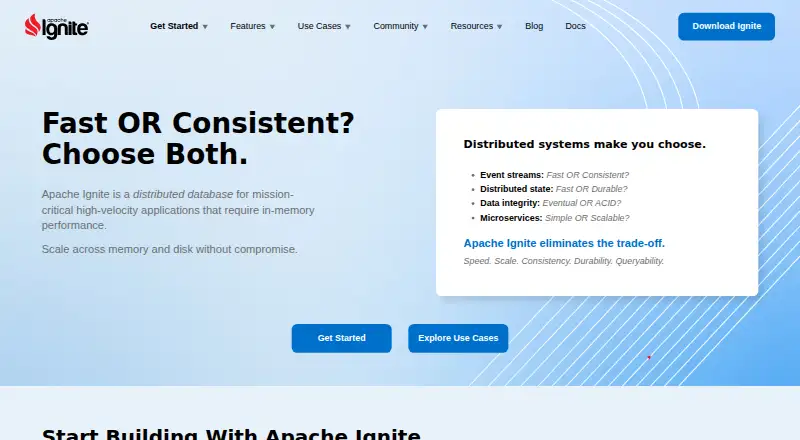
What Apache Ignite is
Apache Ignite is a distributed SQL database designed for workloads that need data available at high speed. It keeps data primarily in memory and can add persistence through AIPERSIST. For transactions spanning partitions, Ignite uses ACID guarantees with Raft consensus; MVCC snapshot isolation allows reads to proceed without blocking. SQL access is available through JDBC drivers, a Table API, and native APIs, alongside key-value access. Catalog-driven schema management lets teams make changes such as adding columns or modifying indexes while the cluster continues running.
DataStreamer supports high-throughput writes with backpressure control. Native clients are listed for Java, .NET, C++, and Python, and the download page offers extensions for AWS, Azure, GCE, and Spring, including Spring Cache and Spring Data. Operational features include authentication, SSL/TLS security, OpenTelemetry metrics, and recovery snapshots and backups. Listed applications include event stream processing, microservices state management, session management, and AI/ML feature stores. Apache Ignite is free and open source, with binary, source, Docker, and Maven/Gradle download options. Ignite 2 is identified as a long-term support release recommended for existing deployments.
Who it suits
Apache Ignite suits teams building data intensive services that need distributed SQL, transactions across partitions, or high throughput writes. Its listed use cases also fit teams managing event streams, microservices state, sessions, or AI/ML feature stores, and it offers APIs for several programming languages.
What it does well
- ACID transactions span partitions using Raft consensus.
- MVCC snapshot isolation supports non-blocking reads.
- Schema changes can happen without stopping the cluster.
- Native clients are listed for Java, .NET, C++, and Python.
- Free and open source, with multiple download formats.
What to know first
- Data is primarily held in memory; persistence uses AIPERSIST.
- Deployment is self-hosted.
- The listed platforms are API, Linux, and self-hosted.
Plans
| Plan | Billed and limits | Price |
|---|---|---|
| Apache Ignite | Apache Ignite 3.1.0 download · Ignite 2 long-term support release · Binary, source, Docker, and Maven/Gradle options | Free |
As ignite.apache.org lists them, read 9 Oct 2026. The maker's own page has the final word.
Getting started
- Visit the Apache Ignite website.
- Choose a binary, source, Docker, or Maven/Gradle download option.
- Select Ignite 2 if you need the release identified for existing deployments.
- Deploy it in a self-hosted environment.
- Connect through JDBC, the Table API, a native client, or the listed key-value and protocol APIs.
Verdict
Choose Apache Ignite if you need a free, open-source distributed database with SQL, partition-spanning transactions, and an in-memory primary tier. It is a fit for teams comfortable with self-hosted deployment; teams seeking a different deployment model should look elsewhere.
Questions
How much does Apache Ignite cost?
The Apache Ignite plan is free. The project is open source.
Can I use Apache Ignite without paying?
Yes. The listed plan is free, and the project is open source.
Where can Apache Ignite run?
The listed platforms are API, Linux, and self-hosted. Its deployment model is self-hosted.
Which languages have native clients?
The project lists native clients for Java, .NET, C++, and Python.
What does Ignite 2 offer existing deployments?
The download page identifies Ignite 2 as a long-term support release recommended for existing deployments.
How can I get help with Apache Ignite?
The project directs usage questions to its user mailing list and technical questions to Stack Overflow.
Facts from Apache Ignite's own pages
- ACID transactions
- The platform provides ACID transactions across partitions using MVCC snapshot isolation and distributed replication. · ignite.apache.org, 15 Oct 2026
- Concurrency
- MVCC snapshot isolation enables non-blocking reads. · ignite.apache.org, 9 Oct 2026
- Data placement
- Colocation annotations and distribution zones keep related data together and control replica placement. · ignite.apache.org, 15 Oct 2026
- Deployment
- Ignite can run on bare metal, virtual machines, Docker, Kubernetes and cloud environments, with thick and thin clients plus JDBC, ODBC and REST access. · ignite.apache.org, 15 Oct 2026
- Distributed replication
- Ignite replicates partitions through Raft groups with leaders and followers to provide durability and availability. · ignite.apache.org, 15 Oct 2026
- Documentation
- The documentation site provides quick starts and API references for Java, SQL, REST, C#/.NET, C++, Python, Node.js and PHP. · ignite.apache.org, 15 Oct 2026
- In-place processing
- Compute jobs can execute on nodes holding the relevant data to reduce network transfer. · ignite.apache.org, 15 Oct 2026
- Integration modules
- Documented integrations include Kafka, Kubernetes, Spark, Spring Data, AWS, Azure, GCE, ZooKeeper and REST HTTP. · ignite.apache.org, 15 Oct 2026
- Integrations
- The download page lists AWS, Azure, GCE, and Spring extensions, including Spring Cache and Spring Data extensions. · ignite.apache.org, 9 Oct 2026
- JDBC API
- Ignite 3 ships a JDBC driver using class org.apache.ignite.jdbc.IgniteJdbcDriver for distributed SQL operations. · ignite.apache.org, 15 Oct 2026
- Languages
- The project lists native clients for Java, .NET, C++, and Python. · ignite.apache.org, 9 Oct 2026
- Language support
- Official materials list Java, .NET, C++, Python and SQL/CLI access. · ignite.apache.org, 15 Oct 2026
- Latest release
- The download page identifies Apache Ignite 2.18.0 as the latest 2.x release and lists its release date as 2026-04-26. · ignite.apache.org, 15 Oct 2026
- License
- The project source is licensed under the Apache License 2.0, with some bundled components under separate licenses. · github.com, 15 Oct 2026
- Limit: Gartner complaints
- Gartner reviewers report slow support responses, high RAM cost requiring optimization, and missing Delta and Apache Arrow integrations. · gartner.com, 15 Oct 2026
- Limit: learning curve and documentation
- G2 reviewers repeatedly describe a steep learning curve and documentation that could be easier to use. · g2.com, 15 Oct 2026
- Limit: operational overhead
- A G2 reviewer says distributed-cluster setup can outweigh the benefits for simple or small projects. · g2.com, 15 Oct 2026
- Maker founded
- The Apache Software Foundation was established in 1999. · linkedin.com, 15 Oct 2026
- Maker headquarters
- The Apache Software Foundation lists Wilmington, Delaware as its headquarters. · linkedin.com, 15 Oct 2026
- Maker legal name
- The Apache Software Foundation is a nonprofit software-development organization. · linkedin.com, 15 Oct 2026
- Maker size
- LinkedIn lists the foundation's company size as 5,001–10,000 employees. · linkedin.com, 15 Oct 2026
- Memory-first storage
- Ignite uses memory as its primary storage tier, with AIPERSIST for durable sub-millisecond storage and AIMEM for microsecond latency when durability is unnecessary. · ignite.apache.org, 15 Oct 2026
- ODBC API
- Ignite 2 includes an ODBC 3.0 driver for selecting and modifying distributed data with SQL. · ignite.apache.org, 15 Oct 2026
- Praise: Gartner reviewers
- Gartner's review summary highlights performance, scalability and ease of managing high-load applications. · gartner.com, 15 Oct 2026
Where Apache Ignite stands on Freedom251
- Distributed SQL Databases#1 of 25
- Key-Value Databases#2 of 31
- Multimodel Databases#2 of 26
- Distributed Systems#3 of 30
- In-Memory Databases#3 of 25