Freedom251 › Android Emulators for PC

Android-x86
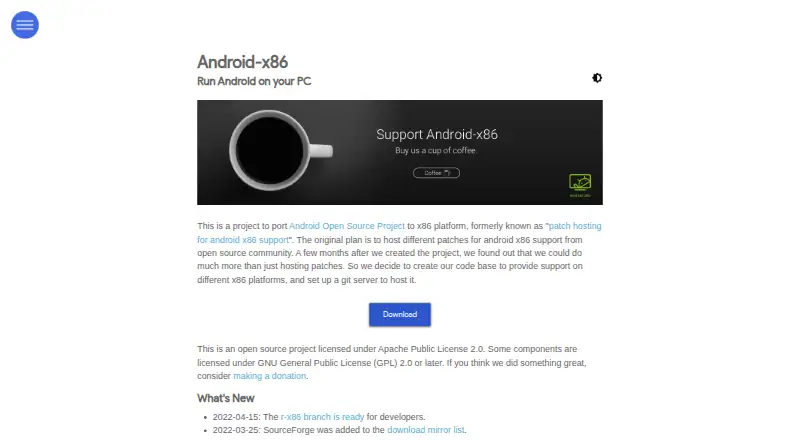
What Android-x86 is
Android-x86 ports the Android Open Source Project to x86 devices, offering a complete Android system for common x86 platforms. Universal android_x86 and android_x86_64 targets cover 32-bit and 64-bit machines. The project says its images can run on physical hardware and virtual machines such as QEMU or VirtualBox; Linux users can also install RPM packages on a standalone ext4 root partition. Listed capabilities include Wi-Fi with a graphical interface, suspend and resume, battery status, audio, camera, Bluetooth, and G-sensor support. It also lists native netbook resolutions, mirrored external-monitor output, external keyboards, a software mouse cursor, and mouse-wheel support. External storage can mount automatically, and the project documents ways to save data to USB or hard disk. The source tree is compilable, with instructions for building ISO images and RPM files. Android-x86 is free under Apache Public License 2.0, with some components under GPL 2.0 or later. The newest named release line is Android-x86 9.0 (pie-x86); its 9.0-r2 release is dated 2020-03-25. Multiple-display support, better power management, and Miracast are listed as to-do items.
Who it suits
Android-x86 suits people seeking to run Android on compatible x86 PCs or virtual machines, and those who want to build from its source tree. The project names a range of tested devices, including ASUS Eee PCs and laptops, Dell Inspiron Mini Duo, and Lenovo ThinkPad x61 Tablet.
What it does well
- Free and open source under Apache Public License 2.0.
- Build targets cover 32-bit and 64-bit x86.
- Images are intended for devices and virtual machines.
- Source and build instructions are provided.
What to know first
- Newest named release line is Android-x86 9.0.
- The 9.0-r2 release is dated 2020-03-25.
- Multiple-display support and better power management are to-do items.
- Google Play access is not provided.
Limits
Android-x86 is free. Its project lists multiple-display support and better power management among items on its to-do list, and Google Play access is unavailable.
Plans
| Plan | Billed and limits | Price |
|---|---|---|
| Android-x86 | Open-source project · Android for x86 PCs | Free |
As android-x86.org lists them, read 4 Oct 2026. The maker's own page has the final word.
Getting started
- Visit the Android-x86 website and review its release and build instructions.
- Choose the 32-bit or 64-bit ISO for your device.
- Boot the ISO on x86 hardware or use it with QEMU or VirtualBox.
- On Linux, use an RPM package with a standalone ext4 root partition.
- For a source build, follow the project instructions for producing an ISO image or RPM file.
Overview
Android-x86 is an open-source project that adapts Android for ordinary x86 computers, including 32-bit and 64-bit hardware. It is best for technically confident users who want to install, build, or experiment with Android on a PC or in a virtual machine. Its flexibility and buildable source are real advantages, but the newest named release is Android 9.0, making it a poor choice when a newer Android base is essential.
Key features
Universal build targets cover both x86 architectures, and the project says its images can run on physical devices as well as QEMU or VirtualBox. The 9.0-r2 release notes also explain how to start the system in QEMU with the installed qemu-android script. That makes it useful for testing or setting up an alternative Android environment, though support for a specific machine is not guaranteed.
The project’s listed hardware features include Wi-Fi with a graphical interface, suspend and resume, battery status, audio, camera, Bluetooth, and G-sensor support. For PC use, it also supports native netbook resolutions, external-monitor mirroring, external keyboards, a software mouse cursor, and mouse-wheel input. External storage can mount automatically, and documented methods allow user data to be saved to USB or hard disk. This is a substantial feature base for an x86 Android port, but multiple-display support and improved power management remain planned work; Miracast is also on the to-do list.
Build instructions accompany a complete, compilable source tree, including steps for producing CD-ROM ISO images and RPM files. The source repositories are hosted on OSDN and SourceForge. Apache Public License 2.0 governs the project, with some components under GNU GPL 2.0 or later.
Pricing
Android-x86 is free: its Android-x86 plan costs nothing and is an open-source project for Android on x86 PCs. There is no free trial because there is no paid tier to trial. The project provides no Google Play access, so users who depend on that store should factor in the limitation before choosing it.
Platforms
Android-x86 targets Linux and self-hosted use. The project packages releases as RPMs for Linux systems with a standalone ext4 root partition, and provides 32-bit and 64-bit ISO images. For release 9.0-r2, it recommends the 64-bit image for most modern devices and the 32-bit image for older legacy-BIOS hardware. The release note says that version fixed an issue preventing ISO boot in UEFI mode.
The newest named Android-x86 release family is 9.0 (pie-x86); release 9.0-r2 is dated 2020-03-25 and updated to LTS kernel 4.19.110. The latest listed project news is dated 2022-04-15 and says the r-x86 branch is ready for developers. The project also documents LineageOS ports for its nougat-x86 and marshmallow-x86 branches. This gives builders more than one route to explore, but the dated release line is a significant drawback for users seeking a current Android base. Earlier 8.1-r6 notes describe security updates and bug fixes and urged users on 8.1-r5 or older to upgrade.
Who it's for
Choose Android-x86 if you are comfortable installing an operating system, working with x86 images, or compiling source, and want Android on compatible PC hardware or in a virtual machine. The project names ASUS Eee PCs and laptops, Viewsonic Viewpad 10, Dell Inspiron Mini Duo, Samsung Q1U, Viliv S5, and Lenovo ThinkPad x61 Tablet among tested platforms. If you need a broadly current Android release, Google Play access, or the unfinished display and power-management capabilities, look elsewhere.
Pros and cons
- Pros: Free, open-source distribution with universal 32-bit and 64-bit build targets, a complete source tree, and instructions for building images and RPMs.
- Pros: The project describes use on both real x86 hardware and QEMU or VirtualBox, with hardware, input, and storage features suited to PC setups.
- Cons: The newest named Android-x86 release is 9.0, and the 9.0-r2 release dates to 2020, limiting its appeal when a newer base matters.
- Cons: Google Play access is absent, while multiple-display support, better power management, and Miracast remain on the to-do list.
Alternatives
For a PC emulator rather than an Android installation aimed at x86 hardware, compare Android Emulators for PC.
- Genymotion Desktop is a better fit if you want an emulator across Linux, macOS, or Windows and a free personal-use edition, or an Educational plan at $49 a year.
- BlueStacks App Player suits readers who want a Windows or macOS option with a free core experience; its BlueStacks Prime plan is $7.99 a month.
- GameLoop is worth considering for a free Windows emulator focused on mobile games and apps.
- Google Play Games on PC is a free Windows option when access to games through Google Play is the priority; games or in-game items may cost extra.
- LDPlayer offers a free Windows emulator with keyboard and mouse controls and multi-instance support; its LD Premium plan has custom pricing.
- MEmu Play is a free Windows alternative supported by advertisements.
- NovaPlay is a free Windows option for users on Windows 10 or 11 with hardware virtualization.
- NoxPlayer is a free alternative for Windows or Mac with keyboard and mouse mapping and multiple emulator instances.
Verdict
Android-x86 is a strong fit for technically capable users who want a free, open-source Android build for compatible x86 hardware or virtual machines, especially if compiling or adapting the system is part of the goal. Its broad PC-oriented feature set and complete source tree are the main reasons to choose it. Look elsewhere if you need Google Play access, unfinished PC capabilities, or a newer Android release line.
Verdict
Android-x86 provides an Android port for x86 hardware, with build options and support for virtual machines. Its newest named release line is 9.0, and several capabilities remain on the project's to-do list.
Questions
How much does Android-x86 cost?
The listed plan is free.
What platforms does it support?
The listed platforms are Linux and self-hosted. Its images are also intended to run on real x86 devices and virtual machines such as QEMU or VirtualBox.
Is Android-x86 open source?
Yes. The project is licensed under Apache Public License 2.0, with some components under GNU GPL 2.0 or later.
Which Android release line is newest?
The newest named Android-x86 release family is 9.0 (pie-x86). The 9.0-r2 release is dated 2020-03-25.
Does it include Google Play access?
No. Google Play access is listed as unavailable.
Facts from Android-x86's own pages
- Architecture images
- Release 9.0-r2 provides 32-bit and 64-bit ISO images, with the page recommending the 64-bit ISO for most modern devices and the 32-bit ISO for older legacy-BIOS devices. · android-x86.org, 4 Oct 2026
- Build and source
- The project provides a complete, compilable source tree and instructions for building CD-ROM ISO images and RPM files. · android-x86.org, 4 Oct 2026
- Compatibility caveat
- The homepage states that multiple-display support, better power management, and Miracast are on its to-do list. · android-x86.org, 4 Oct 2026
- Display and input
- Listed features include native netbook resolutions, external monitor mirror mode, external keyboard support, software mouse cursor, and mouse wheel support. · android-x86.org, 4 Oct 2026
- Hardware features
- The listed release features include Wi-Fi with a GUI, suspend/resume, battery status, audio, camera support, Bluetooth, and G-sensor support. · android-x86.org, 4 Oct 2026
- Intended use
- The project describes itself as a complete solution for Android on common x86 platforms, comparable to an Android BSP for generic x86 platforms. · android-x86.org, 4 Oct 2026
- Kernel
- The 9.0-r2 release updates to LTS kernel 4.19.110. · android-x86.org, 4 Oct 2026
- Latest listed release
- The releases page lists Android-x86 9.0 (pie-x86) as its newest release line. · android-x86.org, 4 Oct 2026
- License
- The project is licensed under Apache Public License 2.0, with some components licensed under GNU General Public License (GPL) 2.0 or later. · android-x86.org, 4 Oct 2026
- LineageOS
- The build instructions describe LineageOS ports for the nougat-x86 and marshmallow-x86 branches. · android-x86.org, 4 Oct 2026
- Linux install
- The project packages releases as RPMs for installation on Linux systems with a standalone ext4 root partition. · android-x86.org, 4 Oct 2026
- Open source
- The project is licensed under Apache Public License 2.0, and some components are licensed under GNU GPL 2.0 or later. · android-x86.org, 4 Oct 2026
- Organization details
- The opened official pages identify the project as Android-x86 but do not state its headquarters or founding year. · android-x86.org, 4 Oct 2026
- Purpose
- Android-x86 ports the Android Open Source Project to the x86 platform to provide Android on common x86 devices. · android-x86.org, 4 Oct 2026
- Release age
- The 9.0-r2 release note dates that release to 2020-03-25. · android-x86.org, 4 Oct 2026
- Release versions
- The releases page lists Android-x86 9.0 (pie-x86) as its newest named Android-x86 release family. · android-x86.org, 4 Oct 2026
- Security updates
- The 8.1-r6 release was described as mainly security updates and bug fixes, and the project encouraged users of 8.1-r5 or older to upgrade. · android-x86.org, 4 Oct 2026
- Source code
- The project says it provides a complete, compilable, workable source tree and links to build instructions. · android-x86.org, 4 Oct 2026
- Source repositories
- The source page links Android-x86 repositories hosted on OSDN and SourceForge. · android-x86.org, 4 Oct 2026
- Storage
- The project lists external storage auto-mount support and documents methods to save user data to USB or hard disk. · android-x86.org, 4 Oct 2026
- Supported targets
- The build instructions provide universal android_x86 and android_x86_64 targets for 32-bit and 64-bit x86 devices. · android-x86.org, 4 Oct 2026
- Support status
- The homepage's latest listed news item is dated 2022-04-15 and says the r-x86 branch is ready for developers. · android-x86.org, 4 Oct 2026
- Tested devices
- The homepage names ASUS Eee PCs and laptops, Viewsonic Viewpad 10, Dell Inspiron Mini Duo, Samsung Q1U, Viliv S5, and Lenovo ThinkPad x61 Tablet among tested platforms. · android-x86.org, 4 Oct 2026
- UEFI
- The 9.0-r2 release note says it fixes an issue that prevented the ISO from booting in UEFI mode. · android-x86.org, 4 Oct 2026
Where Android-x86 stands on Freedom251
- Android Emulators for PC#1 of 11