Freedom251 › Payment Tokenization Software
American Express Token Service
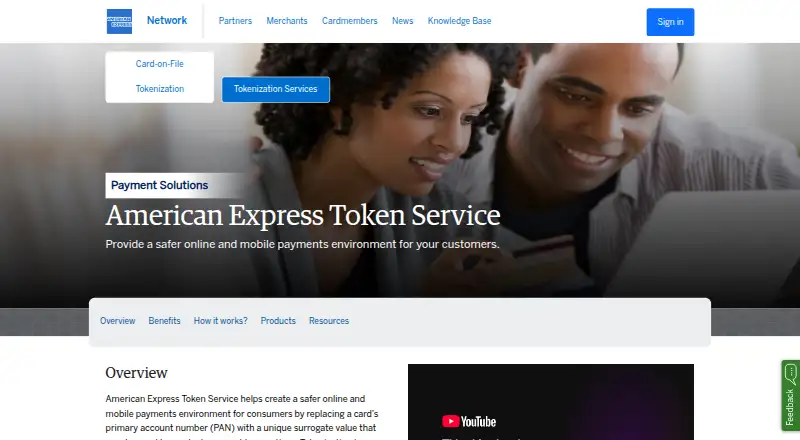
What American Express Token Service is
American Express Token Service replaces a card’s primary account number with a payment token for online and mobile commerce. It includes a token vault, token issuance and provisioning, lifecycle management, and risk management. Tokens are surrogate values that can be restricted by retailer, number of uses, lifetime, and other variables, and follow EMVCo Payment Tokenization specifications. During provisioning, issuers can assess card status, tokenization eligibility, and whether the card belongs to the person requesting the token. Lifecycle management can keep tokens current after card replacement, reducing the need to update stored payment details manually. Listed uses include card-on-file payments, Click to Pay, digital wallets, virtual cards, browser autofill virtual card numbers, and digital or numberless cards. The cloud service supports payment cards, card-on-file credentials, digital wallets, wearables, and QR code payments. The listed plan is free, with no deployment or use fees stated; availability varies by market and enablement is required.
Who it suits
The service suits issuers, merchants, acquirers, and service providers seeking tokenization for online or mobile payment use cases. Its availability and enablement are handled through an American Express relationship manager.
What it does well
- Tokens can be restricted by retailer, usage count, and lifetime.
- Lifecycle management can update tokens when cards are replaced.
- Includes a token vault and risk management capabilities.
- Listed plan is free.
What to know first
- Availability varies by market.
- Issuer, merchant, acquirer, or service provider enablement is required.
- Network authorization certification is required for digital wallet and card-on-file tokenization transactions.
Limits
The listed free plan costs nothing and states no deployment or use fees. Availability varies by market, and enablement is required; network authorization certification is required for digital wallet and card-on-file tokenization transactions.
Plans
| Plan | Billed and limits | Price |
|---|---|---|
| American Express Token Service | For American Express Network issuers, acquirers, merchants and service providers · Country availability varies · Representative contact and certification may be required | On request |
As network.americanexpress.com lists them, read 15 Oct 2026. The maker's own page has the final word.
Getting started
- Visit the American Express Token Service product page.
- Contact an American Express representative or relationship manager to discuss availability and enablement.
- Complete the required network authorization certification for digital wallet or card-on-file tokenization transactions.
- Use the Token Service Cryptogram API for e-commerce cryptogram support where applicable.
Overview
American Express Token Service replaces card numbers with payment tokens for online and mobile commerce. It is best suited to issuers, merchants, and payment partners operating within the American Express network. Its combination of token controls and lifecycle management is useful, but market access and certification requirements may rule it out for some teams.
The service covers card-on-file payments, digital wallets, Click to Pay, virtual cards, browser autofill card numbers, and digital or numberless cards. Card-on-file tokenization focuses on stored e-commerce credentials, including recurring charges and subscriptions.
Key features
Token controls and provisioning
Tokens are unique substitutes for payment card numbers and can be restricted by retailer, use count, lifetime, and other variables. That makes them more controllable than simply storing reusable card credentials, and the service follows EMVCo Payment Tokenization specifications. During provisioning, issuers can assess whether a card is active, suspected of fraud, eligible for tokenization, and associated with the card member requesting the token.
Lifecycle management
When a card is replaced, lifecycle management can keep its tokens current, reducing the need for card members to update stored payment details themselves. The lifecycle application supports Apple Pay, Google Pay, Samsung Pay, Card-on-File Tokenization, and Click to Pay. That range is useful for payment programs spanning wallet and merchant-stored credentials, though network authorization certification is required for digital wallet and card-on-file transactions.
Merchant infrastructure and API
Merchants storing tokens instead of card credentials may be able to reduce PCI-compliant infrastructure needs and PCI audit requirements. The Token Service Cryptogram API provides the channel for eCommerce Cryptogram, which supports dynamic cryptographic authentication for e-commerce and card-on-file tokenization. The service uses a vendor-hosted token vault, supports detokenization through an API, and is deployed in the cloud.
Pricing
The American Express Token Service plan is free. No deployment or use fees are stated for the plan, but that does not make access universal: availability varies by market, and issuer, merchant, acquirer, or service-provider enablement is required. There is no free trial. Market availability is handled through an American Express relationship manager, so this is a network-connected option rather than a self-serve tokenization product.
Platforms
Platforms include Android, iOS, web, and API. Payment methods include payment cards, card-on-file credentials, digital wallets, wearables, Click to Pay, and QR code payments. The broad channel coverage suits programs that need to support multiple digital payment experiences, subject to enablement and certification.
Who it's for
Issuers seeking token provisioning with eligibility and fraud checks, merchants storing credentials for repeat online payments, and payment partners supporting wallet or Click to Pay use cases are the clearest fit. Merchants can benefit from reduced exposure to stored card credentials, while issuers gain lifecycle management that can keep credentials usable through card replacement. Teams without an American Express relationship or those needing an immediately deployable, market-agnostic service should look elsewhere.
Pros and cons
- Pros: Tokens can be scoped by retailer, use count, and lifetime, providing practical controls over credential use.
- Pros: Provisioning checks and card-replacement lifecycle support address both eligibility and ongoing credential upkeep.
- Pros: The token vault, detokenization API, cryptogram API, and multiple wallet and stored-credential use cases cover a broad payment workflow.
- Cons: Market availability and relationship-manager enablement make access dependent on network reach and coordination.
- Cons: Network authorization certification is required for digital wallet and card-on-file transactions, adding a qualification step.
Alternatives
Choose Very Good Security if you want a paid tokenization option with a free plan and a published Starter Package at $1,000 a month. Basis Theory is another paid alternative, with a Standard platform plan at $995 a month and 20,000 tokens included; its additional-token charge and payload and retention limits may matter when estimating usage.
Cashfree Token Vault is another paid option. FIS Data Integrity Manager is a paid, web-based alternative without a free plan. Purse Vault has custom pricing. Mastercard Decision Intelligence has custom pricing. DeloPay offers a Power plan at $2.25 a month, billed at 2.25% per transaction for monthly volume from $100,000 to $500,000. NORBr Network Tokenization is another paid API and web option. Browse the Payment Tokenization Software list for more choices.
Verdict
American Express Token Service is a strong fit for issuers and merchants already positioned to work with the network, especially those needing scoped tokens, provisioning risk checks, and automatic credential upkeep. Its breadth is a reason to choose it; market-dependent availability and certification are the main reasons to seek a more directly accessible alternative.
Verdict
American Express Token Service covers token issuance, controls, and lifecycle management for a range of payment use cases. Market availability, enablement, and certification requirements are important considerations.
Questions
How much does American Express Token Service cost?
Pricing is on request. The listed plan is free, with no deployment or use fees stated.
Is there a free plan or trial?
A free plan is listed. There is no free trial.
What platforms does it support?
The listed platforms are Android, API, iOS, and web. The deployment model is cloud.
What payment use cases does it support?
Use cases include card-on-file tokenization, Click to Pay, digital wallets, virtual cards, browser autofill virtual card numbers, and digital or numberless cards.
What integrations are listed?
The issuer overview lists Apple Pay, Google Pay, Samsung Pay, Card-on-File Tokenization, and Click to Pay for its lifecycle management application.
What is required to enable the service?
Issuers, merchants, acquirers, or service providers contact an American Express representative or relationship manager to discuss enablement. Network authorization certification is required for digital wallet and card-on-file tokenization transactions.
Facts from American Express Token Service's own pages
- API
- The FAQ identifies a Token Service Cryptogram API as the channel for eCommerce Cryptogram, which supports dynamic cryptographic authentication for e-commerce and card-on-file tokenization. · network.americanexpress.com, 2 Oct 2026
- API integration
- American Express says enabling AETS and its supporting services is done through API integration. · network.americanexpress.com, 15 Oct 2026
- Availability and onboarding
- Market availability is provided through an American Express relationship manager; issuers and merchants contact their American Express representative or relationship manager to discuss enablement. · network.americanexpress.com, 2 Oct 2026
- Browser autofill
- Virtual Card Number for Browser Autofill creates a tokenized number that fills payment credentials and can use a cryptogram instead of manual security-code entry. · network.americanexpress.com, 15 Oct 2026
- Card-on-file
- Card-on-file tokenization covers stored credentials for future purchases, recurring billing and subscriptions. · network.americanexpress.com, 15 Oct 2026
- Card-on-file scope
- Card-on-File Tokenization focuses on online and e-commerce stored-credential transactions, including recurring payments and subscriptions. · network.americanexpress.com, 2 Oct 2026
- Certification limit
- Network authorization certification is required to support digital wallet and Card-on-File Tokenization transactions. · network.americanexpress.com, 2 Oct 2026
- Certification requirement
- Network authorization certification is required for card-on-file and digital-wallet transactions. · network.americanexpress.com, 15 Oct 2026
- Click to Pay
- Click to Pay uses tokens linked to enrolled card credentials across websites, apps and other digital channels. · network.americanexpress.com, 15 Oct 2026
- Company headquarters
- LinkedIn lists American Express headquarters in New York, New York. · linkedin.com, 15 Oct 2026
- Company size
- LinkedIn lists American Express as having more than 10,001 employees. · linkedin.com, 15 Oct 2026
- Company type
- LinkedIn identifies American Express as a public company in financial services. · linkedin.com, 15 Oct 2026
- Current status check
- StatusGator reported American Express operational on October 15, 2026 while showing recent user reports involving login and payment access. · statusgator.com, 15 Oct 2026
- Digital wallets
- Digital-wallet implementations store payment tokens instead of card data for in-app and point-of-sale payments. · network.americanexpress.com, 15 Oct 2026
- Documentation access
- The implementation guide is accessed through Amex Enabled registration and dashboard access. · network.americanexpress.com, 15 Oct 2026
- Fraud reduction
- Domain controls can restrict payment tokens to a particular merchant, helping limit unauthorized use after a breach. · network.americanexpress.com, 15 Oct 2026
- Included services
- The service includes a token vault, token issuance and provisioning, lifecycle management, and risk management capabilities. · network.americanexpress.com, 2 Oct 2026
- Integrations
- The issuer overview lists Apple Pay, Google Pay, Samsung Pay, Card-on-File Tokenization, and Click to Pay as supported by its lifecycle management application. · network.americanexpress.com, 2 Oct 2026
- Lifecycle management
- Lifecycle management automatically keeps payment credentials current when cards are replaced. · network.americanexpress.com, 15 Oct 2026
- Limit: Android app eligibility
- The Amex Android app listing says its features are limited to eligible U.S. American Express card accounts and exclude prepaid cards and cards issued by other issuers. · play.google.com, 15 Oct 2026
- Limit: customer-service complaints
- Trustpilot's review summary says recurring complaints concern scripted or unhelpful support, payment problems, delayed transactions and unexpected fees. · trustpilot.com, 15 Oct 2026
- Limit: observed service incident
- StatusGator recorded a 52-minute incident on February 9, 2026 in which account balances and transactions were not displaying or processing, with no official acknowledgement shown. · statusgator.com, 15 Oct 2026
- Merchant benefit
- The product page says storing tokens instead of card credentials can reduce merchants’ PCI-compliant infrastructure needs and PCI audit requirements. · network.americanexpress.com, 2 Oct 2026
- Notable news: headquarters plan
- An SEC filing says American Express announced on February 25, 2026 plans for an approximately 1.95-million-square-foot headquarters at 200 Greenwich Street in New York, targeted for completion in 2031. · sec.gov, 15 Oct 2026
Where American Express Token Service stands on Freedom251
- Payment Tokenization Software#1 of 22