Freedom251 › Payment Tokenization Software
Purse Vault
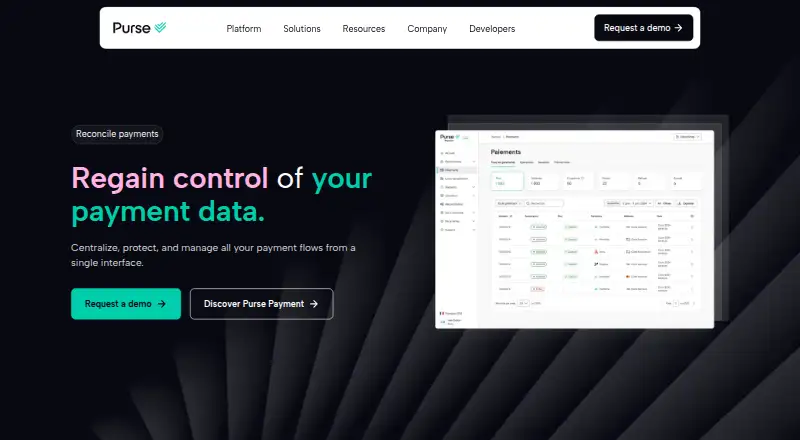
What Purse Vault is
Purse Vault is part of a cloud payment-orchestration platform that sits between merchants and their chosen payment-service providers (PSPs). Its independent, PSP-agnostic vault stores card data and supports portability of payment methods between providers. Centralized tokens can be used to retry transactions or route them to a partner in real time. Purse also consolidates orders, settlements, fees, transfers and chargebacks, standardizes PSP transaction logs, and provides dashboards by country, provider or payment method, including acceptance rates and decline reasons. A single technical integration connects to more than 100 PSPs and local or international payment methods; its catalog lists more than 80 providers and methods. Purse says it will integrate a provider outside the catalog within 25 working days. SecureFields collects card details in secure iframes and returns a vault_form_token without PAN or CVV reaching merchant systems. The Vault is PCI DSS v4 Level 1 certified and hosted on sovereign infrastructure in Europe. Merchants must whitelist their domain and contact Purse’s Integration Team for preproduction and production API use. Pricing is on request.
Who it suits
Purse Vault suits merchants that use payment-service providers and want to manage portable payment tokens, transaction routing and reconciliation. It may also suit businesses seeking unified payment dashboards across countries, providers or methods.
What it does well
- Vault stores payment data independently of PSPs
- Tokens support retries and real-time routing
- Connects more than 100 PSPs and methods
- Dashboards show acceptance rates and decline reasons
- PCI DSS v4 Level 1 certified
What to know first
- Pricing is available on request
- Merchants must whitelist their domain
- API use requires contacting the Integration Team
Plans
| Plan | Billed and limits | Price |
|---|---|---|
| Purse Vault | request a demo | On request |
As purse.eu lists them, read 30 Sept 2026. The maker's own page has the final word.
Getting started
- Visit the Purse Vault website.
- Request a demo to discuss pricing.
- Whitelist your domain.
- Contact the Purse Integration Team for preproduction and production API use.
Purse Vault is a cloud payment-orchestration service for merchants that need one vault across multiple payment-service providers. It suits businesses managing several PSP relationships, cross-border payment methods, or recurring retry and reconciliation work. Its strongest case is portability and consolidated payment operations, while API onboarding and custom pricing make it a considered purchase rather than a self-serve tool.
Overview
Purse, founded in 2021 and headquartered in Lille, France, sits between a merchant and its chosen payment providers. The Vault keeps card data in an independent, PSP-agnostic store, allowing payment credentials to move with the merchant instead of being locked to one provider. That architecture is valuable when a merchant changes PSPs, adds local acquiring, or wants to route each attempt to a more suitable partner.
The service is delivered in the cloud and supports credit cards, PayPal, and Apple Pay. Merchants can use a detokenization API and webhooks, but API access requires domain whitelisting and contact with the Purse Integration Team for both preproduction and production use. That process is sensible for a security-sensitive payment service, though it adds coordination before engineering teams can begin.
Key features
Portable vault and routing
Purse centralizes customer payment methods and supports token portability between PSPs and payment partners. Transactions can be retried or routed to the best partner in real time. For merchants exposed to provider outages, uneven approval rates, or market-specific payment coverage, this reduces the operational cost of changing or balancing PSPs. A merchant with one provider and little routing complexity will gain less from the model.
3DS-aware retries
The Vault stores and transmits a 3DS authentication token between attempts. If a PSP transaction fails for technical reasons, Purse can reroute it without forcing the customer through authentication again. That can remove unnecessary friction from recovery flows, although the benefit depends on the merchant's providers and transaction mix.
Secure collection and compliance
SecureFields collects card details in secure iframes and returns a vault_form_token, keeping the primary account number and CVV out of merchant systems. Purse Vault is PCI DSS v4 Level 1 certified, and Purse Payment describes its infrastructure as PCI DSS Level 1 and GDPR compliant. Hosting on sovereign infrastructure in Europe will appeal to organizations with European data-residency requirements.
Reconciliation and analytics
Purse consolidates orders, settlements, fees, transfers, and chargebacks, then standardizes transaction logs from PSPs. Unified dashboards can be filtered by country, PSP, or payment method and show acceptance rates and decline reasons. This is a practical advantage for finance and payment teams that otherwise reconcile several provider reports by hand.
Integration coverage
A single technical integration connects more than 100 PSPs and local or international payment methods. Purse says its directly integrated catalog contains more than 80 providers and methods, and commits to adding a partner outside the catalog within 25 working days. That commitment helps merchants entering a market with a particular local method, but it is still a delivery promise rather than an immediately available connector.
Pricing
The Purse Vault plan uses custom pricing; merchants must request a demo. No seat, usage, or free-plan allowance is published, so it is best suited to organizations prepared for a sales-led assessment and able to model costs around their transaction volume and integration scope. There is no lower-cost self-serve tier to test the product before that conversation.
Platforms
Purse Vault is offered on Android, iOS, and the web. Its cloud deployment, API, detokenization endpoint, and webhook support make it primarily an infrastructure service for payment and finance systems rather than a standalone consumer wallet.
Who it's for
Choose Purse Vault if your business works with multiple PSPs, needs to preserve payment credentials while changing providers, or wants one view of settlements, fees, chargebacks, and declines. It is particularly relevant to international merchants coordinating local payment methods and to teams that value European hosting and Level 1 PCI controls.
It is a weaker fit for a small merchant seeking transparent monthly pricing, a quick self-serve setup, or a single-provider checkout with limited reconciliation needs. The required whitelisting and Integration Team contact also mean that implementation planning is part of the purchase.
Pros and cons
- Pro: PSP-agnostic token portability reduces lock-in when providers or payment partners change.
- Pro: Real-time routing and 3DS-token reuse can improve recovery without repeating customer authentication.
- Pro: Consolidated reconciliation and dashboards give payment and finance teams one operational view.
- Pro: More than 100 PSP and payment-method connections, with a 25-working-day new-partner commitment, support international expansion.
- Pro: PCI DSS v4 Level 1 certification, GDPR compliance, and European sovereign hosting address demanding security and residency requirements.
- Con: Custom pricing and no published free tier make budgeting and initial evaluation harder.
- Con: Domain whitelisting and Integration Team contact add steps before API work can move into preproduction or production.
Alternatives
For a broader starting point, browse Payment Tokenization Software.
- American Express Token Service is worth considering when you need an issuer-specific token service with a free plan and no free trial.
- Hyperswitch Card Vault suits teams wanting a free, self-hosted community edition with 90-plus integrations and end-to-end compliance responsibility.
- Basis Theory fits organizations comfortable with a $995-per-month standard platform that includes 20,000 tokens and charges $0.05 per additional token.
- Cashfree Token Vault is another paid token-vault option for Android, API, iOS, and web deployments.
- FIS Data Integrity Manager is a paid web alternative without a free plan.
- Paysafe offers a US/CAD standard option with zero setup and monthly fees plus transaction charges, alongside bespoke pricing.
- Razorpay TokenHQ is a paid option whose standard and custom checkout carries zero added cost, while S2S saved-card fees apply.
- Very Good Security may suit teams seeking a paid vault with a starter package from $1,000 per month and a free-start option.
Verdict
Purse Vault is a strong choice for mid-sized and larger merchants that need portable payment tokens, multi-PSP routing, and unified reconciliation across markets. Its main reason to choose it is the combination of provider independence and operational visibility. Look elsewhere if transparent pricing, self-serve onboarding, or a free implementation path matters more than PSP portability and centralized payment control.
Verdict
Purse Vault combines a portable payment vault with transaction routing, reconciliation and analytics. Merchants should account for the required domain whitelisting and integration-team contact before API use.
Questions
How much does Purse Vault cost?
Pricing is available on request. The Purse Vault plan asks users to request a demo.
Which payment methods does it support?
The listed methods are credit cards, PayPal, and Apple Pay.
Which platforms does Purse Vault support?
It is listed for Android, iOS, and web.
Where is the Vault hosted, and what certification does it have?
The Vault is hosted on sovereign infrastructure in Europe and is PCI DSS v4 Level 1 certified.
Does Purse Vault connect to multiple payment providers?
Yes. Purse describes a single technical integration to more than 100 PSPs and local or international payment methods. Its catalog contains more than 80 providers and methods.
What does a merchant need before using the APIs?
Merchants must whitelist their domain and contact the Purse Integration Team for preproduction and production API use.
Facts from Purse Vault's own pages
- 3DS handling
- Purse stores and transmits a 3DS authentication token between attempts so a technically failed PSP transaction can be rerouted without repeating authentication. · purse.eu, 30 Sept 2026
- Analytics
- Purse provides unified dashboards by country, PSP, or payment method and tracks acceptance rates and decline reasons. · purse.eu, 30 Sept 2026
- API security
- Purse SecureFields collects card details in secure iframes and returns a vault_form_token without PAN or CVV reaching merchant systems. · docs.payment.purse.eu, 30 Sept 2026
- Compliance
- Purse Payment states that its infrastructure is PCI DSS Level 1 and GDPR compliant, with data hosted in Europe. · purse.eu, 30 Sept 2026
- Founded
- 2021 · purse.eu, 28 Sept 2026
- Headquarters
- Lille, France · purse.eu, 28 Sept 2026
- Integrations
- Purse connects more than 100 PSPs and local or international payment methods through a single technical integration. · purse.eu, 30 Sept 2026
- New integrations
- Purse commits to integrating a partner not in its catalog within 25 working days. · purse.eu, 30 Sept 2026
- Partner catalog
- Purse says its catalog contains more than 80 payment providers and international payment methods integrated directly. · purse.eu, 30 Sept 2026
- Purpose
- Purse is a SaaS payment-orchestration platform that intermediates between merchants and their selected payment-service providers. · purse.eu, 30 Sept 2026
- Reconciliation
- Purse consolidates orders, settlements, fees, transfers, and chargebacks and standardizes PSP transaction logs. · purse.eu, 30 Sept 2026
- Security certification
- The Purse Vault is PCI DSS v4 Level 1 certified and hosted on sovereign infrastructure in Europe. · purse.eu, 30 Sept 2026
- Support requirement
- Purse requires merchants to whitelist their domain and contact the Purse Integration Team for preproduction and production API use. · docs.payment.purse.eu, 30 Sept 2026
- Token portability
- The Vault centralizes customers’ payment methods so transactions can be retried or routed to the best partner in real time. · purse.eu, 30 Sept 2026
- Vault storage
- Purse Vault stores card data in an independent PSP-agnostic vault and supports portability between PSPs and payment partners. · purse.eu, 30 Sept 2026
Where Purse Vault stands on Freedom251
- Payment Tokenization Software#13 of 22