Freedom251 › Payment Tokenization Software

Basis Theory
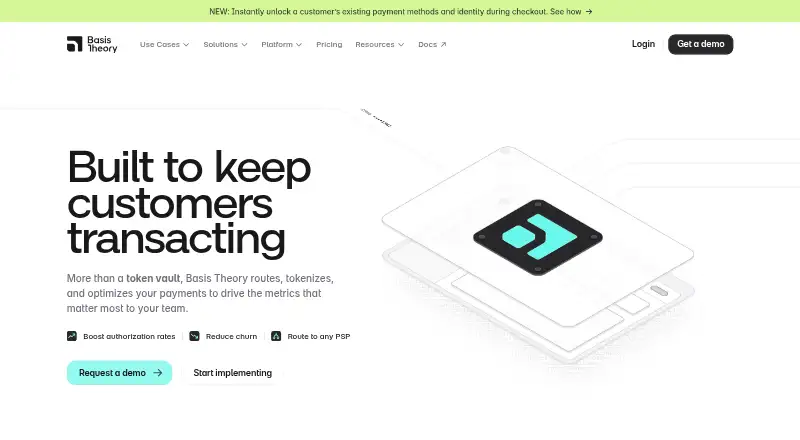
What Basis Theory is
Basis Theory is a cloud platform for centralizing sensitive payment data, controlling access, and routing tokens to payment service providers or other services. It tokenizes card data at collection so raw primary account numbers do not pass through customer systems. Its tools include Proxy, Reactors, Elements, and Token Intents for routing, server-side logic, sensitive-data collection, and validation before tokenization. Vault features include Account Updater, BIN Details, Network Tokens, and 3DS. The company says its API connects with existing payment providers, including examples such as Stripe, Adyen, Worldpay, Chase, Braintree, Nuvei, Amazon Pay, and ACI. SDKs cover .NET, Java, Go, NodeJS, Python, Terraform, React, JavaScript, iOS, Android, and React Native. Basis Theory states it is PCI Level 1 compliant, SOC 2 Type II certified, ISO 27001 certified, and HIPAA compliant, with encryption at rest and in transit using tenant-specific keys and TLS 1.2+ for communication. The Standard platform costs $995 a month and includes 20,000 tokens; additional tokens cost $0.05 each. Added-then-deleted tokens still count during that calendar month.
Who it suits
It suits payment businesses and platforms that need to tokenize and route sensitive data, including e-commerce, fintech, digital health, gaming, and subscription services. Its SDKs and payment integrations support teams working across the listed languages, frameworks, and providers.
What it does well
- Tokenizes card data at collection
- Connects to existing payment service providers
- Vault includes Account Updater, BIN Details, Network Tokens, and 3DS
- Lists several compliance certifications and standards
What to know first
- Standard platform costs $995 a month
- Only 20,000 tokens are included
- Additional tokens cost $0.05 each
- Deleted tokens still count toward monthly total
Limits
The Standard platform costs $995 a month and includes 20,000 tokens, with each additional token costing $0.05. It has a 1MB payload limit, 24 hours of logs, and US environment only; tokens added and then deleted during a calendar month still count toward that month’s total.
Plans
| Plan | Billed and limits | Price |
|---|---|---|
| Standard platform | $995/month; platform fee charged at the beginning of the month · 20,000 tokens included · $0.05 per additional token · 1MB payload limit · 24 hours of logs · US environment only | $995 a month |
| Enterprise | Get in touch · Additional PII and PHI compliance options · Unlimited monthly interactions per token · Custom log access and payload size · Uptime guarantees · Enterprise support options · SSO/SAML | On request |
As basistheory.com lists them, read 29 Sept 2026. The maker's own page has the final word.
Getting started
- Visit https://basistheory.com/.
- Contact Sales about the Enterprise plan if you need its listed options.
- Use the documented SDK for your environment, such as JavaScript, iOS, or Android.
- Connect your existing payment service provider through the API.
Basis Theory is a cloud platform for collecting, storing, and routing sensitive payment data. It suits payment teams that need tokenization across multiple providers and services. Its broad controls and integrations come with a substantial monthly starting price and token-based charges.
Overview
Basis Theory tokenizes card data at collection, keeping raw primary account numbers out of customers’ systems. Teams can manage access to that data and route tokens to payment service providers (PSPs) and other services. The platform is cloud-deployed, with vendor-hosted token vaults and a detokenization API.
Its API is intended to connect with existing PSPs; examples include Stripe, Adyen, Worldpay, Chase, Braintree, Nuvei, Amazon Pay, and ACI. That flexibility is useful for businesses working across providers, though the standard plan’s US-only environment is a meaningful constraint for teams that need another environment.
Key features
Proxy, Reactors, Elements, and Token Intents cover routing, server-side logic, sensitive-data collection, and validation before tokenization. The vault also includes Account Updater, BIN Details, Network Tokens, and 3DS. Together, these capabilities address more of the payment-data workflow than token storage alone, but the included token quota and log retention place limits on the standard package.
Documented SDKs cover .NET, Java, Go, NodeJS, Python, Terraform, React, JavaScript, iOS, Android, and React Native. Payment methods include credit cards, bank accounts, network tokens, Apple Pay, and Google Pay.
Basis Theory states that it is PCI Level 1 compliant, SOC 2 Type II certified, ISO 27001 certified, and HIPAA compliant. It says data is encrypted at rest and in transit with tenant-specific keys, and communications use TLS 1.2+. These stated controls may suit teams handling regulated or sensitive data; they do not remove the need to assess how a deployment meets a team’s own obligations.
Pricing
Standard platform
Standard costs $995 a month, billed at $995/month, with the platform fee charged at the beginning of the month. It includes 20,000 tokens, then charges $0.05 per additional token. The plan has a 1MB payload limit, 24 hours of logs, and a US environment only. This is a substantial fixed commitment, so it is best suited to teams that need the platform’s payment-data controls and can use the US environment. Token counts include tokens added and deleted within the same calendar month, which can make short-lived tokens count toward usage too.
Enterprise
Enterprise has custom pricing. It adds options for PII and PHI compliance, unlimited monthly interactions per token, custom log access and payload size, uptime guarantees, enterprise support options, and SSO/SAML. Those terms are aimed at organizations needing higher limits or enterprise controls; teams should compare the custom quote against their actual requirements.
Platforms
Basis Theory supports Android, iOS, web, and API access. Its cloud deployment and SDK coverage across server, web, mobile, and infrastructure tooling give teams several integration paths.
Who it's for
Use cases named by the company include creator economy, digital health, e-commerce, fintech, gaming, subscription platforms, and vertical SaaS. It is most compelling for payment teams that need to keep raw card data out of their systems while coordinating tokens across providers. Support for implementation, bugs, and issues is available by email; private Slack or Microsoft Teams channels are offered through Sales.
Pros and cons
Pros
- Broad payment-data toolkit: Tokenization, routing, validation, vault features, and detokenization sit within one platform.
- Wide integration reach: The maker says its API connects with any existing PSP, and SDKs cover common server, web, mobile, and infrastructure environments.
- Published security controls: The stated certifications and encryption practices are relevant to teams handling sensitive payment information.
Cons
- High entry price: Standard starts at $995 a month, before charges for tokens beyond the included 20,000.
- Usage accounting catches deleted tokens: Tokens created and deleted in one month still count toward that month’s total.
- Standard has tight operational boundaries: A 1MB payload limit, 24 hours of logs, and US-only environment may not fit teams needing larger payloads, longer log access, or another environment.
Alternatives
Payment Tokenization Software is the broader category to compare when you want to survey tokenization products rather than focus on one platform.
- American Express Token Service is worth considering if a free plan matters: it is priced at $0, with availability varying by market.
- Hyperswitch Card Vault is a free, self-hosted option with a community edition that includes 90+ payment integrations and community support; choose it if you want to manage compliance end to end rather than use a vendor-hosted vault.
- Cashfree Token Vault is another paid option available on Android, API, iOS, and web.
- FIS Data Integrity Manager is a paid, web-based alternative.
- Paysafe may suit Shopify merchants seeking a plan with no setup or monthly fee and a transaction fee instead; its Bespoke plan uses custom pricing.
- Purse Vault is a paid alternative available on Android, iOS, and web, with pricing by demo request.
- Very Good Security may suit teams looking for a free-start option or a published starting price of $1,000 a month for its Starter Package.
Verdict
Basis Theory is a strong fit for payment teams that need tokenization, access governance, and routing across multiple PSPs, with security controls and SDKs to support varied integrations. Its main drawback is the cost and the standard plan’s quota, short log window, and US-only environment. Choose it when those capabilities justify $995 a month; look elsewhere if you need a free or self-hosted starting point, or cannot work within the standard plan’s limits.
Verdict
Basis Theory combines payment-data tokenization, access controls, routing, and vault capabilities in one cloud platform. Standard pricing is $995 a month, and token counts include tokens deleted during the same month.
Questions
How much does Basis Theory cost?
The Standard platform costs $995 a month, billed $995/month. It includes 20,000 tokens, then charges $0.05 per additional token. Enterprise pricing is available by getting in touch.
Is there a free plan?
No free plan is listed. The listed Standard platform plan is paid.
What platforms and SDKs does it support?
The listed platforms are Android, API, iOS, and web. Documented SDKs include .NET, Java, Go, NodeJS, Python, Terraform, React, JavaScript, iOS, Android, and React Native.
Which payment services can it connect to?
The maker says its API connects with any existing payment service provider and gives Stripe, Adyen, Worldpay, Chase, Braintree, Nuvei, Amazon Pay, and ACI as examples.
Who makes Basis Theory?
The site identifies the company as Basis Theory Inc., headquartered in San Francisco, California, United States.
What payment methods are listed?
Credit cards, bank accounts, network tokens, Apple Pay, and Google Pay are listed.
Facts from Basis Theory's own pages
- Card features
- Vault capabilities include Account Updater, BIN Details, Network Tokens, and 3DS. · basistheory.com, 29 Sept 2026
- Company
- The site identifies the company as Basis Theory Inc. · basistheory.com, 29 Sept 2026
- Data protection
- The maker says data is encrypted at rest and in transit with tenant-specific keys and communication uses TLS 1.2+. · basistheory.com, 29 Sept 2026
- Headquarters
- San Francisco, California, United States · basistheory.com, 28 Sept 2026
- Integrations
- The maker says its API connects with any existing payment service provider and displays Stripe, Adyen, Worldpay, Chase, Braintree, Nuvei, Amazon Pay, and ACI as examples. · go.basistheory.com, 29 Sept 2026
- Intended users
- The maker lists creator economy, digital health, e-commerce, fintech, gaming, subscription platforms, and vertical SaaS as use cases. · basistheory.com, 29 Sept 2026
- Payment tools
- Its platform includes Proxy, Reactors, Elements, and Token Intents for routing, server-side logic, collecting sensitive data, and validating data before tokenization. · basistheory.com, 29 Sept 2026
- Product
- Basis Theory centralizes sensitive payment data, governs access, and routes tokens to any PSP or service. · basistheory.com, 29 Sept 2026
- SDKs
- Documented SDKs cover .NET, Java, Go, NodeJS, Python, Terraform, React, JavaScript, iOS, Android, and React Native. · developers.basistheory.com, 29 Sept 2026
- Security
- Basis Theory states that it is PCI Level 1 compliant, SOC 2 Type II certified, ISO 27001 certified, and HIPAA compliant. · basistheory.com, 29 Sept 2026
- Support
- Implementation, bug, and issue support is available by email, with private Slack or Microsoft Teams channels offered through Sales. · basistheory.com, 29 Sept 2026
- Token billing limit
- Tokens added and then deleted during a calendar month still count toward that month’s token total. · basistheory.com, 29 Sept 2026
- Tokenization
- It tokenizes card data at the point of collection so raw primary account numbers do not touch customers’ systems. · go.basistheory.com, 29 Sept 2026
Where Basis Theory stands on Freedom251
- Payment Tokenization Software#6 of 22