Freedom251 › CRM Data Migration Software

Airbyte Data Replication
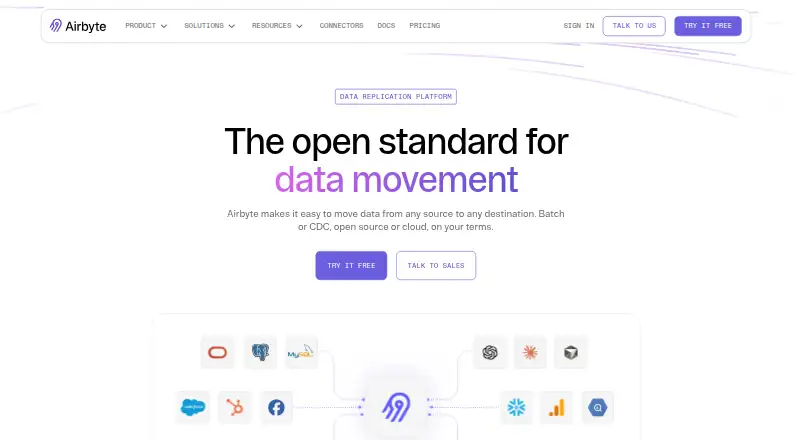
What Airbyte Data Replication is
Airbyte Data Replication moves data from sources to destinations through batch replication or change data capture (CDC). It lists more than 700 connectors and provides a no-code Connector Builder for custom connectors. Users can choose full refresh, incremental append, or log-based CDC, select streams and fields, and schedule syncs or trigger them through an API. Monitoring covers sync health, record counts, schema-change alerts, and failure notifications. Data can land in a warehouse or lake with a user-defined schema, as raw tables or with dbt transformations. Named destinations include Snowflake, BigQuery, Redshift, and Databricks. Airbyte lists integrations with Airflow, Prefect, and Dagster, alongside API and Python SDK controls. The service has a free plan and a 30-day trial; Standard starts at $20/month and Plus at $189/month. Pro and Enterprise Flex use custom pricing. Airbyte Core is an open-source self-hosted option, with deployment described for Kubernetes, a VM, or a local computer.
Who it suits
Airbyte describes its production pipeline capabilities for data engineers and recommends Standard or Plus as starting plans for small developer teams. Its self-hosted Core option may suit teams that want to manage deployment themselves.
What it does well
- Lists more than 700 connectors
- No-code Connector Builder supports custom connectors
- Syncs offer batch and CDC options
- Monitoring includes schema alerts and failure notifications
- Airbyte Core is open source and self-hosted
What to know first
- Standard sync frequency is limited to one hour
- Plus starts at $189/month
- Pro and Enterprise Flex pricing is custom
- Paid plans have plan-specific sync frequency limits
Limits
Standard allows a maximum sync frequency of one hour, while Plus allows 15-minute syncs. Standard starts with five credits, and Plus includes 40 credits; extra credits or overage cost $5 each. Pro and Enterprise Flex allow syncs as often as every five minutes.
Plans
| Plan | Billed and limits | Price |
|---|---|---|
| Standard | Starting at $20/month · 5 credits included · extra credits $5 each · volume-based pricing · 30-day free trial | $20 a month |
| Plus | Starting at $189/month · 40 credits · overage $5.00/credit · 2 workspaces · 15-minute syncs · 30-day free trial | $189 a month |
| Pro | Custom; talk to sales for capacity-based pricing. · Multiple workspaces · SSO and RBAC · up to 5-minute sync frequency · premium support | On request |
| Enterprise Flex | Custom; talk to sales for in-boundary deployment. · On-premises and multi-region options · hybrid deployment · all Pro features · premium support | On request |
| Airbyte Core | Open source offering; no price stated on page. · Self-hosted option | Free |
As airbyte.com lists them, read 4 Oct 2026. The maker's own page has the final word.
Getting started
- Visit https://airbyte.com/data-replication.
- Choose a cloud plan or the Airbyte Core self-hosted option.
- For Airbyte Core, deploy on Kubernetes, a VM, or a local computer.
- Select a source and destination using a listed connector.
- Choose sync mode, streams, and fields, then schedule or trigger the sync.
Overview
Airbyte Data Replication moves data between sources and destinations through batch replication or change data capture (CDC). It is best suited to data engineers and small developer teams building production pipelines that need configurable syncs. The range of deployment and connector options is a strength, but sync-frequency caps and credit-based pricing make plan fit important.
Key features
Airbyte offers more than 700 connectors and a no-code Connector Builder for custom ones. That breadth can spare teams from building integrations themselves, though teams should confirm their specific sources and destinations are supported.
Syncs can use full refresh, incremental append, or log-based CDC. Teams can select streams and fields, schedule runs, or trigger them through an API. This control suits pipelines with different freshness and data-selection needs, but the plan caps matter: Standard allows syncs at most hourly, Plus every 15 minutes, and Pro and Enterprise Flex every five minutes.
Monitoring covers sync health, record counts, schema-change alerts, and failure notifications. These signals help operators spot changes and failures, although they do not remove the need to manage pipeline behavior. Airbyte names Snowflake, BigQuery, Redshift, and Databricks as destinations. Data can land in a warehouse or lake using a user-defined schema; teams can use dbt for transformations or deliver raw tables if they transform elsewhere.
Native integrations with Airflow, Prefect, and Dagster, plus API and Python SDK controls, give engineering teams options for fitting syncs into orchestration workflows. Airbyte states that it is SOC 2 Type II certified and offers GDPR and HIPAA support. It also advertises 24/7 support and 99.9% availability under contractual SLAs for mission-critical workloads.
Airbyte Core is the open-source self-hosting option. Deployment guidance covers Kubernetes in cloud environments, a VM, or a local computer, which gives teams control over deployment but makes self-hosting a distinct operational choice from paid plans.
Pricing
Airbyte has a free plan, paid plans from $20/mo, and a 30-day free trial on Standard and Plus. Standard is $20 a month, starting at $20/month, with five included credits, extra credits at $5 each, and volume-based pricing. It is the entry point for smaller developer teams willing to accept hourly syncs; credit use and volume-based charges mean the starting price alone may not reflect the cost of a larger workload.
Plus is $189 a month, starting at $189/month, and includes 40 credits, overage at $5.00/credit, two workspaces, 15-minute syncs, and a 30-day free trial. It suits teams needing more frequent syncs and separate workspaces, but still has explicit credit overages.
Pro uses custom pricing based on capacity and requires talking to sales. It adds multiple workspaces, SSO and RBAC, syncs up to every five minutes, and premium support. Enterprise Flex also has custom pricing and requires contacting sales for in-boundary deployment; it includes Pro features, on-premises and multi-region options, hybrid deployment, and premium support. These tiers target teams with tighter freshness, access-control, support, or deployment requirements, but require a sales discussion rather than a published price.
Airbyte Core is a free, open-source self-hosted option. It avoids a listed subscription price, but is not the same managed-plan choice as Standard or Plus. The published plan comparison does not give a seat allowance or renewal term.
Platforms
Airbyte supports API, Linux, self-hosted, and web access, and its deployment model is both hosted and self-hosted. The self-hosting guidance spans Kubernetes, VMs, and local computers.
Who it's for
Airbyte is a strong fit for data engineers and small developer teams that need a broad connector catalog, configurable replication, monitoring, and orchestration integration. Teams that need frequent updates should weigh Plus, Pro, or Enterprise Flex against Standard's hourly cap. Organizations needing on-premises or hybrid deployment have a specific path in Enterprise Flex; teams that do not need pipeline-level control may find this product more than they need.
Pros and cons
- Pros: More than 700 connectors and a no-code builder provide options for standard and custom integrations.
- Pros: Full refresh, incremental append, CDC, field selection, and API-triggered syncs let teams shape replication around pipeline needs.
- Pros: Monitoring alerts and orchestration integrations support operational oversight and workflow coordination.
- Pros: Hosted plans and an open-source self-hosted option accommodate different deployment approaches.
- Cons: Standard's one-hour sync-frequency cap does not suit pipelines that need updates more often.
- Cons: Standard and Plus use credits with per-credit overages, so workload volume affects cost beyond the starting subscription.
- Cons: Pro and Enterprise Flex have custom pricing, which means teams must contact sales to assess cost.
Alternatives
For a broader category search, see CRM Data Migration Software.
Choose Freshsales or Zoho CRM when the priority is a CRM with a free plan for up to three users, rather than a configurable replication platform.
Skyvia is an alternative for modest scheduled workloads: its free plan covers 10,000 records per month, two scheduled integrations, once-a-day scheduling, and 30-day schedule expiration. Workbench is a free alternative with no paid plans stated.
Celigo may suit teams looking for a flow-based integration product; its free plan allows two endpoints, one flow, and one production environment. CDS Data Migrator is a free, MIT-licensed Windows alternative.
Dataimporter may fit teams whose needs match its free plan's 20,000 records, 1 GB backup, one production instance, and one integration. dataloader.io is another alternative for web-based data loading.
Verdict
Choose Airbyte if your team needs configurable data replication, broad connector options, monitoring, and an orchestration path that fits an engineering-led pipeline. Its central advantage is the combination of sync control and hosted or self-hosted deployment; its central drawback is that freshness limits, credit overages, and custom-priced higher tiers make cost and plan fit workload-dependent. Look elsewhere if you need simpler data loading or a clear price for advanced capacity before speaking with sales.
Verdict
Airbyte combines configurable replication, connector options, and pipeline monitoring. Plan choice matters for sync frequency, and custom-priced tiers require contacting sales.
Questions
Is Airbyte Data Replication free?
Yes. Airbyte offers a free plan, and Airbyte Core is an open-source self-hosting option.
How much do the listed paid plans cost?
Standard starts at $20/month with five credits included and extra credits at $5 each. Plus starts at $189/month with 40 credits and $5 overage per credit.
Does Airbyte offer a trial?
Yes. Standard and Plus list a 30-day free trial.
Can Airbyte be self-hosted?
Yes. Airbyte Core is an open-source self-hosting option. Deployment guidance covers Kubernetes in cloud environments, a VM, or a local computer.
Which destinations are named?
The product page names Snowflake, BigQuery, Redshift, and Databricks.
Which orchestration integrations are listed?
Airbyte lists native integrations with Airflow, Prefect, and Dagster. It also supports sync control through its API and Python SDK.
Facts from Airbyte Data Replication's own pages
- Connectors
- Airbyte lists 700+ connectors for data replication and supports building custom connectors with its no-code Connector Builder. · airbyte.com, 4 Oct 2026
- Data delivery
- Data can land in a warehouse or lake using a user-defined schema, with dbt support for transformations or the option to use raw tables. · airbyte.com, 4 Oct 2026
- Destinations
- The product page names Snowflake, BigQuery, Redshift, and Databricks as destinations for SaaS, database, and API data. · airbyte.com, 4 Oct 2026
- Founded
- 2020 · airbyte.com, 28 Sept 2026
- Headquarters
- San Francisco, California, United States · airbyte.com, 28 Sept 2026
- Intended users
- Airbyte describes its production pipeline capabilities as built for data engineers and recommends Standard or Plus as starting plans for small developer teams. · airbyte.com, 4 Oct 2026
- Monitoring
- The platform provides sync health, record counts, schema change alerts, and failure notifications. · airbyte.com, 4 Oct 2026
- Notable plan limits
- The pricing comparison lists maximum sync frequencies of one hour for Standard, 15 minutes for Plus, and five minutes for Pro and Enterprise Flex. · airbyte.com, 4 Oct 2026
- Orchestration
- Airbyte lists native integrations with Airflow, Prefect, and Dagster, and supports controlling syncs through its API and Python SDK. · airbyte.com, 4 Oct 2026
- Purpose
- Airbyte moves data from sources to destinations using batch replication or change data capture (CDC). · airbyte.com, 4 Oct 2026
- Security and compliance
- Airbyte states that it is SOC 2 Type II certified and offers GDPR and HIPAA support. · airbyte.com, 4 Oct 2026
- Self-hosted deployment
- Airbyte Core is an open source self-hosting option, and the deployment guide describes deployment on Kubernetes in cloud environments, a VM, or a local computer. · airbyte.com, 4 Oct 2026
- Support and availability
- Airbyte advertises 24/7 support and 99.9% availability backed by contractual SLAs for mission-critical workloads. · airbyte.com, 4 Oct 2026
- Sync configuration
- Users can choose full refresh, incremental append, or log-based CDC, select streams and fields, schedule syncs, or trigger them through an API. · airbyte.com, 4 Oct 2026
Where Airbyte Data Replication stands on Freedom251
- CRM Data Migration Software#1 of 41
- Data Integration#3 of 26