Crashes, No Sound, or Screen Glitches?
Random freezes, missing sound and display glitches usually trace back to one bad driver. Find and replace yours safely.Free scan · under a minuteWindows Errors? Fix Them Before They Spread
Repair common Windows errors and clear accumulated junk for a smoother, more stable PC - no reinstall needed.Free scan · no reinstallFor most concerts, festivals and sports venues, a governed hybrid is the strongest design: keep dependable continuous recording for evidence, add narrowly defined AI alerts in high-risk or high-density areas, and require trained staff to verify every alert before action. AI CCTV can spot defined conditions faster and reduce the burden of watching dozens of screens, while traditional CCTV remains simpler and highly dependable for recording and later investigation. Neither is automatically safer, cheaper or more accurate in every venue.
What separates AI CCTV from traditional CCTV?
Both systems use cameras, networks, recording hardware and operators. The important difference is what happens after a camera captures a frame.
As an Amazon Associate I earn from qualifying purchases.
Traditional CCTV
Traditional CCTV primarily records and displays video. A guard or control-room operator watches live feeds, responds to something noticed on screen, and searches recordings after an incident. Motion detection and basic video-management functions may be available, but the system generally does not make detailed classifications about people, vehicles or events.
Free tools Windows power users keep installed
One-click scans. No signup required.
This approach provides broad evidentiary coverage. If a gate, concourse or backstage corridor is continuously recorded, investigators can review what happened before and after an incident. Its weakness is human attention: sustained monitoring of many feeds can lead to missed events, delayed recognition and inconsistent response.
#1 Best Overall

- AI Motion Detection 2.0 – Driving AI to the next level, human&vehicle detection and flexible detection area are more accurate than before. For quicker locating in crucial moments, human&vehicle smart searching in recordings offers you great help.
- Tried-and-True Safe Guard – This one-stop security solution can work with TVI, AHD, CVI, CVBS & IP cameras, the kit includes 1080P cams. The 8CH 3K lite DVR can hook up with 1080P@30fps or 3K/5MP@20fps cams. Therefore, you can also DIY it with other cameras in your home.
- Reliable 24/7 Continuous Recording – With a pre-installed 1TB HDD(Support up to 10TB HDD), providing 24/7 surveillance recording for you. Upgraded H.265+ saves more storage space and uses less bandwidth, recording videos longer and smoother viewing.
- Smart Dual-Light Effectively Guard Your Home – This newly upgraded security system offers you a crisp full color night vision, IR mode and color night vision switch flexibly. Once detect intruders, immediate pushes pop up on your phone, securing your peace of mind day&night.
- Color Night Vision & IP67 Weatherproof – Built-in IR lights and white lights, these cameras can see up to 100ft in B&W night vision, full-color night vision up to 66ft. Rated IP67, these wired cameras can brave all weather, and stand from cold to hot.
AI CCTV
AI CCTV adds software analytics that classify or detect defined conditions and generate alarms. The Security Industry Association’s 2025 Data Privacy Code describes AI-powered systems that can recognize humans, vehicles, objects and events, then generate alarms so users can respond to potential threats. The same code says automation can reduce human error associated with surveillance fatigue and improve alarm accuracy and response.
In practice, an AI camera or server may detect a person entering an exclusion zone, count people in a queue, identify a vehicle in a restricted area or flag an object left behind. Some systems run analytics on the camera; others send streams to an on-premises server or cloud service. The analytics do not replace recording: they add metadata and alerts to recorded video.
AI does not understand “suspicious behaviour” in a general human sense. A useful rule must specify the observable condition, such as a person crossing a virtual line, a crowd exceeding a configured threshold or a vehicle appearing where vehicles are prohibited. Vague rules are difficult to validate and can create excessive false alarms.
Do these 3 things before closing this tab:
1Scan for outdated or missing drivers - takes under a minute2Clear out junk files and repair common Windows errors3Fix the driver behind crashes, sound loss and screen glitchesWhich option is better for an event?
| Decision axis | AI CCTV | Traditional CCTV |
|---|---|---|
| Live detection | Can classify people, vehicles, objects and defined events, then generate alarms for high-density or high-risk zones. | Depends mainly on guards or operators noticing an event on live feeds. |
| Response workload | Prioritizes alerts and can reduce screen-watching fatigue, but needs rule tuning, triage and human verification. | Has less algorithmic complexity, but continuous manual monitoring can miss events. |
| Post-event investigation | Metadata can accelerate searches when it is reliable; export, timestamps and chain-of-custody controls are still required. | Provides a strong recording baseline; inconsistent export formats can reduce evidentiary value. |
| Privacy | Greater risk when systems identify or classify people, especially with facial recognition or linked databases. | Still processes personal data, but usually makes fewer automated inferences. |
| Deployment | Requires suitable camera views, network capacity, compute or cloud services, analytics configuration and cybersecurity controls. | Recording architecture is simpler, although storage, networking and access controls remain necessary. |
| Best fit | Defined detection tasks where rapid alerts have operational value and trained staff can verify them. | Broad evidentiary coverage, lower-complexity monitoring and situations where analytics are not justified. |
Choose AI where an early, actionable alert changes the outcome: an intrusion at a closed gate, dangerous crowd density near a barrier or a vehicle entering a pedestrian zone. Choose traditional recording where the main requirement is reliable coverage and later review. At most events, those requirements coexist, which is why a hybrid architecture is usually more practical than replacing every camera with an AI model.
What AI can and cannot detect at an event
Tasks that can be defined and tested
- Presence and entry: detect a person or vehicle in a marked area, such as a restricted tunnel, emergency exit approach or loading bay.
- Boundary crossing: trigger an alarm when a person crosses a virtual line or enters an exclusion zone outside permitted hours.
- Queue and occupancy thresholds: estimate people in a defined queue or zone and alert when a configured threshold is exceeded. Counts should be treated as operational estimates, not exact census data.
- Object and vehicle rules: identify a vehicle in a pedestrian-only space or an object left in a monitored area, subject to the model’s tested capabilities.
- Search assistance: use event or object metadata to narrow a post-event video search when the recorder preserves that metadata accurately.
Tasks that need particular caution
“Fight detection,” “aggressive behaviour” and “suspicious person” are not universal capabilities. A model may flag rapid movement, people falling or a cluster forming, but lighting, camera angle, occlusion, costumes, smoke and crowd movement can produce both false positives and missed detections. Before deployment, require the vendor to define the rule, the conditions under which it was evaluated and the expected operator workflow. If the supplier cannot explain what observable event causes an alarm, do not treat the feature as a dependable security control.
Facial recognition and other identity-linked analytics carry a higher privacy and accuracy burden than presence or zone detection. NIST’s Face in Video Evaluation 2024 includes degraded imagery, long-range views, elevated platforms, multiple people and crowded-space screening. NIST notes that acceptable performance depends on the tolerance for false positives, the role of human review, prior probabilities and the cost of recognition errors. A headline accuracy number from a controlled test cannot establish performance at your venue.
Rank #2
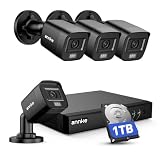
- 【AI Motion Detection 2.0】Driving AI to the next level, human&vehicle detection and flexible detection area are more accurate than before. For quicker locating in crucial moments, human&vehicle smart searching in recordings offers you great help.
- 【Tried-and-True Safe Guard】This one-stop security solution can work with TVI, AHD, CVI, CVBS & IP cameras, the kit includes 1080P cams. The 8CH 3K lite DVR can hook up with 1080P@30fps or 3K/5MP@20fps cams. Therefore, you can also DIY it with other cameras in your home.
- 【Reliable 24/7 Continuous Recording】With a pre-installed 1TB HDD(Support up to 10TB HDD), providing 24/7 surveillance recording for you. Upgraded H.265+ saves more storage space and uses less bandwidth, recording videos longer and smoother viewing.
- 【Smart Dual-Light Effectively Guard Your Home】This newly upgraded security system offers you a crisp full color night vision, IR mode and color night vision switch flexibly. Once detect intruders, immediate pushes pop up on your phone, securing your peace of mind day&night.
- 【Color Night Vision & IP67 Weatherproof】Built-in IR lights and white lights, these cameras can see up to 100ft in B&W night vision, full-color night vision up to 66ft. Rated IP67, these wired cameras can brave all weather, and stand from cold to hot.
Why traditional recording still matters
An alert is not evidence by itself. Investigators need the underlying footage, a trustworthy time reference, the surrounding context and a way to show that the file has not been altered.
NIST describes CCTV and DVR video as a powerful forensic resource but warns that the lack of a common export standard can lead to format conversion, degraded image quality, lost metadata and costly delays. Its emerging profile uses an MP4 container, H.264 video and embedded date/time metadata. Ask the supplier to demonstrate an export that investigators and police can open without proprietary playback software, and confirm that timestamps remain accurate after export.
- Record continuously in locations where an incident may need reconstruction, even if analytics are disabled or unavailable.
- Synchronize cameras, recorders and control-room systems to a reliable time source.
- Preserve original files and document who exported, copied or viewed them.
- Keep the alert, the associated clip and the wider context before and after the event.
- Test playback and export before opening the venue to the public, not after an incident.
Design a hybrid system around a risk map
Start with the event’s risks rather than a camera brand or an AI feature list. Mark entrances, queues, turnstiles, barriers, emergency exits, cash points, alcohol-service areas, backstage routes, loading bays and other locations where a defined detection task exists.
Use traditional coverage for evidentiary continuity
Provide continuous recording for entrances, circulation routes, stands, concourses and service areas where investigators may later need to trace movement. Ensure the field of view shows faces or clothing at a usable scale where lawful and proportionate, while avoiding unnecessary capture of private spaces.
Add AI only where a rapid alert has operational value
Place analytics on a limited number of zones first: an emergency exit that must remain clear, a barrier where crowd density can become dangerous, or a vehicle route that intersects with pedestrians. Define the condition, the alert recipient, the response time and the escalation path. If staff cannot act on an alert, the alert is unlikely to justify the added complexity and privacy risk.
Keep people in the decision loop
Require an operator to view the live scene and relevant clip before an alert leads to removal, arrest, denial of entry or another consequential intervention. The operator should record whether the alarm was valid, what action was taken and whether the rule needs tuning. Automated classification is a prompt for review, not a final finding about a person.
Rank #3

- INCREDIBLE 12MP UHD IMAGE -- Mind-blowing 12MP PoE home security camera system becomes affordable for your home and business security. Subtle details are recorded to ensure your peace of mind.
- FULL COLOR NIGHT VISION -- The Spotlight of the 12MP outdoor surveillance cameras enables a full color night vision. You can schedule it to work at a time period and switch to IR LED mode other time flexibly. The spotlight can also be Motion-activated to deter intruders working with the siren.
- SMART HUMAN/VEHICLE/PET DETECTION -- Reolink latest smart cameras can now identify people, vehicles, and pets according to their shapes and minimize unwanted alerts.
- TWO-WAY TALK -- The 12MP camera of this home security system has a speaker built-in for two-way communication with your family as well as threat deterrence. Simply press a button on Reolink App or Client to talk.
- 16 POE PORTS, EXPANDABLE TO 24 CHANNELS -- The NVR with hardware version N6MB01 offers 24 channels for Reolink PoE, plug-in Wi-Fi cameras, and specific battery-powered Wi-Fi cameras (Argus PT Ultra, Argus Eco Ultra & Argus 3 Ultra for now, with more supported models in the future) with the latest firmware. Ensure battery cameras and Reolink App are updated. Supports a maximum of 16 PoE/plug-in Wi-Fi cameras.
Step-by-step deployment plan
- Define the purpose. Write the security problem in observable terms: for example, “alert when a person enters the closed service yard after 23:00,” not “detect suspicious people.” State what response the alert should trigger.
- Map the venue. Mark camera positions, expected crowd flows, barriers, blind spots, lighting changes, weather exposure and areas where privacy requires masking or exclusion.
- Choose the architecture. Decide which cameras record continuously, where analytics will run, how much network and storage capacity is required, and what happens if a cloud connection or analytics service fails.
- Configure privacy controls. Set privacy masks and exclusion zones, restrict viewing areas, disable unnecessary identification features and establish authentication, encryption and role-based access. The SIA code specifically recommends addressing camera viewing areas and analytics software during planning.
- Complete governance documents. Record the purpose, legal basis, transparency notices, retention period, access permissions, analytics settings and process for handling data-subject requests or incidents. The Information Commissioner’s Office says surveillance should be a helpful supporting tool where lawful, necessary and proportionate, not a cure for organisational problems.
- Test in real conditions. Run the rules during representative lighting, crowd density, camera height, weather and clothing conditions. Measure alert quality for your venue rather than adopting a vendor’s headline figure. Include rehearsals with stewards who will receive and verify alarms.
- Set thresholds and escalation. Start with conservative, understandable rules. Define who receives an alert, how quickly it must be checked, when security dispatches staff and when an incident commander is notified.
- Validate evidence export. Export clips from each recorder, open them on a separate system, confirm timestamps and metadata, and document the chain of custody. Verify that police or investigators can use the format.
- Run the event with fallback procedures. If analytics fail, staff should still have live views and continuous recording. If the network fails, document which cameras continue locally and how footage will be retrieved.
- Audit and tune. After every event, review false alarms, missed detections, operator actions, response times and incidents. Record the camera firmware, model version, rule configuration and confidence thresholds so changes can be traced.
Privacy, legality and public transparency
Both systems process personal data when identifiable people appear in footage. AI can create additional inferences about people, locations or behaviour, and facial recognition or linked databases can process more sensitive categories. The ICO’s guidance on evolving AI-based CCTV emphasizes that surveillance must be lawful, necessary and proportionate.
Document the purpose and legal basis
State why each camera and analytic rule exists, what risk it addresses and why less intrusive measures are insufficient. Do not deploy facial recognition merely because the camera platform offers it. Identity matching requires a stronger justification, accuracy controls and a clear process for handling false matches.
Tell people what is happening
Use clear entrance signage and an accessible privacy notice. Explain who operates the system, the purposes of recording and analytics, retention periods, how people can raise a question or request, and whether any identity-related technology is used. Notices should match the actual configuration; disabling a feature in the policy while leaving it enabled in software creates a governance failure.
What’s actually slowing this PC down?
Pick the symptom - the matching free tool is one click away.
Minimize collection and access
- Use the narrowest camera view and shortest retention period that meet the stated purpose.
- Mask private areas and exclude neighbouring property where possible.
- Separate routine viewing from investigative access and grant permissions by role.
- Encrypt recordings in transit and at rest, protect administrator accounts with strong authentication and patch cameras, recorders and analytics servers.
- Define deletion schedules and legal-hold procedures before the first event.
End users remain responsible for the purpose, scope and privacy compliance of surveillance even when an integrator or cloud provider operates the system. Put responsibilities, breach notification, support access and data return or deletion into contracts.
Independent reader supportYour contribution helps us test, update, and keep practical guides available for everyone.Accuracy, false alarms and human factors
There is no universal event-security accuracy or false-positive rate. Performance changes with camera height, lens, resolution, backlighting, rain, smoke, crowd occlusion, clothing, scene layout and the definition of an alert. NIST’s evaluation work stresses that acceptable performance depends on the cost of errors and how humans review results.
Design the control room for triage rather than alarm volume. Each alert should show the camera, rule, time, confidence information supplied by the system and a short clip or live view. Operators need a way to mark valid, invalid, duplicate and unresolved alarms. A threshold that generates hundreds of unreviewed notifications is not an effective safety measure.
Rank #4

- Total Property Coverage with Revolutionary 2-In-1 Design: Secure every corner of your property with zero blind spots. In this 4-camera bundle, every single device does the work of two. The innovative Triple-Lens system combines an upper 4K bullet lens (130° wide view) with a lower 2K PTZ lens that locks on, tracks, and zooms. Get both the complete scene and crucial close-ups at the same time. It’s the perfect all-in-one security solution for large estates, sheds, rental.
- AI Tracking from Close-Ups to Cross-Zones: Each camera independently utilizes AI to lock on, auto-frame multiple subjects, and zoom in for crisp details up to 164 ft away. Linked by the HomeBase S380, the 4-camera bundle takes it further with true Cross-Camera Tracking. As someone walks through your property, the cameras hand off the target seamlessly, stitching the activity across different zones into one continuous, timestamped video.
- Forever Solar Power & Effortless Setup: Skip the hardwiring and professional installers! Equipped with an ultra-large 5.5W solar panel and SolarPlus 2.0 tech, just 1 hour of direct sunlight daily keeps your camera running year-round. Thanks to this 100% wire-free, smart detachable design, you can easily mount and set up the camera anywhere in just minutes.
- No Subscription & Guaranteed Privacy with HomeBase S380: This bundle securely stores all your footage locally on the HomeBase S380’s 16GB built-in drive (expandable with any 2.5" drive). Beyond massive storage, the hub unifies all 4 cameras into one easy-to-use app. Featuring local BionicMind AI, it learns to recognize familiar faces, drastically reducing false alerts so you’re only bothered by real threats. Starting with 4 cameras, this highly scalable system can easily support up to 16 devices total.
- Precise Detection, Powerful Deterrence: Radar and PIR sensors deliver precise motion alerts with fewer false alarms. When a threat is detected within your set zone or schedule, red and blue warning lights and a 105 dB siren activate to deter intruders.
- False positive: the system alerts, but the defined event did not occur. Tune the zone, threshold, schedule or camera view; do not simply train staff to ignore the alarm.
- Missed detection: the event occurred without an alert. Check occlusion, lighting, model limits and rule scope, then add another control if the consequence is serious.
- Model drift or scene change: construction, new advertising boards, seasonal lighting or changed barriers can alter performance. Re-test after material layout changes.
- Operator overload: too many concurrent alerts delay verification. Reduce rules or add staffing before expanding analytics.
Costs and operational requirements
No authoritative source provides a general event-security price, accuracy percentage or false-positive rate. A meaningful budget must include more than the camera itself.
The Tool Desk
Outbyte PC Repair FREERepair Windows errors before they cause bigger problemsFix Now →Outbyte Driver Updater FREEScan for outdated or missing drivers - takes under a minuteDriver Scan →| Cost area | What to include | Questions to ask |
|---|---|---|
| Hardware | Camera resolution and low-light capability, mounts, protective housings, recorders, servers and displays. | Does the camera retain usable detail at the required distance and angle? What continues recording if analytics stop? |
| Analytics | On-camera licenses, server capacity or cloud subscription, feature tiers and model updates. | Is pricing per camera, channel, event or time period? What happens when a license expires? |
| Network and power | Structured cabling, switches, bandwidth, power-over-Ethernet, wireless links and resilient connectivity. | Can the network carry all streams at peak bitrate, and are critical links redundant? |
| Storage and retention | Disk capacity, backups, replication, retention duration and export storage. | What frame rate, resolution and metadata are retained, and how quickly can a clip be exported? |
| People and training | Control-room staffing, event stewards, incident management, privacy training and post-event review. | Who verifies alerts, who can intervene, and who authorizes evidence release? |
| Governance and security | Privacy impact assessment, signage, access reviews, patching, penetration testing and audit logs. | Can the supplier document data flows, subprocessors, support access and deletion? |
| Installation and lifecycle | Site survey, mounting, configuration, calibration, maintenance and replacement. | What conditions void performance claims, and how are firmware and model changes approved? |
Traditional CCTV can have lower software complexity, but storage, networking, staffing and privacy obligations still apply. AI adds analytics licensing, compute or cloud dependencies, configuration and ongoing tuning. Compare total operating cost over the event season rather than the purchase price of a camera.
When traditional CCTV is enough
A traditional system may be sufficient when the venue has a small, well-staffed control room; risks are primarily investigated after the event; the layout is stable; and there is no defined alert that staff could act on faster than a human observer. It can also be the right choice when the organisation cannot yet support privacy governance, cybersecurity maintenance, operator training and evidence-export testing for AI.
“Enough” still means continuous coverage of critical areas, trained operators, a documented response plan, secure access, lawful retention and tested exports. Simply placing guards in front of screens does not guarantee that a brief or obscured event will be noticed.
When AI CCTV is justified
AI is more defensible when a specific risk is frequent or consequential, the camera view supports the rule, trained staff can verify alerts, and the organisation can monitor performance. Examples include a restricted backstage door during public hours, a vehicle route crossing a pedestrian flow, or a barrier where density thresholds trigger a stewarding response.
Start with a limited pilot covering those zones. Keep recording independent of the analytics service, publish the actual data practices, and expand only when event logs show that alerts are useful and manageable. Facial recognition, ANPR and other linked-database functions should be treated as separate, higher-risk projects rather than bundled automatically with ordinary object or zone analytics.
Decision checklist for an event operator
- Can you name the exact event an analytic rule must detect?
- Will a verified alert change a decision quickly enough to justify the system?
- Is the camera view tested under the venue’s real lighting, weather and crowd conditions?
- Who verifies the alert, and what happens when the operator is uncertain?
- Does recording continue if the model, server, cloud link or network fails?
- Can you export an ordinary, playable file with accurate time and metadata?
- Have purpose, legal basis, signage, retention, access and deletion been documented?
- Are identity-related features disabled unless separately justified and governed?
- Can you measure false alarms, missed detections and response outcomes after each event?
- Do contracts cover security updates, support access, subprocessors and data deletion?
Bottom line
AI CCTV is better for defined event-security tasks that benefit from rapid, prioritized alerts; traditional CCTV is better as a dependable, lower-complexity recording and review layer. For most venues, the practical answer is not one or the other. Use continuous traditional-style recording across the areas that may matter as evidence, add carefully scoped analytics where an early warning has clear value, require human verification before consequential action, and govern the resulting personal data from camera placement through deletion.
Quick Recap
Product prices and availability are accurate as of the date/time indicated and are subject to change. Any price and availability information displayed on Amazon at the time of purchase will apply.

