Your CPU can report several temperatures because the numbers may describe individual cores, a package-level value, a control value, or a separate motherboard sensor. Your fans may be reacting to a different reading than the one you are watching. To find out which, check the temperature source selected for the CPU fan curve, then compare that reading with fan speed as the computer’s workload changes.
Why your CPU shows several temperatures
Temperature labels are not always different views of the same sensor. Some readings come from inside the processor; others may come from a motherboard sensor near the CPU socket. Even readings from the processor can represent different things: one core, the hottest core, a package calculation, or a temperature-control value.
As an Amazon Associate I earn from qualifying purchases.
Names and behavior vary by CPU model, motherboard, firmware, and monitoring software. A lower motherboard reading and a higher internal reading do not necessarily conflict; they may describe sensors in different locations.
What common CPU temperature labels mean
| Label | What it can represent | What to keep in mind |
|---|---|---|
| Core #n | Temperature reading for an individual CPU core. | Different cores can show different temperatures under a workload. |
| Core Max | The highest temperature among the CPU cores, according to HWiNFO Author Martin. | It is a maximum, not an average across all cores. |
| CPU Package (Intel, in HWiNFO’s explanation) | Martin describes this as a CPU-calculated 256-millisecond average of the hottest temperature sensor within the CPU package. HWiNFO forum explanation | This describes the tool’s label; it is not a universal definition for every CPU generation or app. |
| Tctl and Tdie (applicable AMD Zen CPUs) | Tctl is the temperature-control value. On models that use an offset, Tdie represents the real die temperature while Tctl reflects the offset. Some models report Tctl/Tdie together. | Whether an offset applies depends on the CPU model. |
| Motherboard CPU / CPU (onboard) | May refer to a dedicated motherboard sensor near the socket, or in some cases an internal CPU sensor exposed through the board. | Do not assume every motherboard label uses the same sensor source. |
Find the temperature input controlling your CPU fan
The number that matters for fan noise is the one the fan curve actually uses. Firmware can expose temperatures, fan speeds, and fan settings together; the ASRock manual’s Hardware Health Event Monitoring Screen is one board-specific example. Labels and menus differ by motherboard, so consult the manual for your exact model.
#1 Best Overall

- Fan Speed Regulator: This device is a 4 wire temperature-controlled fan speed regulator that allows for automatic or manual adjustment of fan speed based on temperature (℃) readings. It features a digital display showing both the current temperature and the fan’s rotational speed in RPM (revolutions per minute). The system helps maintain optimal cooling performance and energy efficiency by increasing fan speed as temperatures rise and reducing speed when cooling demand is lower.
- X100RPM: The RPM (rotations per minute) is displayed in units of 100 RPM, which allows it to accommodate and clearly show the speeds of high-performance fans, this makes it particularly suitable for industrial or specialized applications that utilize high-RPM fans. The maximum readable value on the display is 300 × 100 RPM = 30,000 RPM, ensuring compatibility with a wide range of fan types.
- 2 Control Modes: The device offers both manual and automatic fan speed control modes, giving users flexibility to adapt to various cooling needs and environments. This dual-mode system provides an ideal balance between user control and intelligent automation.
- Temperature Probe: To ensure accurate thermal regulation, the fan controller is equipped with a 42cm (16.54 inch) temperature probe. This probe continuously senses the surrounding temperature and sends real-time data to the controller, which is then shown on the digital display. The extended cable length provides flexibility in sensor placement, allowing users to position the probe closer to heat-sensitive components or areas where precise temperature monitoring is needed. Temperature probe parameters: NTC10KB = 3590
- Note: This controller only controls the fan speed adjustment controlled by a 4-wire PWM signal. The signal specification is 25KHZ 5V. It cannot control the speed regulation of 2-3 wire fans. The working voltage must be equal to the fan voltage.
- Identify your hardware and software. Note the exact CPU, motherboard, firmware version, and monitoring app. Sensor availability and naming can vary across all four.
- Check the fan-control settings. Open the motherboard firmware or its fan-control utility and find the temperature source assigned to the CPU fan. It may be a package, die/control, core, or motherboard reading.
- Watch the selected reading and fan RPM together. In a monitoring app, observe the likely control input alongside CPU fan speed while workload changes. HWiNFO describes sensor monitoring with current, minimum, maximum, and average values; those columns can help you distinguish brief spikes from sustained heat. HWiNFO features
- Compare the same sensor across tools. Match the fan curve’s input to the corresponding reading in the monitoring app. A motherboard sensor and an internal die reading are not interchangeable just because both have “CPU” in the name.
- Consult system-specific documentation if the behavior still concerns you. Use the CPU and motherboard documentation for your exact system to assess its temperatures and fan behavior.
How to tell whether a reading is driving the noise
Look for a relationship between a temperature rise and a change in CPU fan RPM. If the fan accelerates when the selected input rises—even while another displayed temperature stays lower—that selected input is the likely reason the fan curve is responding. Current, minimum, maximum, and average readings can help show whether the rise was a short-lived spike or a sustained change.
This correlation helps identify what the fan is reacting to; it does not, by itself, establish whether a temperature is safe or whether a component needs replacement. The available sources do not establish one universal safe CPU temperature threshold. That judgment requires the specifications for the exact CPU and the context of the system.
Quick Recap
Best Value
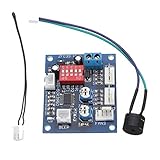
- Circuit load capacity: maximum current per output 5A, the bus currents up 9A
- Output Range: The first channel 20% -100%, or 40% -100% (TFL = ON)
- Working voltage: DC12V
- Stall alarm minimum speed: 700-800 rpm
- Temperature probe parameters: 50K B = 3950
Rank #4

- Supports all internal 12V 5A fans, synchronous rectified output, high efficiency, no need for additional heat sinks even for high current operation.
- Multiple fans can be used in parallel (total current does not exceed 5A), support automatic temperature control and air cooling speed control, temperature control speed has four temperature zone settings, widely used.
- It can be turned on with the three-wire fan monitoring function (stall warning).
- Circuit load capacity: 5A for each output and 8A for bus current.
- Output range: 20%-100% for the first channel, or 40%-100% for the first channel (TFL = ON), 10%-100% for the second channel and the third channel. (Note: The above range is only applicable to the PWM range, the actual control effect will vary depending on the fan)
Rank #3

- ✅ Ultra-Compact Design for Tight Spaces Measuring only 11mm x 17mm (about the size of a fingernail), this mini PWM fan controller is perfect for compact enclosures, small PC builds, 3D printers, Raspberry Pi projects, and other space-constrained cooling applications. No bulky modules, maximum installation flexibility.
- ✅ Smart PWM Temperature Control Fully compatible with 5V/12V standard 4-pin PWM fans (NOT for 2/3-wire fans). Features 343 customizable control modes, adjustable start temperature (35-65℃), start duty cycle (20-60%), and full-speed temperature difference (5-50℃) to match your specific cooling needs.
- ✅ Low Power Consumption & Reliable Performance Ultra-low standby power: only 10mW at 5V, 25mW at 12V, minimizing energy waste. Supports input voltage 5-15V, fan current up to 3A, with stable direct input-output transmission for long-lasting, reliable operation.
- ✅ Easy Setup & Configuration Simple button operation with LED indicator prompts for intuitive parameter setting. No complex software required—set your desired temperature thresholds, save the configuration, and the module will automatically adjust fan speed in real-time based on NTC 50K B=3950 temperature probe readings.
- ✅ Wide Application Scenarios Ideal for PC case/router cooling, 3D printer hotend/bed cooling, Raspberry Pi/DIY electronics cooling, small server racks, car audio systems, and any other 4-pin PWM fan cooling projects that require automatic temperature control.
Rank #2
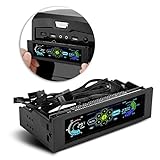
- AUTO /MANUAL manual mode automatic mode switch
- Big LCD screen to display the temperature, fan speed, alarm temperature, hard disk state, to constantly know the the working condition
- the computer temperature though controlling the wind speed of 5 groups of fans
- Can manually set up the alarm temperature range from 40 to 90 degree
- When the fan breaks down and can not cool the computer, it will alert immediately
When the readings do not seem to match
- One core is warmer than the others: Core readings can differ under load; Core Max reports the hottest core in HWiNFO’s explanation.
- The motherboard reading is lower than the die or package reading: The readings may come from sensors in different locations, so compare their sources before treating the difference as a fault.
- The fan speeds up while the displayed temperature looks calm: Check whether the fan curve uses a different reading from the one you are watching, and compare that input with RPM.
- Two apps use different labels: Treat labels as software- and model-dependent. Verify which sensor each app exposes instead of assuming identically named readings are equivalent.
Product prices and availability are accurate as of the date/time indicated and are subject to change. Any price and availability information displayed on Amazon at the time of purchase will apply.
Recommended Free Tools




