Making hydrogen directly from seawater is difficult because the electrolyser must split water while tolerating chloride, other dissolved ions, and changing surface conditions. At the anode, chloride can compete with the desired oxygen-producing reaction; across the cell, corrosion and mineral deposits can shorten operating life. Researchers are testing selective catalysts, protective materials, membranes, feedwater treatment, and new cell designs—but direct seawater electrolysis has not yet shown a clear general advantage over desalinating water first.
What “direct seawater electrolysis” means
Electrolysis uses electricity to split water, producing hydrogen at the cathode and oxygen at the anode. In direct seawater electrolysis (DSE), seawater is supplied to the electrolyser. In the indirect route, water is desalinated first and the resulting water is then electrolyzed. The distinction matters: findings from desalinated water, synthetic seawater, pretreated seawater, or an alkaline solution containing salt do not automatically demonstrate performance with untreated natural seawater.
As an Amazon Associate I earn from qualifying purchases.
Seawater is a mixture of dissolved ions and impurities, not simply pure water with table salt added. Its composition and the cell’s operating conditions affect what happens at the electrodes and membranes. Reviews emphasize that results should identify the feedwater and assess the complete device, not just a catalyst in a laboratory test. The Journal of Power Sources review discusses the need to connect catalyst performance to membranes and reactor-level behavior.
Do these 3 things before closing this tab:
1Clear out junk files and repair common Windows errors2Scan for outdated or missing drivers - takes under a minute3Repair Windows errors before they cause bigger problemsWhy the anode is a difficult trade-off
The intended anode reaction is oxygen evolution. But seawater contains chloride, which can undergo competing oxidation and form chlorine-related products. Researchers therefore need an anode that favors oxygen production while suppressing chloride reactions—and remains active and stable in chloride-rich conditions. A material that initially suppresses a side reaction is not necessarily useful if it corrodes, loses activity, or fails to maintain selectivity during sustained operation.
#1 Best Overall

- High-precision Encoder Knob: Different from general knobs, this DC power supply has a precise encoder knob. You can press the knob to switch each digit, and then turn the knob to customize each digit in the range of 0-9. Set the voltage or current you want more accurately.
- Output Enable/Disable Button: In the process of using the bench power supply, Output button can prevent us from forgetting to turn off the output and causing damage to the load. Just press this button to turn on or turn off the output of the power supply. This makes it more convenient for you to use the variable power supply.
- Overcurrent Protection: When the OCP function is turned on, if the load equipment is short-circuited during operation, the adjustable power supply will automatically stop output and send a buzzer to alert the user. Protect the adjustable power supply and load from damage.
- Precise 4-digit LED Display: The dc power supply is equipped with a high-definition 4-digit display with data accurate to 0.01 V and 0.001 A. It has constant voltage (C.V.) and constant current (C.C.) modes, which can be switched automatically. You can see the working status indicator on the display. Additionally, you can adjust the brightness of the screen according to your needs.
- USB Fast Charging Port: The variable power supply is configured with an 18W fast charging port. No more mplaining about mobile phones or repaired devices not being charged in time. The NANKADF dc power supply allows you to avoid this dilemma. It charges your devices quickly anytime, anywhere.
That combination of selectivity and durability is central to the problem. The 2025 Nature Reviews Materials review identifies corrosion, chlorine-related side reactions, and metal precipitates as challenges linked to poor catalytic activity and limited lifetime. Reviews in ACS Materials Letters and the Journal of Power Sources examine approaches to avoiding chlorine evolution. This does not mean every seawater electrolyser releases chlorine: product formation depends on the chemistry and operating conditions, and suppressing competing chloride reactions is a research goal.
How corrosion and deposits can undermine operation
Corrosion and degradation
Chloride-rich conditions can accelerate corrosion and damage electrodes or other cell components. Protective layers and corrosion-resistant materials may help, but protection must work without blocking the desired reaction or preventing efficient transport through the cell. The practical question is not only whether a catalyst works at first, but whether the whole device keeps working under the stated feed and operating conditions.
Rank #2

- 1️⃣【4-Digit Display & Power Calculation】: The Jesverty SPS series features a big bright 4-digit LED display that shows measured values of V/A/W that the unit outputs in real-time. The display resolution is up to 0.01V, 0.001A, and 0.1W.
- 2️⃣【Auto C.V. and C.C. Mode】: The Jesverty SPS series can be used as a constant-voltage*(C.V.) power supply and constant-current*(C.C.) power supply even when the load is changed. It switches automatically between CV mode and CC mode according to the changes in the load.
- 🌟Note: The V and A settings you set are the crossover point at which the mode switches.
- 3️⃣【Compact Body & Lightweight】: The Jesverty SPS series measured only 7.1(D)x3.35(W)x6.1(H)inches and weight of approx. 2.5lbs. It saves space on your workbench and can be moved around without any frustration.
- 4️⃣【Reliability and Safety】: The Jesverty SPS series is built with high-quality materials and reliable circuit designs that include multiple protection functions, such as short-circuit protection, over-load protection, grounding terminal, temperature-regulated fan, etc. to ensure performance and extend the lifespan.
Precipitation and fouling
Electrode reactions create local conditions that can encourage dissolved species to form deposits. Magnesium- and calcium-containing hydroxides are among the concerns discussed in the literature. Deposits can cover active surfaces and interfere with sustained operation. The 2024 durability review describes approaches intended to limit hydroxide precipitation or adhesion, including strategies aimed at interactions involving hydroxide ions, magnesium, and calcium. It also discusses combining electrolysis with the production of nanoscale magnesium hydroxides; that is a proposed process direction, not proof that mineral fouling has been solved. The review’s PubMed record summarizes the durability topic.
What researchers are trying
Selective and protective anode surfaces
One research direction is to tune catalyst surfaces to favor oxygen evolution, reduce chloride oxidation, or limit chloride access to reactive sites. Protective, passivating, chloride-blocking, and selectively adsorbing layers are among the approaches considered in reviews. These strategies involve trade-offs: a surface layer must suppress unwanted chemistry without unduly reducing oxygen-evolution activity or becoming unstable in operation. A catalyst label alone does not establish selectivity; the measurement, electrolyte, and operating conditions matter.
Rank #3

- Precise 4-digit LED Display, Auto Power Calculation: The NICE-POWER DC power supply variable is a professional switching power supply regulation device with a high resolution of 0.01V and 0.001A. The variable power supply features a big bright 4-digit LED display that shows the adjustable power supply output values of Voltage (V) / Current (A) / Power (W) in real-time. The high-definition backlit 4-digit LED display provides an accurate and clear readout for the voltage, current and power values even if you are in low-light condition
- OUTPUT Switch Control: Sometimes we need to switch between different voltage or current outputs in experiments or work, but we often forget to turn off the output and causing damage to the load. The adjustable DC power supply OUTPUT key is designed to solve this problem, just with a single press of the added OUTPUT key, you can easily turn the output on or off. The required voltage and current can be adjusted without actual output power, which makes this benchtop DC power supply more secure and more energy saving. Also, you don't need to remove the load or turn off the power each time, making the variable DC power supply more convenient and efficient to use
- Reliability and Safety: Safety is our priority, all lab power supplies are certified. The adjustable switching regulated power supply is built with premium electronic components and reliable circuit designs that include multiple protection functions, such as leakage, grounding terminal, over-voltage, over-current, over-power, over-load, over-temperature, short-circuit protection to ensure stable working performance and prolong the life of the adjustable DC power supply effectively. KINDLY REMIND - For safety considerations, the DC power supply comes with only 110V input which meets the US standard voltage. 220V input is NOT available for this bench power supply
- 5V 2A USB Port, Intelligent Cooling Fan: Complaining about mobile phones or repaired devices not being charged in time? The NICE-POWER adjustable DC power supply allows you to avoid this dilemma. The variable power supply has built-in 5V 2A USB charging interface which can quickly charge any USB devices anytime. The adjustable power supply features with intelligent temperature-controlled fan and heat sink for excellent heat dissipation when the working temperature of the switching power supply exceeds 122℉/50℃, greatly reduce working noise and improving the DC regulated power supplies working efficiency and lifespan
- Compact Design, Lightweight and Portable: The DC voltage stabilized power supplies adopt stable vertical design with the shock-absorbing rubber feet on the bottom of bench supply, making it safer and more stable when using. The size of adjustable DC power supply is 8.4*3.3*5.5 inches and the lab power supply weighs only 2.6 lbs, which is very light and portable. You can carry your bench supply in and out of various workplaces
Corrosion-resistant materials and interfaces
Materials selection, protective coatings, and interfacial design aim to slow degradation. Durability claims are meaningful only when readers can see the test duration, load or current conditions, electrolyte composition, and whether the result came from a complete cell or an isolated material test. A short laboratory trial cannot by itself establish practical service life. The 2024 durability review considers the path from catalysts to systems, while the 2025 Nature Reviews Materials review addresses the linked activity and lifetime challenges.
Membranes and ion management
Membranes and ion-selective designs can help control which species reach particular parts of a cell or manage the ionic environment around the electrodes. They introduce their own engineering challenges, including fouling, degradation, and compatibility with the rest of the electrolyser. Their value must therefore be judged in the complete device rather than assumed from an isolated separation function.
Rank #4

- 2024 Upgrade High Precision Encoder Adjustment: High-precision encoder adjustment knob replaces the hard-to-adjust potentiometer switch to accurately adjust the desired voltage and current values, Rotary knob adjusts each digit in the range of 0-9, and the backlit 4-digit led display accurately displays the voltage and current values, Which can be clearly seen even in low-light environments
- Stable Output, Auto Switch C.C/C.V Mode: Preset the voltage and current value you need through the encoder, When connecting your electronic items, the machine has an internal over-voltage and over-current protection device, When the load current is greater than or close to your preset value, the c.c/c.v lamp will automatically light up
- Intelligent Cooling Fan, Reliable and Safe: Our DC power supply built-in cooling elements, When the product is overloaded for a long time, the temperature reaches 50 ℃, the fan will be automatically turned on, in your long time work at the same time can protect the product is not damaged, Do not have to worry about the product's load is too large and so on
- CE & FCC Certification, Widely Used: 200V 5A Lab power supplies have passed CE & FCC Certification. , High-power DC power supply application of a wider range of 100 lamps at the same time to do the aging test, as well as other applications such as laboratories, schools, electronic maintenance, drone power supply, LED power supply, battery charging ( LiFePO4, lead acid batteries, etc.) solar energy testing, work on and/or test a car radio,electrolysis
- Compact Design, Quality Check: The lab power supply is compact and lightweight, measuring only 38 x 24 x 13 cm and weighing only 3.3 kg, Saving you more bench space and making it easy to take with you when you need it. inside the box you will find: DC power supply *1; power cord *1; english manual; low-power output cable *1; high-power output cable *1. If you have any questions about our lab power supply, Please contact us and we will reply you within 24 hours
Feedwater treatment and desalination-first operation
Pretreatment can remove some impurities; desalination goes further by separating salts before electrolysis. This indirect approach avoids some direct-contact challenges, but it also adds water-treatment equipment and operating requirements. A fair comparison must consider the whole system: treatment energy and infrastructure on one side, and any resulting changes in electrolyser performance, reliability, or suitability for a particular site on the other.
Reactor and electrolyser design
Cell geometry and reactor architecture can be designed to coordinate fluid transport, electrode protection, membrane function, and product separation. Such designs are promising lines of investigation, not universal fixes. A device-level claim should be evaluated under a clearly specified feed and realistic operation; a catalyst result in a half-cell cannot answer every question about a working electrolyser.
Best Value
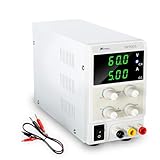
- 🎯3-DIGIT DISPLAY &EASY TO USE📗: This dc power supply supports 0-60 volts and 0-5 Amp outputs with high precision 3 LED digital bright display , easy to read the number, with resolution of 0.1 V(100mV)and 0.01A(10mA), It's easy to set the voltage, short the wire leads, and set the current
- 🎯WIDE APPLICATIONS📗: High performance applications, the 60v power supply is suitable for testing/ troubleshooting many 48V DC equipment elements and component, It's nice for electronic maintenance, electrolysis, electroplate, battery charger, laboratory, scientific research and teching, arduino, power on breadboard, for regulated filament voltage power supply and DIY tools. Good🎁present choice for DIY electronic gears
- 🎯HIGH QUALITY AND SAFETY📗: High quality circuit board made, and make the variable power supply stable output. It's built-in cooling fan with thermo-sensor and two heat sinks used will keep the 60volt 5amp dc bench power supply cool,noise reduced and life prolonged. It's set anti-reverse connection,and better to protect the user's device. Perfect limit current protection, thermal protection, voltage overload protection, short-circuit protection
- 🎯CONSTANT VOLTAGE AND CCURRENT MODE AUTOMATIC CONVERSION📗: This lab power supply is easy to adjust your desired voltage and current with coarse and fine turning knob. The constant voltage and current mode automatically switch over with load changes. You can see the working status indicator on the display. (CV and CC conversions are indicated by the LED display)
- 🎯COMPACT AND LIGHTWEIGHT📗: The measures of the adjustable power supply 60v 5a is only 8.91 x 3.23 x 5.43inch(22.6x13.8x8.2cm) and the weight is only 2.95 pounds, takes up very little room on the bench,and is convenient for you to carry when you need it
How to judge claims about a seawater electrolyser
When comparing a direct seawater system with desalination-first electrolysis, look for evidence across the whole process rather than a single headline result:
- Chloride chemistry: Does the study measure oxygen selectivity and chlorine-related products under the stated conditions?
- Durability: How long did the test run, at what load, and did it use a complete cell?
- Scaling and fouling: Does it explain how magnesium- and calcium-containing deposits are managed?
- Feedwater: Is the test based on natural seawater, synthetic seawater, pretreated water, or another electrolyte?
- Device integration: Are membrane, reactor, and product-separation performance reported alongside catalyst behavior?
- System comparison: Are water-treatment requirements compared with electrolyser performance, reliability, and operating needs?
These distinctions prevent results from one carefully controlled material test from being mistaken for proof of an economical, durable seawater-to-hydrogen system.
Does direct seawater electrolysis already save money?
That has not been established as a general advantage. In its record dated 20 January 2025, the European Commission Joint Research Centre stated: “There is currently no research or industrial project demonstrating clear benefits of using direct seawater electrolysis over indirect seawater electrolysis.” The assessment also allows that DSE could become viable for specific target applications. Read the JRC review record.
Recommended Free Tools
This is a dated assessment, not a forecast about every later project or a claim that no direct-seawater design could work. It does mean that using seawater at the electrolyser cannot, by itself, be treated as evidence of lower cost or greater sustainability. The comparison depends on water treatment, cell performance, durability, and site-specific operating needs.
Quick Recap
Product prices and availability are accurate as of the date/time indicated and are subject to change. Any price and availability information displayed on Amazon at the time of purchase will apply.




